





Breakfront Marble Credenza
A breakfront marble credenza brings grand proportions and cool stone surfaces to a room, offering substantial storage beneath a polished top.
Breakfront Marble Credenza
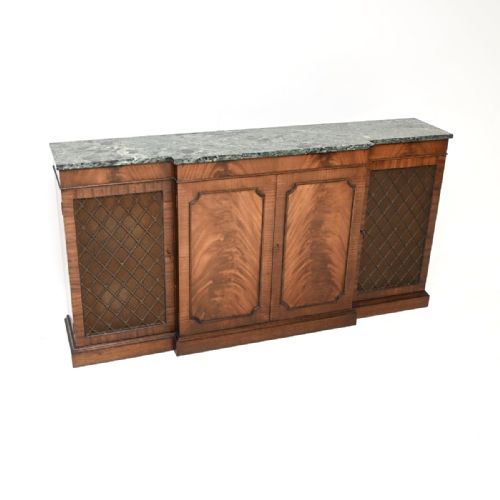
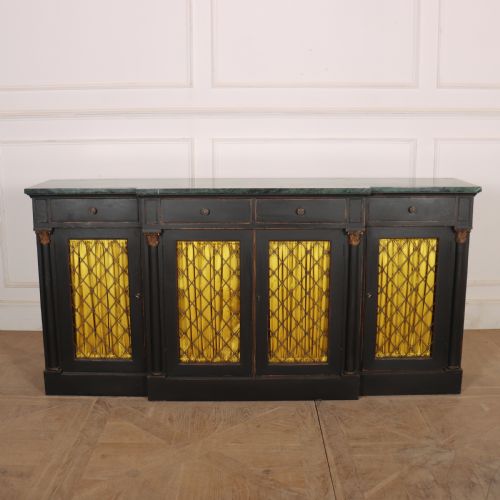
A breakfront marble credenza combines a prominent central section with recessed sides, topped by a smooth slab of marble and fitted with doors or open shelves. These pieces function primarily as statement storage furniture in principal reception rooms, drawing the eye with their architectural silhouette.
The selections gathered under this search phrase draw from nineteenth-century revivals, Regency designs, and eighteenth-century origins, appearing as side cabinets, chiffoniers, and commodes. Mahogany, rosewood, and kingwood form the main timber carcasses, paired with stone tops and metal mounts.
How they were made
Cabinet makers built these carcasses from dense timbers such as mahogany, rosewood, and kingwood, often applying intricate parquetry or painted finishes over the structural wood. Heavy stone slabs were then shaped to follow the stepped contour of the breakfront top and fitted securely to the frame.
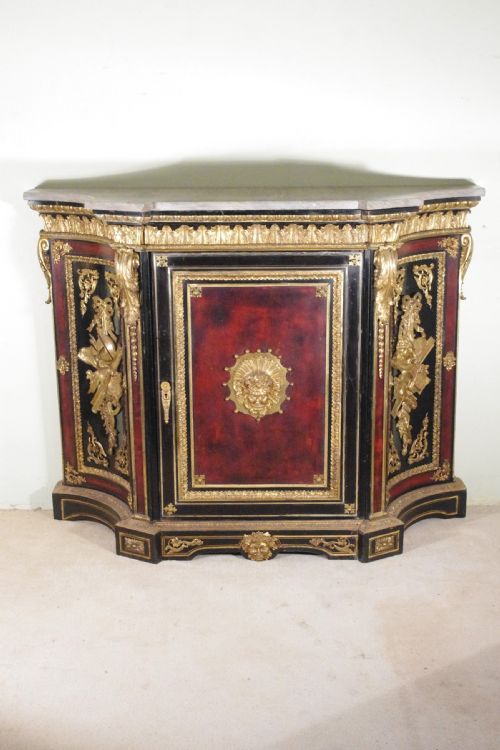
Metal ornament played a major role in the construction, utilising cast ormolu, gilt bronze, and brass mounts fixed around doors, friezes, and corners. Glazed panels, brass grilles, and Pietra Dura inlays added further decorative complexity to the foundational cabinetry.
Materials appearing across these entries include rosewood, mahogany, kingwood, marble, ormolu, gilt bronze, and painted wood.
What varies in quality
The distinction between standard and superior examples lies in the crispness of the bronze or ormolu mounts and the depth of the timber grain. Finer pieces display hand-chased metalwork and carefully matched veneers that follow the complex curves of the breakfront shape without distortion.
Structural integrity also separates grades, visible in the weight and thickness of the marble top and the precision with which doors and drawers close. Finer execution shows in robust internal construction and high-grade secondary woods that support heavy stone tops over long periods.
Gillow·Riesener
The Breakfront Marble Credenza Glossary
- Breakfront
- A cabinet design where the central section projects forward from the flanking outer sections. This architectural arrangement creates depth and shadow across the front elevation.
- Ormolu
- Gilt bronze mounts applied to furniture for decorative effect. The technique involves coating cast bronze in a layer of gold amalgam.
- Chiffonier
- A low nineteenth-century sideboard or cabinet, frequently fitted with doors enclosing shelves. These items served dining and drawing rooms for storing silver and linens.
- Parquetry
- Geometric patterns formed by fitting small pieces of contrasting veneer together. Makers used this technique to decorate table tops and cabinet doors.
Breakfront Marble Credenza: Frequently Asked Questions
Where should I place a breakfront marble credenza?
These large cabinets suit principal reception rooms, formal dining areas, or wide hallways where their architectural presence can be appreciated. Their finished backs and substantial proportions mean they command a wall rather than fitting into a corner.
The cool stone top also provides a durable surface for displaying lamps, sculptures, or ceramics without risking heat or moisture marks on polished wood.
How do I care for the marble top?
Marble requires gentle cleaning with warm water and a soft cloth, avoiding acidic substances like lemon juice or vinegar that can etch the polished surface. Regular dusting and occasional neutral stone soap treatments keep the material looking clear.
Because the heavy stone rests on a timber carcass, lifting from the base rather than the top is essential if the cabinet needs to be moved.
What is the difference between a credenza and a sideboard?
While both serve storage functions, credenzas traditionally sit lower and often feature glass doors or open shelving for display. Sideboards lean more towards dining room use with enclosed cupboards for tableware and serving dishes.
In nineteenth-century design, the terms often overlap, especially when combined with decorative stone tops and metal mounts.
How can I identify a Regency period piece?
Regency furniture typically dates from the early nineteenth century and utilises dark exotic timbers like rosewood alongside restrained brass inlay or gilt mounts. The lines tend to reflect classical architectural principles with balanced proportions and understated mounts.
Later Victorian revivals often exaggerated these classical elements with heavier cast bronze and more complex parquetry patterns.