

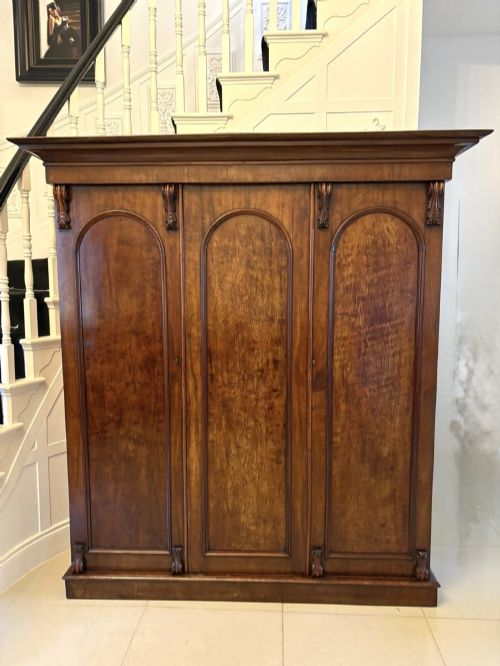
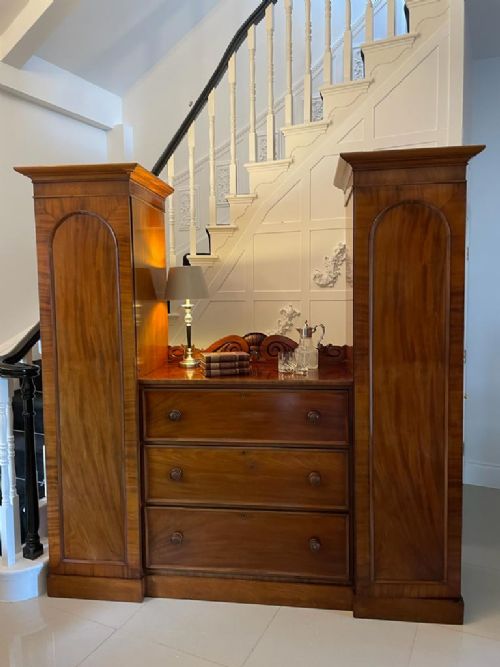
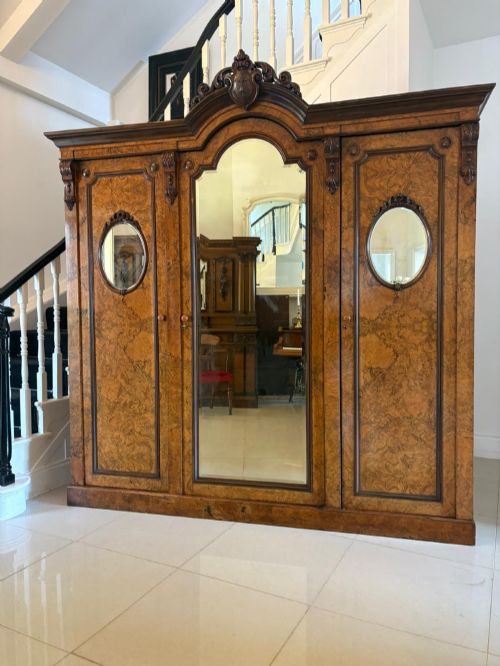
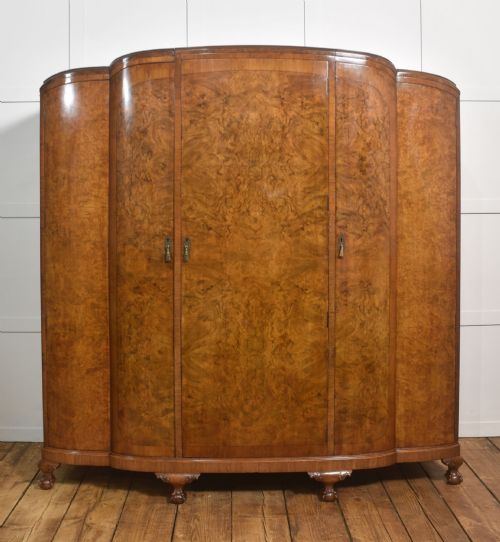
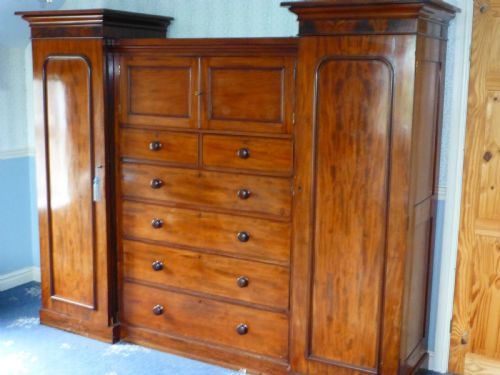


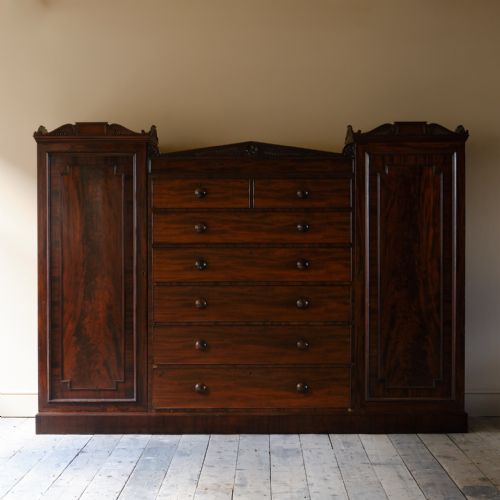


Breakfront Clothes Press
A breakfront clothes press offers grand architectural scale and deep storage, housing substantial hanging space and linen drawers in a single imposing piece.
Breakfront Clothes Press
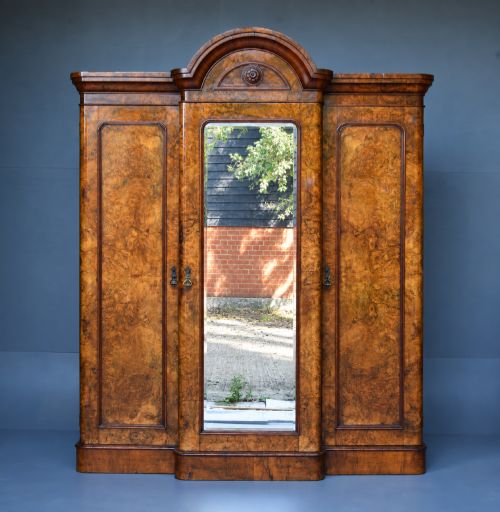
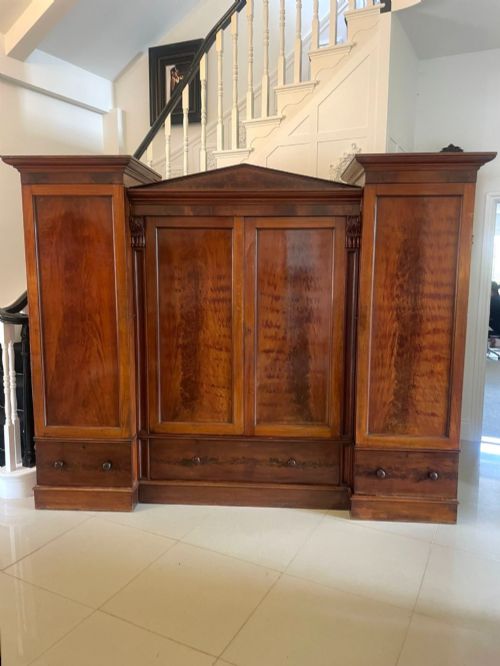
A breakfront clothes press is a large storage item designed for bedrooms, distinguished by a central section that projects forward from the flanking wings. You will most frequently encounter Victorian and Edwardian examples on this page, alongside earlier Georgian and William IV iterations.
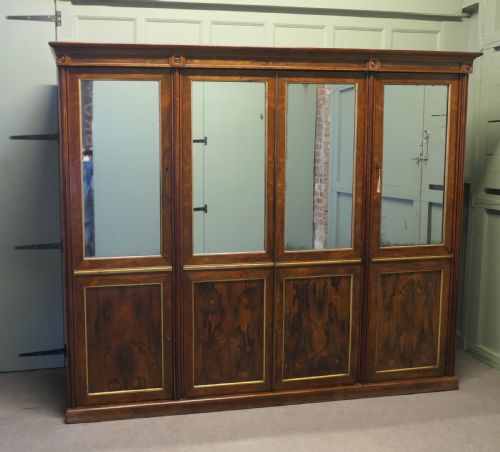
These pieces function primarily as wardrobes and linen presses, often combining hanging compartments with interior sliding trays, drawers or full compactum layouts. They appear in configurations ranging from three-door triple wardrobes to four-door architectural facades.
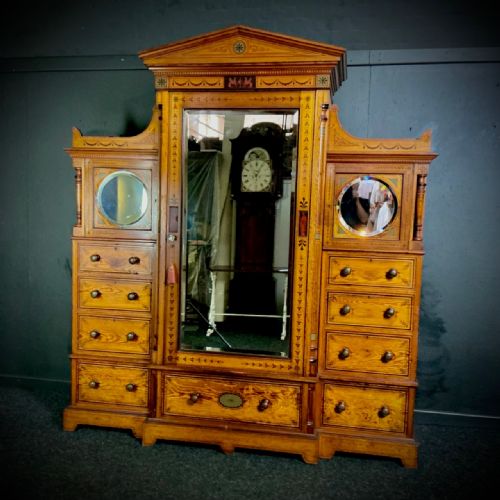
Origins span English country houses and cabinet makers' workshops, utilising forms that transition from formal George III proportions through to later Sheraton Revival and inlaid satinwood designs.
Materials and construction
Cabinet makers utilised dense timbers such as mahogany, flame mahogany veneer, burr walnut and rosewood, often enhanced by contrasting satinwood inlays, brass fittings and mirror glass doors.
Construction relies on large-scale carcase joinery with panelled doors, breakfront cornices and fitted internal drawers, occasionally incorporating pitch pine or oak for secondary framing timbers.
Breakfront Clothes Press Retail Price Guide 2026
Typical asking prices for breakfront clothes press among the pieces listed under this phrase on Sellingantiques today, from the lower quarter to the upper quarter. They describe what is for sale here now, not the wider market.
Several pieces conceal ingenious internal compactum arrangements behind grand architectural doors, ready to swallow modern garments with nineteenth-century efficiency.
What separates fine examples from ordinary ones
Quality reveals itself in the selection of timber veneers, where highly figured flame mahogany, burr walnut or curl mahogany is matched symmetrically across the projecting central doors and flanking wings.
The refinement of internal fitting defines superior pieces, seen in dovetailed linen trays, well-organised compartment layouts, original brass hardware and intricate marquetry or inlaid detailing rather than plain surfaces.
Gillows·Lamb of Manchester·Robert Strahan·Edwards and Roberts·Maples and Son
The Breakfront Clothes Press Glossary
- Breakfront
- A cabinet design where the central section projects forward from the flanking sections, creating a pronounced architectural rhythm. This layout allows for deeper central storage and varied internal configurations.
- Compactum
- A fitted wardrobe designed to maximise storage by combining hanging spaces, sliding trays, and banks of internal drawers within a single carcass. These multifunctional pieces often include mirrors and specialised compartments.
- Linen press
- A tall piece of furniture traditionally used for storing folded linen on internal sliding trays behind upper doors, positioned above a base of lower drawers. They frequently share forms with large wardrobes.
- Flame mahogany
- A highly decorative veneer cut from timber where the grain creates a flickering, flame-like pattern across the surface. Cabinet makers reserved this material for the principal doors of high-status furniture.
- Marquetry
- The art of applying decorative pieces of veneer to a structure to form intricate pictorial or geometric designs. This technique often employs contrasting woods like satinwood and rosewood.
Breakfront Clothes Press: Frequently Asked Questions
How do I fit a large breakfront clothes press?
Measure your ceiling height and wall space carefully before acquisition, ensuring clearance for projecting cornices and wide-opening doors. Many of these large wardrobes dismantle into modular sections for easier transport and room positioning.
Position the piece against a principal bedroom wall where its architectural proportions can command the room without obstructing pathways or windows.
What is the difference between a wardrobe and a clothes press?
A traditional wardrobe focuses primarily on vertical hanging space for garments, enclosed by full-length doors. A clothes press typically incorporates internal sliding linen trays or shelves within the upper section, accompanied by lower drawers.
Many surviving antique examples combine both functions into a single compactum layout, offering versatile storage for modern bedroom use.
How do I date a mahogany breakfront piece?
Examine the secondary timbers, construction joints, and stylistic details to determine the period. Georgian pieces from the eighteenth century exhibit refined proportions and subtle bracket feet, while Victorian and Edwardian examples often feature heavier plinths, plate glass mirrors and elaborate carving.
Inlays such as satinwood stringing or Sheraton-style fans help narrow down the manufacture to the late eighteenth or nineteenth centuries.
Are these pieces delivered fully assembled?
Most large breakfront furniture is constructed to be dismantled into manageable component parts, including a detachable cornice, central carcass, side wings, and a plinth base. This modular construction was essential for moving heavy furniture through historic hallways.
Professional antique delivery specialists typically handle the reassembly on site to ensure the carcase remains square and doors hang true.