

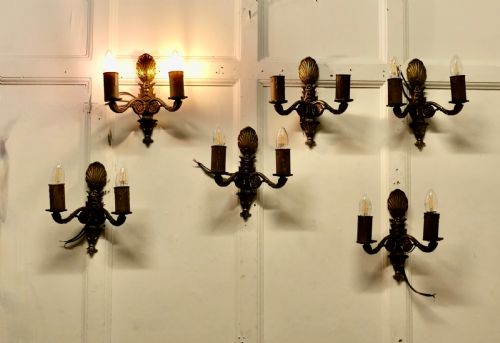


Brass Twin Branch Lamp
A brass twin branch lamp brings targeted light and structural form to a room, offering dual illumination through articulated or fixed arms.
Brass Twin Branch Lamp
When you search for a brass twin branch lamp, you are looking at dual-light fixtures designed for walls, tables, and floors. These pieces provide balanced illumination through two distinct arms branching from a central stem or backplate.
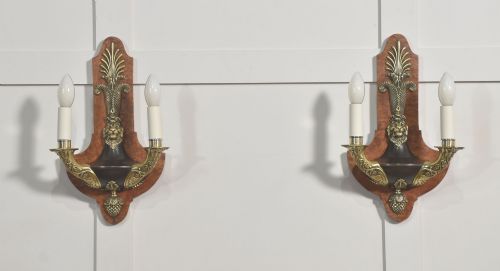
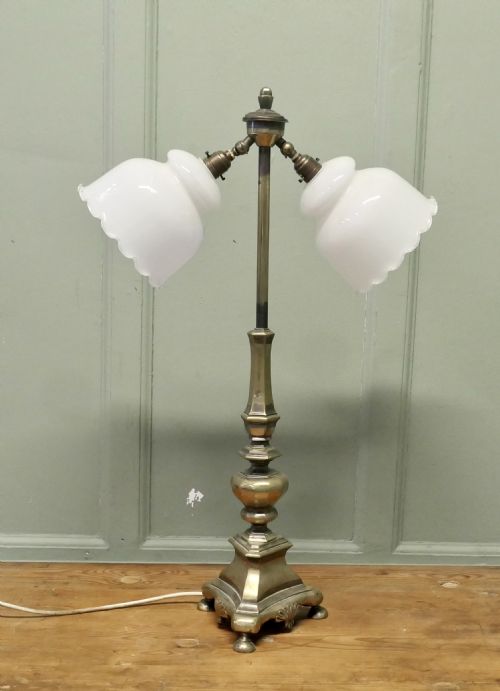
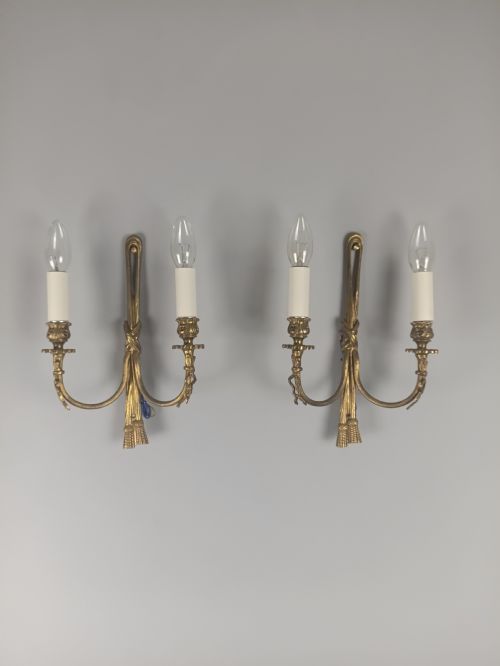
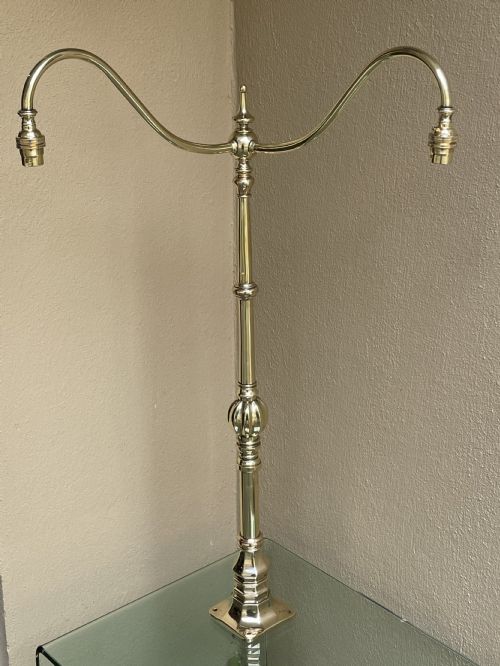
The versions you are most likely to meet on this page span the Victorian, Edwardian, and 1920 periods, taking forms such as wall lights, table lamps, standard lamps, and newel post lamps. They draw upon Neoclassical, Empire, and French Louis XVI styles to shape their metalwork.
Makers and designers of these fixtures utilised varied configurations, pairing the twin branches with materials like cut glass and burr walnut. Their origins trace across the nineteenth and early twentieth centuries, reflecting changing domestic lighting needs.
How they were made
These fixtures rely primarily on cast, gilt, and polished brass, frequently combined with glass, cut glass, and crystal drops. Certain examples incorporate burr walnut to anchor the metalwork on wall-mounted backplates.
The structural components join through casting and jointing techniques suited to supporting twin arms, whether angled for reading or fixed in symmetrical pairs. Surface finishes range from high-polish gilt bronze to patinated brass.
Materials recorded include brass, cast brass, gilt brass, polished brass, gilt bronze, glass, cut glass, and burr walnut.
What varies in quality
The distinction between standard production and finer work lies in the crispness of the cast brass detailing and the proportion of the twin branches. Pieces influenced by specific design traditions display deliberate attention to junction points and backplate profiling.
Material integration also separates examples, as seen in the pairing of solid brass with burr walnut or cut glass crystals. Finer models maintain structural balance across both arms while preserving the integrity of their period finishes.
F. and C. Osler
The Brass Twin Branch Lamp Glossary
- Bouillotte table lamp
- A traditional desk or table light featuring a central shaft, twin branches, and an adjustable shade. These pieces originated in France for card playing.
- Newel post lamp
- A decorative light fixture mounted upon the ornamental post at the bottom of a staircase. They provide illumination for hallways and landings.
- Gilt bronze
- Metalware coated with a thin layer of gold, often referred to asormolu in French decorative arts. This finish provides a warm, reflective surface that resists tarnishing.
- Empire style
- A Neoclassical design movement inspired by the archaeological finds of ancient Rome and Greece. It favours symmetry, classical motifs, and heavy metal mounts.
- Wall light
- A fixture designed to be secured directly to a vertical surface rather than resting on a table or floor. They often utilise backplates to distribute the weight of multiple branches.
Brass Twin Branch Lamp: Frequently Asked Questions
Where should I place a wall light?
Wall-mounted twin branch fixtures suit hallways, flanking fireplaces, or framing mirrors where symmetrical light distribution is required.
They elevate the vertical plane of a room without occupying floor or surface space.
Can I use these with modern bulbs?
Most antique fixtures accommodate modern wiring standards when evaluated and updated by a professional electrician.
Retain the original lamp holders where possible to preserve the historical integrity of the piece.
What is a newel post lamp?
A newel post lamp sits atop the structural timber post at the base or turn of a staircase.
These fixtures were built larger to serve as primary hallway illumination points.