
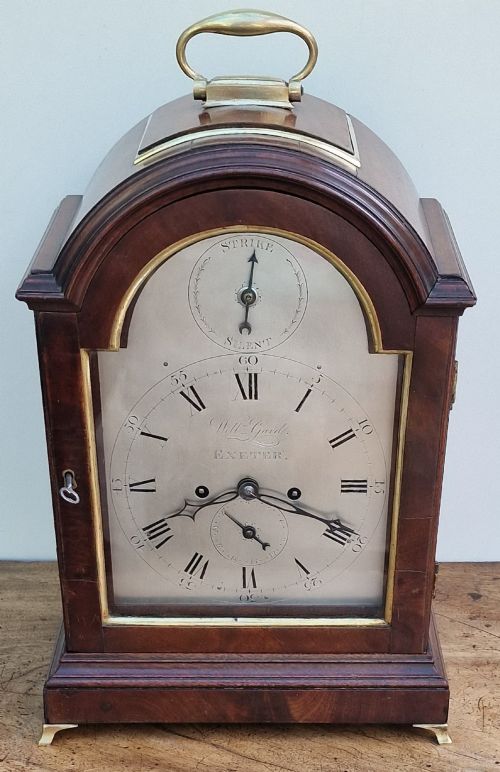
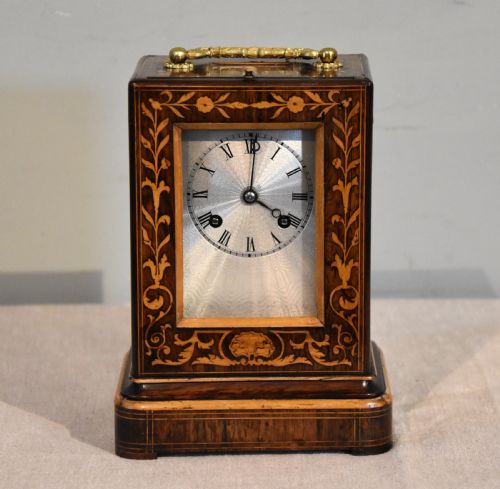


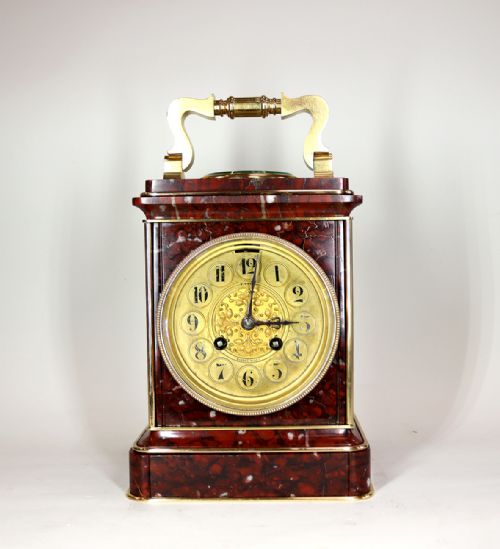


Brass Timepiece Handle
These brass timepiece handle fittings are solid metal components found on carriage clocks and mantel clocks, sought after by collectors and restorers.

Brass Timepiece Handle
A brass timepiece handle is a carrying fixture mounted to the top of portable clocks, particularly carriage clocks and mantel clocks dating from the Georgian period through to the Edwardian era. You will frequently encounter these robust brass mounts attached to French and English timepiece designs spanning the nineteenth century.
The objects housing these brass timepiece handle fittings take various forms, including gorge case carriage clocks, library clocks, and miniature bracket timepieces. Materials paired with these brass components on this page include mahogany, rosewood, ebonised wood, and rouge marble.
Materials and construction
The physical evidence shows that a brass timepiece handle is formed from cast or polished brass, often complementing gilt brass mountings on carriage clocks. These metal elements accompany timber cases constructed from rosewood, mahogany, and ebonised wood.
Makers integrated glass panels, silvered metal dials, and enamel into the clock cases beneath each brass timepiece handle. Techniques varied from inlaid marquetry on timber cases to intricate frets and columns flanking the dial.
Some carriage clocks were built with giant proportions or chaff-cutters, proving that Victorian timekeeping came with a sense of theatre.
Assessing quality in these components
The distinction between standard production and fine quality lies in the execution of secondary elements, such as engraved bronze panels, painted enamel dials, and signed movements by known makers. Finer pieces maintain originality in their casework, whether housed in heavy marble or polished rosewood.
William Gard·Pickford of London·Mappin and Webb·Henry Marc·Arnold and Frodsham·Grimaldi and Johnson·Paul Garnier·Malecot of Paris·Penlington and Batty
The Brass Timepiece Handle Glossary
- Carriage clock
- A small, spring-driven portable clock designed for travel, typically featuring a carrying handle on top and glass panels on the sides.
- Platform escapement
- A self-contained escapement mechanism mounted on a small platform inside portable clocks, regulating the timekeeping.
- Gorge case
- A distinct style of carriage clock case characterised by stepped, tiered mouldings around the top and base.
- Bracket clock
- A portable table clock originally designed to sit on a wall bracket, often featuring fine timber casework and a brass handle.
- Repeat striking
- A mechanism that chimes the hours and quarters on demand when a lever or cord is activated.
Brass Timepiece Handle: Frequently Asked Questions
What is a carriage clock?
A carriage clock is a portable spring-driven timepiece developed in the nineteenth century for travel, featuring a protective glass case and a sturdy metal handle on top.
These clocks were commonly housed in brass frames with glass panels so the movement could be observed from multiple angles.
How do I date a timepiece?
Dating these clocks involves examining the style of the case, the signature of the maker, and the technical development of the internal movement.
Georgian and Regency pieces exhibit distinct architectural proportions, whereas later Victorian and Edwardian examples often incorporate different handle castings and dial treatments.
What is a platform escapement?
A platform escapement is a small, complete regulating unit fitted inside portable clocks that replaces the traditional pendulum.
This innovation allowed carriage clocks to keep accurate time while being transported or moved between rooms.
How were these clocks used?
These clocks were utilised by travellers on journeys or placed upon mantelpieces and desks in domestic interiors.
The carrying handle allowed the clock to be lifted and moved easily without damaging the delicate internal mechanism.