
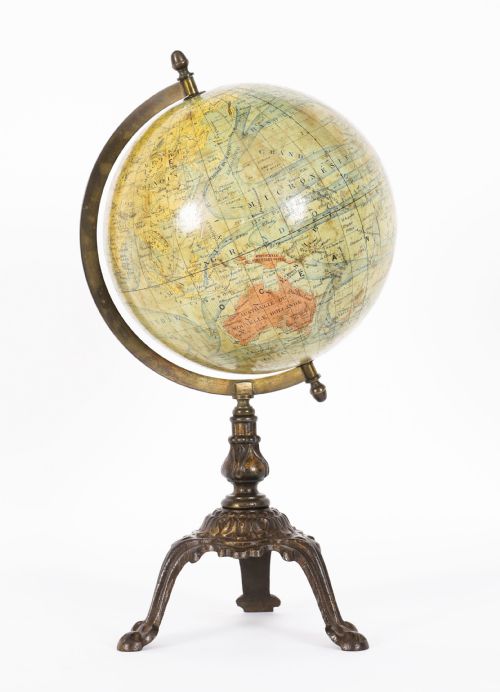
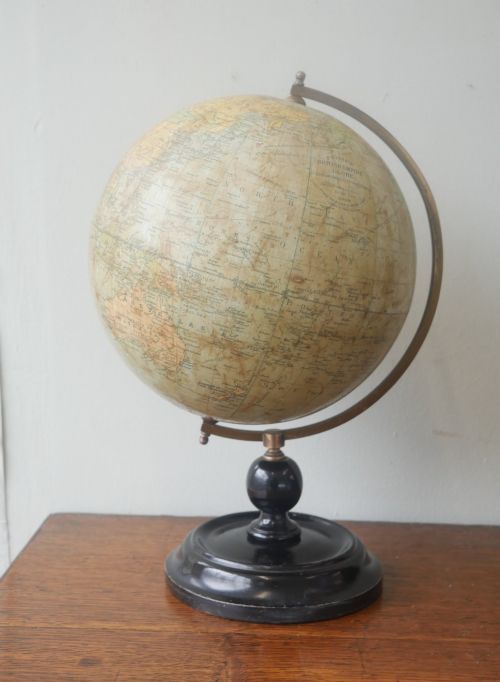
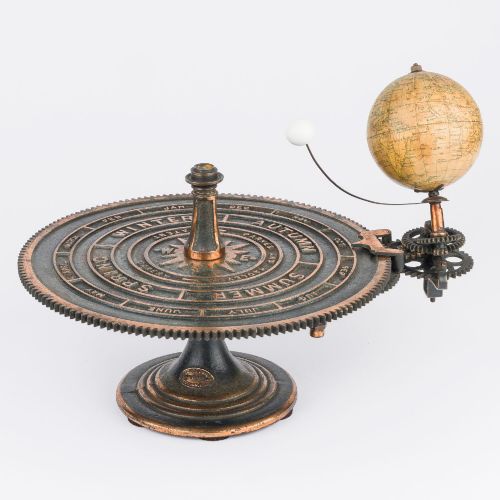
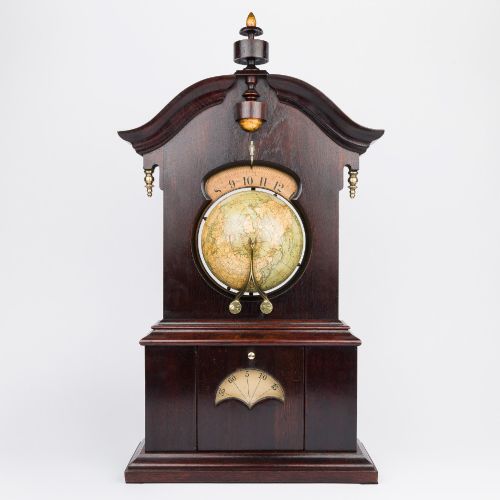
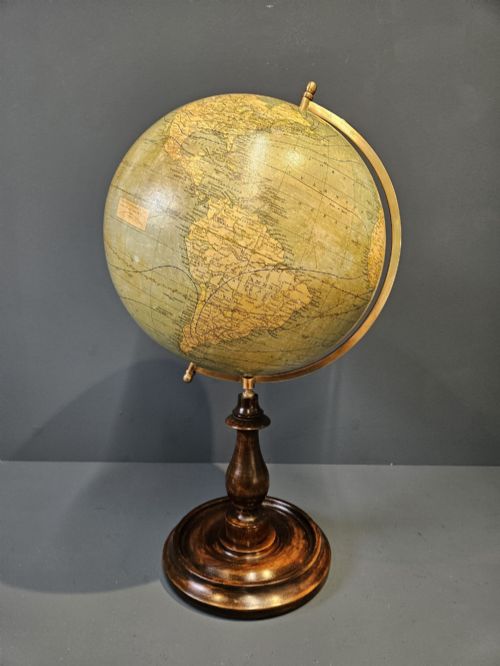
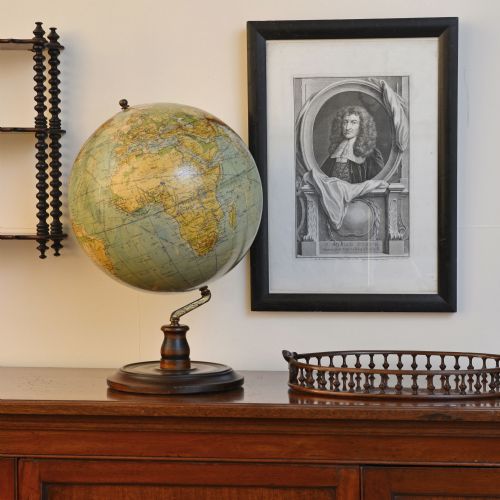


Brass Terrestrial Globe
These brass terrestrial globe examples offer scaled worlds for the desk, charting geographical discoveries in metal and printed paper.
Brass Terrestrial Globe
A brass terrestrial globe represents the earth on a sphere mounted within a brass meridian ring and a supporting stand, designed for desktop or table use. These pieces record global geography across various centuries, serving as both navigational instruments and scientific decor.
The items found here span desktop globes, table globes, and desk globes from diverse periods including the eighteenth century, the nineteenth century, the Edwardian era, and the early decades of the twentieth century. Origins range across British, French, and Indian workshops, including makers such as Lebegue and Cie, J. Forest, Phillips, Chandy Charan and Co of Calcutta, and Geographia.
Buyers encounter formats varying from miniature table pieces to twelve-inch versions, mounted on wood, cast iron, ebonised wood, or brass stands. Each sphere carries printed map gores that reflect the political borders and geographical knowledge of its specific production era.
Materials and construction
Makers construct the spherical bodies using papier-mâché or paper over a core, which they then cover with hand-applied printed paper gores detailing the earth's surface. These paper maps are paired with brass for the meridian rings and sometimes the stands, combining with wood, cast iron, or ebonised wood bases.
The structural assembly unites metalwork with cartographic paper and wooden or cast iron supports, creating a stable desktop instrument. Artisans secure the sphere within a graduated brass meridian ring that allows the globe to tilt and rotate on its axis.
Brass Terrestrial Globe Retail Price Guide 2026
Typical asking prices for brass terrestrial globe among the pieces listed under this phrase on Sellingantiques today, from the lower quarter to the upper quarter. They describe what is for sale here now, not the wider market.
Object forms on this page include desktop globes, desk globes, table globes, and miniature table examples originating from British, French, and Indian workshops.
Qualities of distinction
The distinction between standard and exceptional pieces rests in the clarity and preservation of the printed map gores, alongside the precision of the brass work. Finer examples maintain legible cartographic details and rich patination on their metal components without heavy obscuring wear.
Makers of note and eighteenth-century origins elevate a piece through scarcity of survival and superior geographical engraving. The integrity of the original paper surface and the stability of the wood, cast iron, or ebonised wood stand define the overall caliber of the object.
Lebegue and Cie·J. Forest·Phillips·Chandy Charan and Co·Geographia
The Brass Terrestrial Globe Glossary
- Gores
- The printed paper segments shaped like liquescent triangles that are pasted onto the sphere to form a complete world map. These paper strips require precise alignment during manufacture so the cartography matches properly across the globe.
- Meridian ring
- The graduated brass circle that surrounds the globe, holding it at the correct angle and allowing rotation. This metal ring is often marked with degrees to measure latitude.
- Table globe
- A portable globe designed to sit upon a desk, table, or surface rather than standing on the floor. These instruments provide accessible geographical reference at close range.
- Papier-mâché
- A composite material made from paper pulp or reinforced paper layers mixed with glue, moulded to form the lightweight core of the globe sphere. This technique provides a durable and stable surface for the map gores.
- Ebonised wood
- Timber treated with a dark stain or finish to imitate the appearance of ebony, frequently utilised for the bases and stands of these globes. This dark finish contrasts with the bright brass components.
Brass Terrestrial Globe: Frequently Asked Questions
How do I date a brass terrestrial globe?
Dating relies heavily on the geographical place names, political boundaries, and cartographic details printed on the paper gores. Comparing the nation states and colonial territories shown against historical records often reveals the exact era of production.
Makers' signatures, typography styles, and the materials used for the stand, such as cast iron or ebonised wood, provide further chronological markers for these instruments.
What is the difference between a table globe and a desktop globe?
Table globes and desktop globes essentially describe the same compact format intended for placement on furniture rather than standing independently on the floor. Both provide close-range geographical reference using a mounted sphere.
Dimensions typically range from miniature formats up to twelve inches, fitted with brass meridians and supported by wood, metal, or papier-mâché bases.
How were these globes used historically?
Users consulted these spheres to track global exploration, colonial territories, shipping routes, and international geography in homes, offices, and studies. They functioned as both educational tools and practical references for world events.
The rotating brass meridian allowed the user to tilt the axis and calculate positions, combining scientific utility with decorative status.
How should I care for a paper and brass globe?
Protect the delicate paper gores and printed surfaces by keeping the globe away from direct sunlight, which causes fading and paper degradation. Maintain stable indoor humidity to prevent the papier-mâché core and paper map from warping.
Dust the brass components gently with a dry cloth, avoiding harsh chemical cleaning agents that might damage the historical finish or the surrounding paper.