
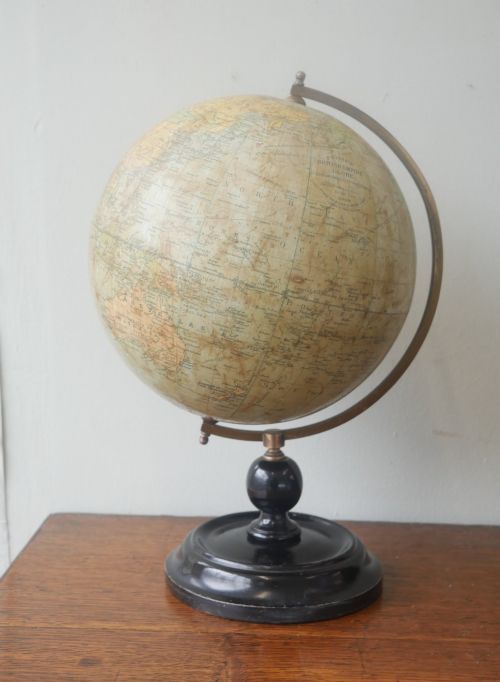
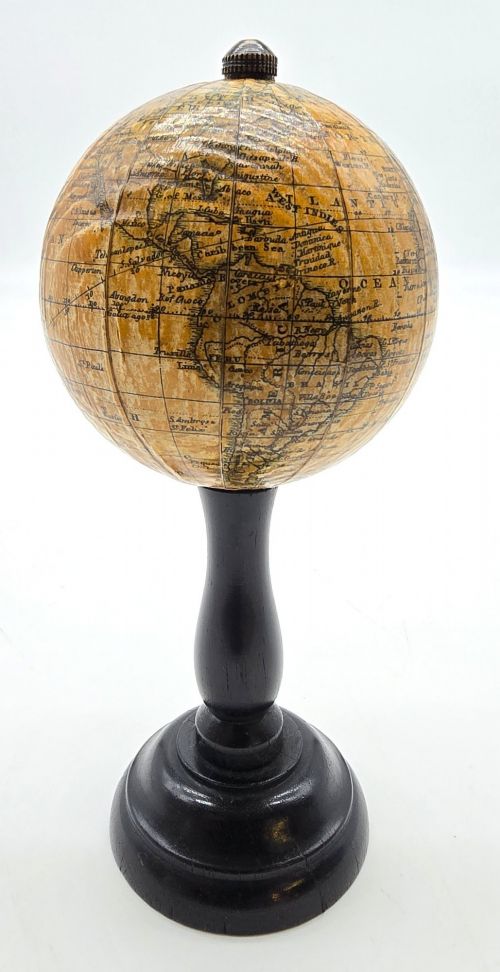


Ebonised Desk Globe
An ebonised desk globe sits squarely in the study, offering a miniature world held upon dark timber.
Ebonised Desk Globe
An ebonised desk globe brings together geography and domestic display, turning cartography into an object for the table or bureau. These pieces range from tiny four-inch examples up to substantial twelve-inch globes made for serious consultation.
The specimens seen here draw from several eras, stretching from nineteenth-century French and Victorian workshop output through the Edwardian period into the interwar years and mid-century modern design. Forms vary from simple library globes to specific British Empire and physical editions.
Makers represented span British firms like Phillips and Geographia, continental houses such as J. Forest and Raths, and colonial makers including Chandy Charan and Co of Calcutta. Smaller miniature pieces on simple ebony stands appear alongside larger papier-mâché spheres.
How they were made
Spheres are formed primarily from papier-mâché or plaster, providing a lightweight yet durable core to receive the printed gores. Paper maps are carefully segmented into gore strips and hand-applied to the curved surface.
Stands and mountings rely on ebonised wood or ebony, paired with brass and chrome hardware for the meridian rings and axes. Metal components allow the sphere to tilt and rotate smoothly within its horizon ring.
Listings feature materials including ebonised wood, brass, chrome, papier-mâché, and plaster across pieces spanning the nineteenth and twentieth centuries.
What varies in quality
The clarity of the cartographic printing and the precision of the paper gores determine visual success. Finer editions show crisp geopolitical boundaries and clear typography without misaligned paper joins.
The substance of the stand dictates the gravitas of the piece, with weighty ebonised timber and well-cast brass hardware separating superior models from lighter, simpler productions.
Chandy Charan and Co·J. Forest·Malby·Phillips·Raths
The Ebonised Desk Globe Glossary
- Ebonised
- Timber treated to resemble ebony, providing a deep black finish that contrasts with the colourful paper globe.
- Gore
- A tapering strip of printed paper pasted onto a sphere to form the map of the world.
- Terrestrial globe
- A scale model of the Earth, showing landmasses, oceans, and political boundaries.
- Meridian ring
- The graduated brass circle surrounding the globe that holds the poles and measures latitude.
Ebonised Desk Globe: Frequently Asked Questions
What size are most desk globes?
Sizes range from miniature four-inch spheres up to twelve-inch or larger library examples designed for prominent placement on a desk.
The smaller versions suit compact writing tables, while larger pieces require a dedicated surface to command attention.
How do I identify the date of a globe?
Cartographic details provide the clearest clues, as political boundaries and country names reflect the geopolitical reality of the era.
Makers often included publication dates or copyright stamps directly upon the printed paper gores near the cartouche.
Where were these globes manufactured?
Production centres spanned Britain, France, Germany, and India, with notable publishing houses and specialist instrument makers issuing their own editions.
Each region brought distinct cartographic styles and regional naming conventions to the printed maps.
How should I care for an antique globe?
Keep the piece away from direct sunlight to prevent the printed paper gores from fading and discolouring over time.
Dust gently with a dry, soft cloth, avoiding any liquid cleaners that could damage the paper surface or the ebonised finish.