


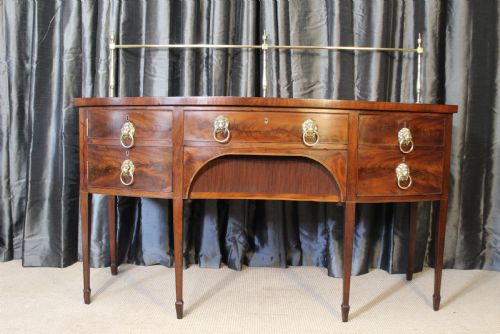


Brass Rail Mahogany Sideboard
These brass rail mahogany sideboards bring grand dining rooms together with deep timber tones and polished gallery work.
Brass Rail Mahogany Sideboard
When you search for a brass rail mahogany sideboard, you are looking at substantial dining furniture designed to hold serving dishes and glassware while displaying a protective gallery at the back. These impressive serving pieces appear most frequently in Georgian, Regency, and Victorian iterations, spanning the eighteenth and nineteenth centuries.
The version you are most likely to meet on this page combines rich mahogany timber with a gleaming brass gallery rail, often shaped with a bowfront or serpentine front. Surviving examples range from authentic period pieces by makers such as Robson & Sons and H Mower & Stephenson to later revival works from the nineteenth century.
Makers shaped these sideboards to serve both practical and decorative functions in large formal rooms. The integration of satinwood and boxwood inlay often defines the finer examples found within these periods.
How they were made
Cabinet makers constructed the primary carcases using dense mahogany timber, selected for its rich grain and structural stability. This wood formed the deep, polished surfaces characteristic of the period.
Workshops incorporated contrasting details through delicate satinwood and boxwood inlay, creating geometric and floral borders across the drawer fronts and tops. Artisans then mounted polished brass rails to the rear of the serving tables to secure display items.
Structural variations include pedestals, bowfronts, and serpentine shapes that demanded advanced timber-bending and joinery skills from the makers.
Materials recorded across the archive include solid mahogany, brass gallery rails, and decorative satinwood and boxwood inlay.
What varies in quality
The distinction between ordinary and exceptional pieces rests upon the precision of the timber selection and the sharpness of the inlay work. Finer examples display carefully matched mahogany veneers and crisp boxwood and satinwood stringing that remains intact.
The quality of the metalwork also separates the ranges, with heavy cast brass galleries demonstrating superior craftsmanship compared to lighter, plain wire alternatives. Proportions and the grace of the serpentine or bowfront curves dictate the overall visual balance.
Robson & Sons·H Mower & Stephenson
The Brass Rail Mahogany Sideboard Glossary
- Bowfront
- A curved cabinet front that swells outward in a convex arc. This shape softens the room and provides extra interior depth.
- Serpentine
- A front profile shaped with a central convex curve flanked by two concave curves. It requires considerable skill from the cabinet maker to execute cleanly.
- Brass gallery
- A metal rail mounted along the rear edge of the sideboard top. It prevented dishes and silver from sliding off during service.
- Inlay
- A technique where contrasting woods like satinwood or boxwood are fitted into recesses within the mahogany surface. This creates decorative borders and patterns.
- Pedestal sideboard
- A form featuring central serving sections flanked by distinct pillar-like cupboard units. These pieces dominate large dining spaces.
Brass Rail Mahogany Sideboard: Frequently Asked Questions
What is a brass rail mahogany sideboard used for?
These sideboards served as practical serving tables in formal dining rooms during the Georgian and Victorian periods. They held platters, serving dishes, and silverware during large meals.
The brass rail at the back kept items secure while plates and dishes were displayed or prepared for the table.
How do I tell Georgian from revival pieces?
Authentic Georgian pieces exhibit the natural wear, timber ageing, and hand-cut joinery consistent with the eighteenth and early nineteenth centuries. Revival pieces from later periods often show different construction methods and fresher wood finishes.
Examining the secondary timbers inside the drawers helps clarify the actual period of manufacture.
Where should I place a sideboard?
These large serving pieces require a prominent wall in a dining room or spacious hallway where their depth and length can be appreciated. Ensure there is enough clearance for the brass rail and doors to open fully.
Keep them away from direct heat sources to protect the mahogany polish and prevent timber movement.
How do I care for mahogany surfaces?
Dust the timber regularly with a soft, dry cloth to prevent dirt buildup on the polished finish. Avoid using silicone-based polishes that can damage the historical surface over time.
Occasional application of traditional wax helps nourish the mahogany and maintains the natural lustre.