
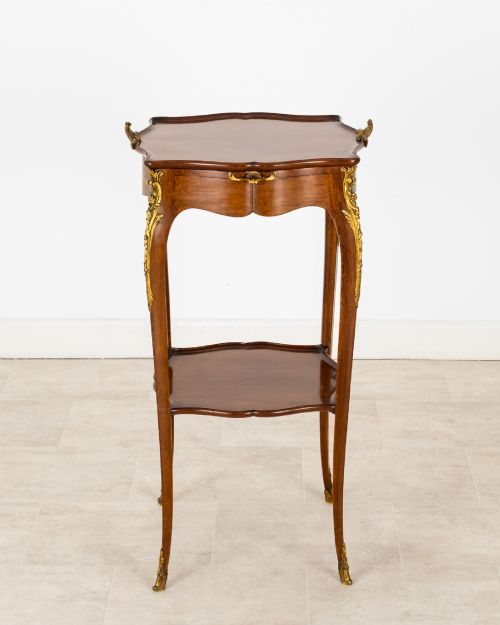


Brass Mounted Tier Table
A brass mounted tier table brings layered French elegance and practical display space into a room.
Brass Mounted Tier Table
A brass mounted tier table is a multi-level surface designed for display and occasional use, drawing heavily from French continental aesthetics. When searching for this form, a buyer encounters various multi-tiered configurations including etageres, occasional tables, and gueridons spanning the nineteenth and early twentieth centuries.
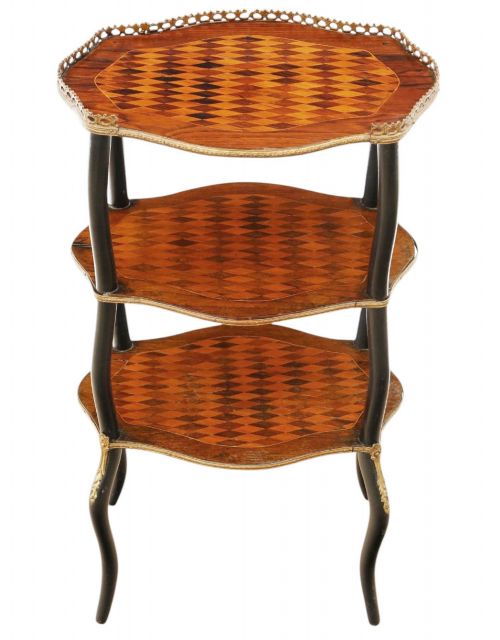
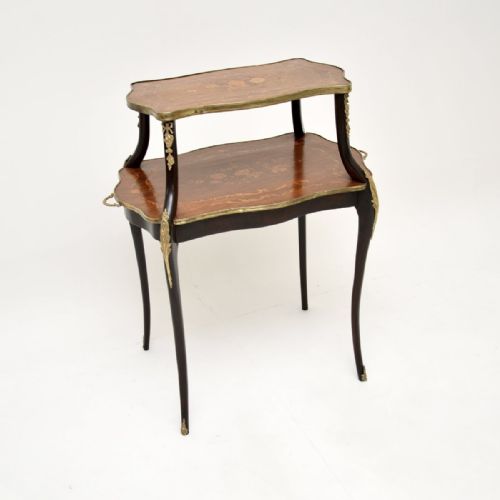
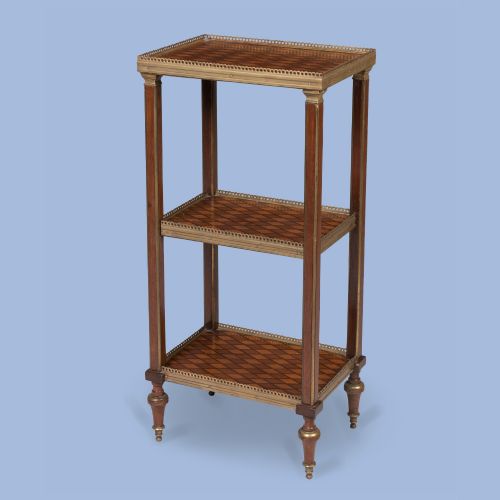
The pieces appearing in this selection reflect distinct revival periods such as Louis XV, Louis XVI, and Regency tastes. Side tables and display shelves dominate the forms, frequently featuring two or three tiers joined by slender supports.
Origins lean strongly toward French workshops and English interpretations of French manners, utilising varied wood veneers arranged in complex geometric or floral patterns. The fundamental character relies upon tiered staging combined with metallic mounts to create vertical visual interest.
How they were made
Construction rests upon substantial hardwood carcasses faced with decorative veneers such as mahogany, kingwood, rosewood, walnut, and amboyna. Cabinetmakers employed intricate marquetry and parquetry techniques to pattern the tops and shelves, incorporating contrasting timbers like satinwood.
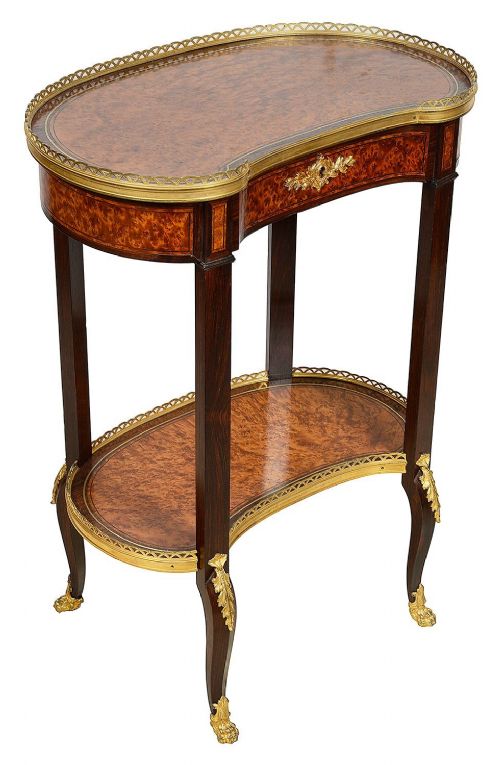
Cast brass and ormolu mounts, galleries, and sabots accent the structural joints and perimeters. These metal elements are secured to the wooden tiers to protect edges and frame the display surfaces, while inset marble tops provide heavier stone contrast on specific occasional and console formats.
Materials span traditional mahogany and walnut alongside exotic kingwood, rosewood, amboyna, and satinwood veneers.
What varies in quality
Quality rests upon the crispness of the bronze or brass cast work and the precision of the veneer work across multiple tiers. Finer examples display meticulously cut marquetry where individual wood types lock together without excessive filler.
Structural integrity through the upright supports and the weight of the marble or timber tiers distinguish high-tier workshop production from standard commercial output. The refinement of the finishing polish also dictates how clearly the grain and brass patination interact.
François Linke·John MaClean·Donald Ross
The Brass Mounted Tier Table Glossary
- Etagere
- A piece of furniture consisting of open shelves for displaying small objects or ornaments. These tiers provide vertical surfaces rising above a main base table.
- Ormolu
- Gilded bronze applied to the mounts and decorative edges of furniture. This technique adds metallic highlights to the wooden framework.
- Marquetry
- Inlaid woodwork forming decorative patterns using various tinted veneers. Craftsmen arrange these wood pieces to create floral or geometric table tops.
- Gueridon
- A small round occasional table supported by one or more columns. French versions frequently incorporate marble slabs and brass galleries.
- Parquetry
- Geometric mosaic woodwork used for surface decoration. This technique arranges wood blocks in repeating patterns across table tiers.
- Sabot
- A metal sleeve fitted to the foot of a furniture leg. It protects the lower wood from damage and mirrors the mounts above.
Brass Mounted Tier Table: Frequently Asked Questions
What is a tier table used for?
These pieces serve as display surfaces for decorative objects, lamps, and small items across sitting rooms and boudoirs. The multi-level structure expands usable surface area without demanding a large floor footprint.
Historically, specific variants accommodated tea service or held books and writing materials close to hand. Their decorative framing suited prominent placement in formal reception spaces.
How do I identify French revival styles?
French revival pieces incorporate characteristic curves, floral marquetry, and symmetrical ormolu mounts that mimic eighteenth-century court furniture. Look for kidney-shaped tops, cabriole legs, and elaborate brass galleries defining the period taste.
These designs emerged strongly during the nineteenth century as cabinetmakers reinterpreted Louis XV and Louis XVI aesthetics. The use of exotic veneers alongside gilt bronze provides a clear visual indicator.
Are marble tops original to these tables?
Many occasional tables and gueridons feature inset marble slabs designed as part of the original construction. These stone surfaces offered practical heat and liquid resistance for serving drinks or displaying plants.
Bevilled edges and precise fits within the wooden frames indicate factory or workshop integration. The weight of the marble also anchored the lighter tiered supports below.
How do etageres differ from side tables?
Etageres primarily feature multiple open display shelves stacked vertically to showcase collections of porcelain or small decorative items. Side tables typically focus on a primary surface with an optional lower tier for secondary storage.
Both forms utilise brass mountings and fine timber veneers, blurring the line between utility and display. The designation often depends on the height and prominence of the intermediate tiers.