
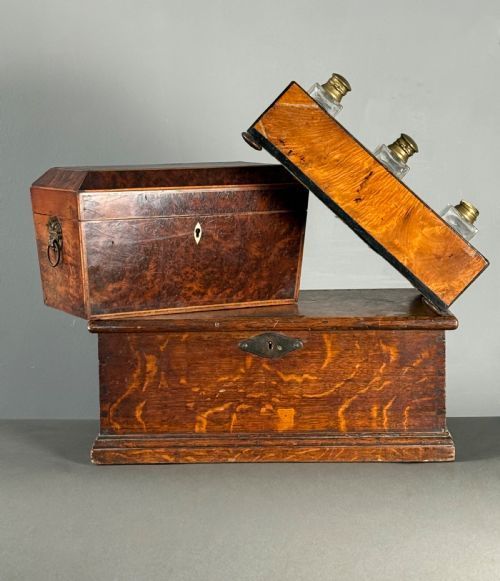


Brass Marquetry Tea Caddy
A brass marquetry tea caddy is a wooden box for storing dry leaf, decorated with metal inlay.
Brass Marquetry Tea Caddy
A brass marquetry tea caddy is a box designed to hold tea leaves safely under lock and key during eras when tea was an expensive dry commodity. The pieces appearing here span the eighteenth century, the Regency period, and the Victorian era, showing how the form evolved from simple rectangular timber containers into more elaborate objects.
Most examples found on this page utilise rosewood or tortoiseshell as the primary body, punctuated by brass inlay or buelle work. Alongside standard tea caddies, listings include larger teapoys on stands and related decorative boxes featuring bone details or inner canisters.
The origins stretch across English workshops and French Napoleonic and Restoration periods. Buyers encounter oblong tapered shapes, burr walnut finishes, and ebonised wood structures alongside traditional rectangular boxes.
How they were made
Maker workshops constructed the primary bodies from dense hardwoods like rosewood, walnut, and oak, often applying fine veneers of burr thorn or tortoiseshell over the carcass. Artisans then cut intricate patterns into the surface timber to receive thin sheets of brass or gilt metal inlay.
Interiors frequently received glass mixing bowls, sugar dishes, and fitted wooden canisters with individual lids. Precision in routing the channels for the metal inlay determined how cleanly the brass sat flush against the polished wood grain.
Some boxes hide tiny keys inside, reminding us of eras when tea was locked away from the staff.
What varies in quality
The standard of a brass marquetry tea caddy rests on the crispness of the metal cutting and the complexity of the botanical or geometric motifs embedded in the wood. Finer specimens display tight registration between the brass inlay and the surrounding rosewood or tortoiseshell veneer, with minimal filler used in the joints.
Material choice alters the character of the box, with tortoiseshell and buelle examples offering a different visual depth compared to plain ebonised wood or oak. The presence of original inner canisters, glass mixing dishes, and functioning keys elevates the completeness of the piece.
The Brass Marquetry Tea Caddy Glossary
- Tea caddy
- A small lidded box constructed to store loose tea leaves securely. Early versions often included internal divisions and locked lids to protect the valuable contents.
- Teapoy
- A larger tea caddy mounted upon a central pillar and pedestal base or legs. These freestanding pieces often incorporated mixing bowls alongside storage compartments.
- Buelle
- An alternative spelling of boulle work, denoting inlaid patterns of brass and tortoiseshell developed in France. This decorative technique creates contrasting dark and metallic surfaces.
- Marquetry
- The art of applying decorative pieces of veneer to a structural structure to form geometric patterns or pictorial designs. Craftsmen assemble these wooden and metal elements meticulously before gluing them down.
Brass Marquetry Tea Caddy: Frequently Asked Questions
What is a brass marquetry tea caddy?
A brass marquetry tea caddy is a lidded wooden box ornamented with inlaid metalwork designed for keeping tea leaves secure.
These containers date from the eighteenth, nineteenth, and Victorian eras, reflecting the high value placed on tea during those centuries.
How were tea caddies used historically?
Household staff or the master of the house stored precious tea leaves inside these boxes under lock and key. The key remained with the head of the household to prevent servants from taking the expensive dry leaves.
Many examples feature internal compartments for different tea varieties and glass bowls used for diluting or mixing the brew.
What woods do makers use?
Makers relied on dense hardwoods such as rosewood, walnut, and oak for the structural carcass and exterior veneers. Tortoiseshell and ebonised wood also appear frequently as primary surfaces.
These dark timbers provided a strong visual contrast against the bright brass inlay and gilt metal details.
How do I date an antique caddy?
Dating relies on observing the overall silhouette, the primary materials, and the style of the brass inlay work. Regency pieces often exhibit tapered oblong forms and distinct geometric brass motifs, while Victorian examples lean towards burr walnut finishes.
Internal fittings, such as shaped wooden canisters or glass dishes, also help place the box within its correct period.
How should I care for a tortoiseshell box?
Tortoiseshell and delicate veneer require stable room temperatures away from direct sunlight and excessive moisture. Sudden humidity changes can cause the organic shell and brass inlay to lift from the wooden carcass.
Gentle dusting with a soft, dry cloth preserves the polished surface without stripping the historic finish.