
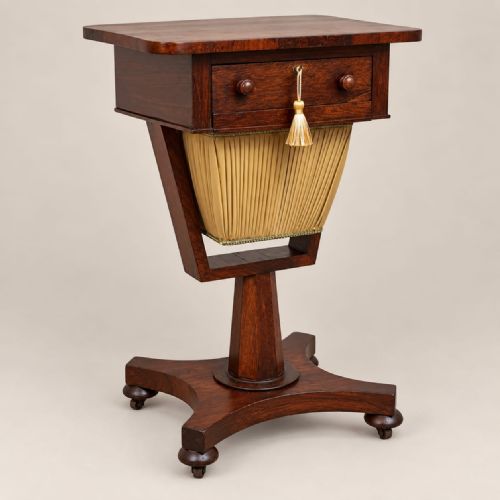
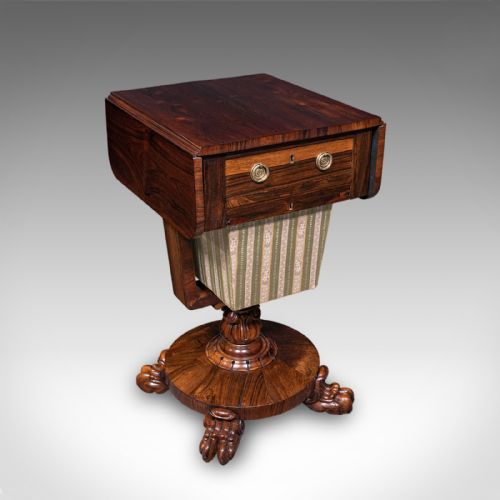
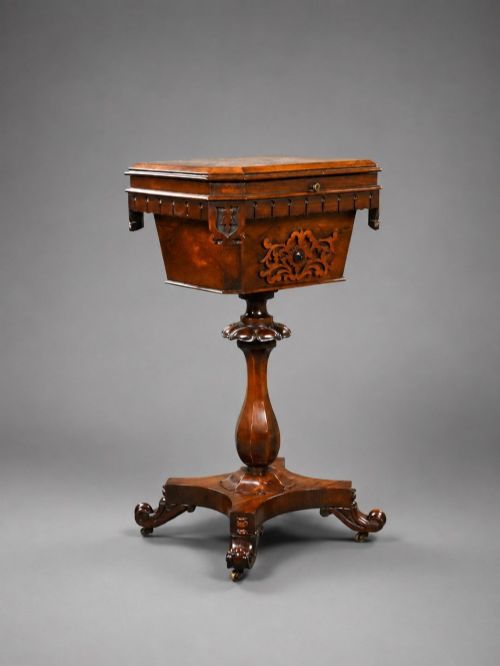
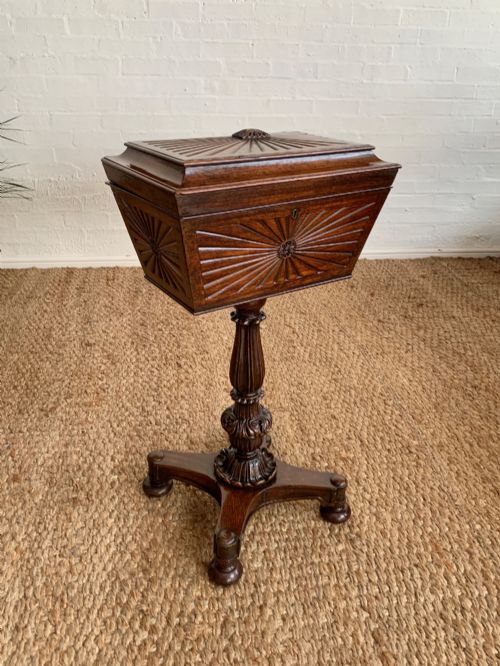


Rosewood Pedestal Box
These rosewood pedestal box pieces are solid timber containers and multi-tasking tables designed for needlework or tea storage, prized for their dense grain and pedestal bases.
Rosewood Pedestal Box
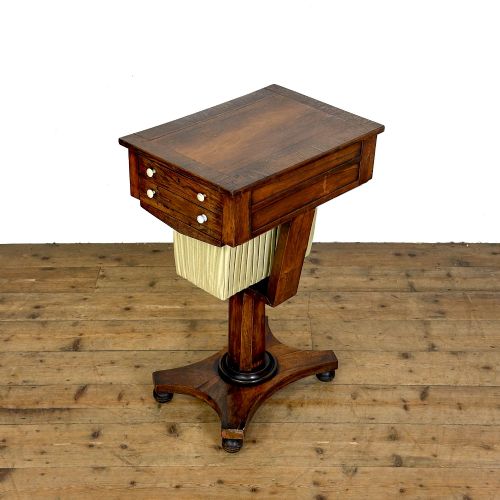
A rosewood pedestal box most commonly takes the form of a work table, sewing table, or teapoy dating from the nineteenth century, including the Regency, William IV, and Victorian eras. These items served domestic purposes in the parlour or drawing room, functioning as repositories for needlecraft, textiles, or tea leaves.
Buyers encounter numerous variations on this page, ranging from drop-leaf sewing tables and games tables to fitted tea caddies mounted on central columns and plinths. Stylistic influences span from English cabinet-making traditions to Anglo-Indian colonial production in padouk and rosewood.
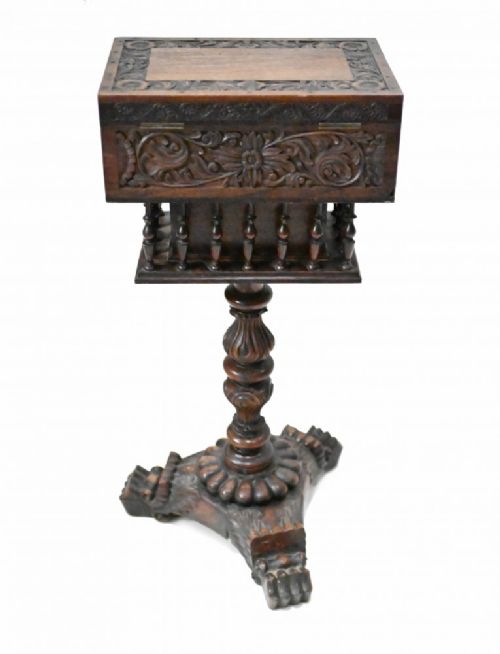
The core structure typically relies on a turned or carved pillar resting on a platform base, supporting an enclosed box or compartment with various internal fittings. Simpler work boxes share shelf space with elaborate examples featuring sunburst carving, brass inlay, and marquetry.
How they were made
Cabinet makers constructed these pieces primarily using rosewood, mahogany, and padouk, often selecting richly figured veneers laid over stable secondary woods. Surface ornamentation frequently incorporates brass inlay, wood inlay, and delicate marquetry patterns.
Interiors and functional elements integrate secondary materials such as silk, fabric, and glass for lining compartments, mirror panels, or caddy fittings. Structural stability depends on heavy central pedestals, occasionally augmented by brass detailing or carved paw feet.
Several pieces double as games tables, proving our ancestors took their parlour entertainment very seriously indeed.
What varies in quality
Quality rests upon the selection of timber veneers, the crispness of hand-carved elements like sunbursts or scrolling foliage, and the precision of brass or wood inlay. Superior examples display seamless grain matching and intact internal partitions for sewing or tea storage.
The structural integrity of the central pedestal and its junction with the platform base dictate durability, as does the condition of original fabric linings and interior compartments. Variations in execution distinguish standard cabinet production from finer workshop output attributed to prominent makers.
The Rosewood Pedestal Box Glossary
- Teapoy
- A pedestal container originally designed for holding loose tea leaves, often fitted with internal canisters and mixing bowls. These pieces typically date from the Georgian and Regency periods.
- Work Table
- A domestic table equipped with drawers, fabric bags, or compartments for sewing and needlework. They frequently double as occasional or writing tables.
- Marquetry
- The art of applying decorative veneer pieces of various woods to a structure to create pictorial designs. It appears on nineteenth-century sewing and work tables.
- Caddy Top
- A hinged lid covering a compartmentalised interior box section, echoing the design of tea caddies. This feature is common on pedestal work boxes.
- Padouk
- A dense tropical timber resembling rosewood, utilised in Anglo-Indian colonial furniture production. Pieces in this material exhibit rich reddish-brown tones.
Rosewood Pedestal Box: Frequently Asked Questions
What is a rosewood pedestal box used for?
These pieces functioned historically as dedicated containers for sewing gear, thread, or luxury tea leaves in nineteenth-century parlours.
Today, they serve as decorative occasional tables or storage boxes for small household items.
How do I identify a Regency teapoy?
Regency teapoys typically feature architectural pedestal bases, brass inlay, and formal proportions dating from the early nineteenth century.
Internal fitted canisters and mixing bowls distinguish authentic tea storage boxes from general work tables.
What is the difference between a work table and a teapoy?
Work tables incorporate hanging fabric bags, drawers, or drop leaves designed specifically to assist with needlecraft and sewing projects.
Teapoys focus entirely on enclosed storage compartments for dry goods rather than textile work.
How should I care for antique rosewood furniture?
Keep rosewood pieces away from direct sunlight and heat sources to prevent the timber veneers from drying and cracking.
Apply occasional microcrystalline wax to maintain the lustre of the polished wood surface.