
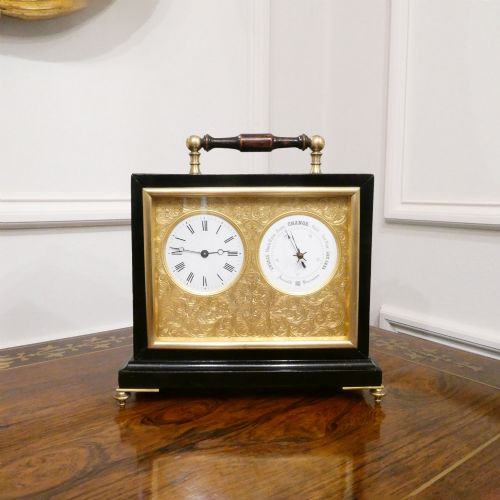
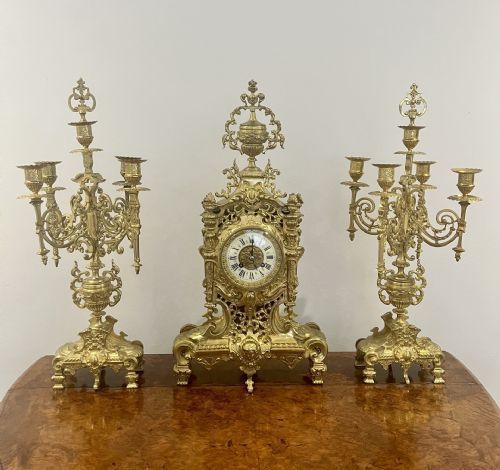
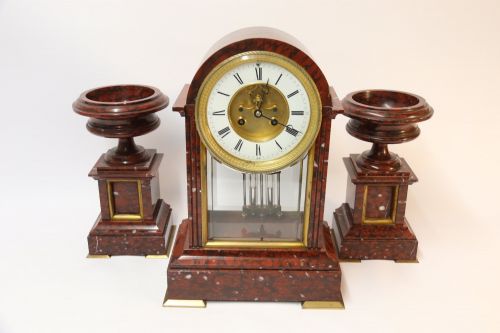
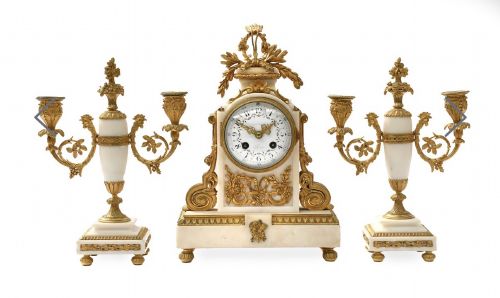
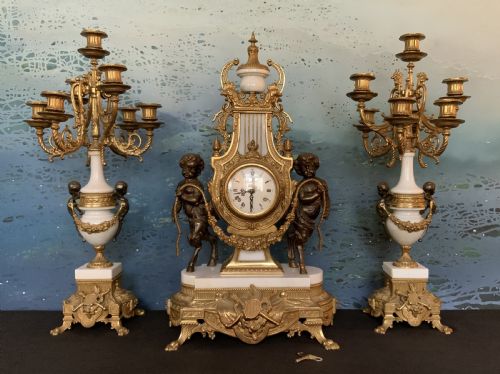


Brass Mantel Clock Set
These heavy, decorative brass mantel clock sets bring formal Victorian presence and matching side garnitures to a mantelpiece.
Brass Mantel Clock Set
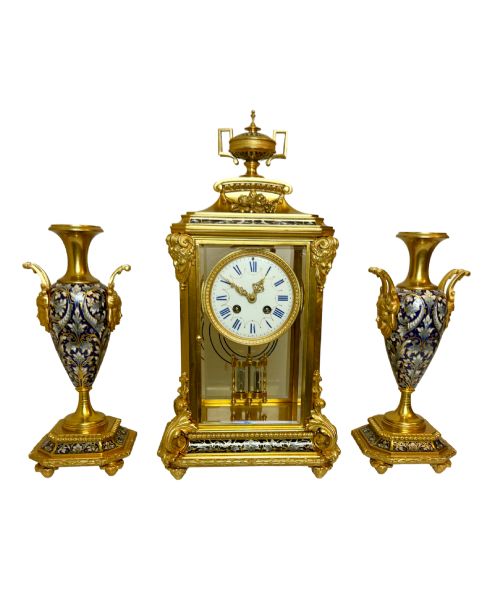
A brass mantel clock set combines a central timekeeper with matching side pieces like candelabras or urns, creating a balanced decorative arrangement. You will most frequently meet nineteenth-century French examples featuring gilt bronze, marble, and ornate architectural or revival cases.
The form developed to anchor the visual centre of a formal room, often standing on a matching plinth or base. These pieces draw on styles ranging from ornate Rococo and Louis XVI to later Art Deco designs.
Makers housed eight-day movements inside these housings, providing a reliable mechanical heart to accompany the striking visual display. The matching side garnitures complete the three-piece ensemble intended for a grand salon or drawing-room mantel.
Materials and Construction
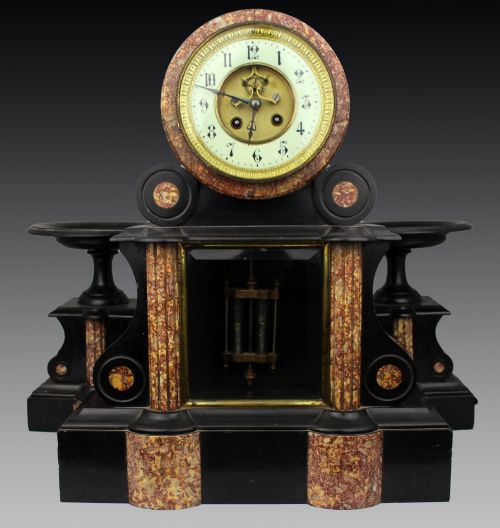
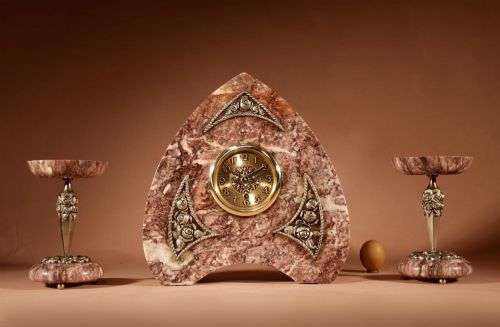
Foundries cast cases in brass, bronze, and ormolu, applying mercury gilt or chemical finishes to achieve deep metallic lustre. These metal mounts were then fastened to dense natural stones including black marble, pink marble, and green onyx.
Enamel dials feature hand-painted numerals, protected behind heavy bevelled glass bezels set into the cast metal case. Craftsmen also incorporated champlevé and cloisonné enamel work directly into the brass and gilt surfaces for added colour and pattern.
Movements came from specialised workshops, utilising brass gear trains and escapements driven by coiled steel springs. These mechanical components were fitted precisely into the stone or metal housings alongside matching side pieces.
Listings feature nineteenth-century periods, Victorian eras, and Art Deco styles, utilising materials like brass, marble, gilt bronze, and champleve enamel.
Evaluating Quality
The crispness of the cast bronze ornament dictates the visual success of the piece, separating sharp, hand-chased detailing from soft, muddy production. Heavier stone bases and thicker mercury gilding signal higher-tier workshops.
Signed movements by renowned makers indicate a superior standard of internal engineering and clockmaking heritage. The integration of the side garnitures with the central clock reveals whether the set was conceived as a unified composition.
Japy Freres·Samuel Marti·A.D Mougin·Vincenti of Paris·Deniere
The Brass Mantel Clock Set Glossary
- Garniture
- A set of matching decorative objects designed to be displayed together on a mantelpiece or sideboard, typically comprising a central clock flanked by two matching candelabras, urns, or vases.
- Ormolu
- Finely ground high-carat gold applied in a mercury amalgam to a base metal object, usually bronze or brass. This historic technique produces a rich, durable golden finish found on nineteenth-century French pieces.
- Champlevé
- An enamelling technique where troughs or cells are hollowed out of a metal surface and filled with vitreous enamel paste before firing. It creates vibrant coloured patterns flush with the surrounding brass or bronze mount.
- Escapement
- The internal mechanical linkage that controls the release of power in a clock movement while giving periodic impulses to the pendulum. Different types affect the precision and ticking sound of the mechanism.
Brass Mantel Clock Set: Frequently Asked Questions
What is a clock garniture?
A clock garniture is a matched decorative set consisting of a central mantel clock paired with two side pieces, such as candelabras or vases. These three items were designed to be displayed together as a unified centrepiece on a fireplace mantel.
The matching side pieces balance the composition and extend the decorative theme across the shelf. This format was particularly popular in nineteenth-century French drawing rooms.
How do I wind an eight day clock?
An eight-day clock movement requires winding approximately once a week using a matching key inserted into the dial arbors. You turn the key gently until you feel firm resistance, taking care not to overwind the mainspring.
Most antique movements feature two winding holes on the face, one for the time train and one for the striking mechanism. Keeping the clock properly wound ensures accurate timekeeping and maintains tension on the internal springs.
Where were these clocks made?
The vast majority of antique mantel clock sets originate from France, particularly Paris and regional centres like the Franche-Comte region. French workshops dominated the export market for decorative timepieces throughout the nineteenth century.
Many pieces combine movements produced by specialised industrial makers with decorative cases styled in Louis XVI or Rococo revivals. Retailers across Europe and Britain then imported these sets for affluent domestic buyers.
How do I care for marble and gilt bronze?
Marble surfaces require dusting with a dry, soft cloth to prevent grit from scratching the polished stone. Avoid using chemical cleaners, water, or acidic household products on antique stone or metal finishes.
Gilt bronze and ormolu should be treated with equal care, using only a very soft brush to clear dust from recessed chasing. Harsh polishes will strip away the historic mercury gilding and ruin the surface patina.