
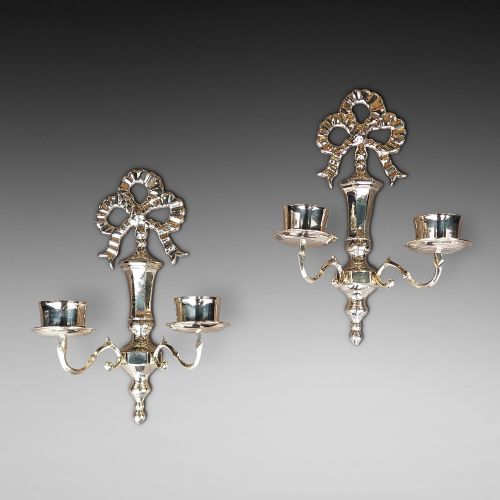
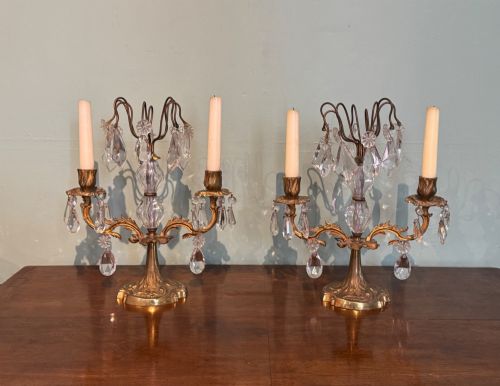
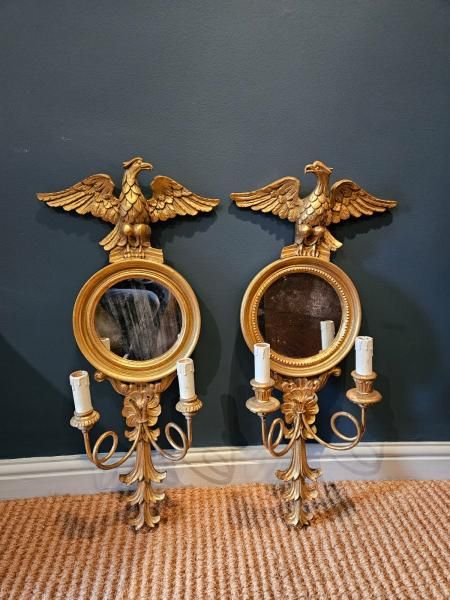

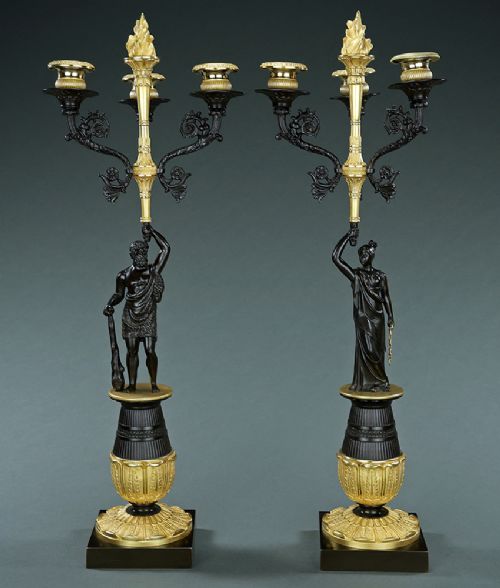
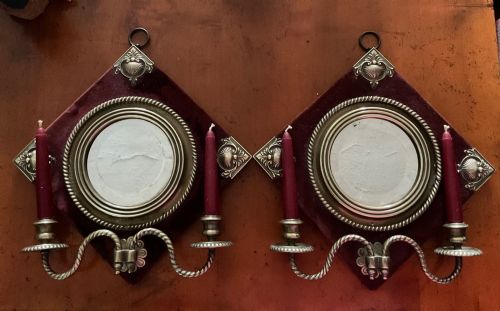
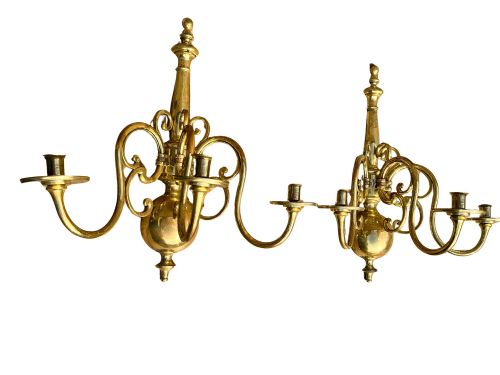


Brass Girandole Pair
A brass girandole pair brings reflected light and sculptural presence to a wall, combining cast metalwork with an integrated mirror.
Brass Girandole Pair
When you search for a brass girandole pair, you look at wall-mounted light fittings that incorporate a mirror plate to multiply the candle flame. These pieces span the Victorian period through to the early twentieth century, with French Rococo Revival and English designs appearing frequently.
The form typically combines a central brass or gilt-bronze frame holding a reflective glass plate with one or more projecting candle arms. You will encounter both compact bedroom brackets and large reception room wall lights featuring crystal drops and elaborate cast ornamentation.
Originating largely from British and French workshops, these twin-arm or multi-light fixtures served to brighten dark panelled rooms before the advent of electricity. Surviving pairs often retain their original mirror plates and gilding, showing the wear of domestic service over generations.
Materials and construction methods
Foundry workers cast the structural components in brass, gilt bronze, and ormolu, often chasing the metal surfaces by hand after casting to sharpen leaf and scroll motifs. Frames were frequently gilded or polished to catch the flickering light of candles.
Makers integrated hand-bevelled mirror plates into the brass frames, securing them from behind with wooden backs or metal tabs. Cut glass and crystal drops were then suspended from the arms to refract the illumination.
The archive records French Empire and Dutch Baroque styling influences among the standard Victorian and Rococo Revival wall fixtures.
Assessing quality in antique girandoles
The crispness of the metal casting dictates the visual success of the piece, as superior examples show deep relief and finely detailed chasing rather than soft, blurred edges. Heavier gauge brass and solid bronze construction ensure the candle arms remain rigidly aligned.
The retention of original mercury mirror plates and matching crystal pendents separates exceptional survivors from later assembled pairs. Finer models demonstrate careful proportion between the reflective backplate and the projection of the candle branches.
The Brass Girandole Pair Glossary
- Girandole
- A branched wall light or candelabrum incorporating a mirror backplate. The reflective glass serves to multiply the light emitted by the candles.
- Ormolu
- Gilt bronze produced by applying a mercury and gold amalgam to a bronze base and heating it. This technique creates a durable, rich golden surface finish.
- Chasing
- The manual tooling of metal surfaces with punches and hammers after casting. It refines the details and adds texture to floral or scrollwork.
- Bevel
- An angled edge cut along the perimeter of a mirror plate. This traditional detail adds depth and catches the light at the glass boundary.
Brass Girandole Pair: Frequently Asked Questions
How do I hang a heavy brass girandole pair?
These wall fixtures require secure fixings into structural wall studs or heavy-duty wall anchors due to the substantial weight of the cast metal and glass mirror plates.
Ensure the hanging bracket or screw placement aligns with the internal weight distribution of the backplate to prevent any forward tilt.
Can I convert these wall lights to electricity?
Many owners choose to adapt these fixtures for electrical wiring by running slim cables through the original candle nozzles or behind the backplate.
Professional electricians can perform this modification using dummy candles that house modern wiring while preserving the historic metalwork.
How do I clean antique brass and glass?
Dust the metal surfaces gently with a soft, dry brush and avoid abrasive commercial metal polishes that strip away original gilding and patina.
Clean the mirror plate and crystal drops using a damp cloth applied carefully, keeping moisture away from the vulnerable backing of old glass.
How do I spot a matched marriage pair?
Examine the casting marks, dimensions, and the amber tone or foxing of the mirror plates to confirm both pieces originated from the same workshop.
Slight variations in the hand-chased surface details often indicate that two separate single sconces were paired together at a later date.