
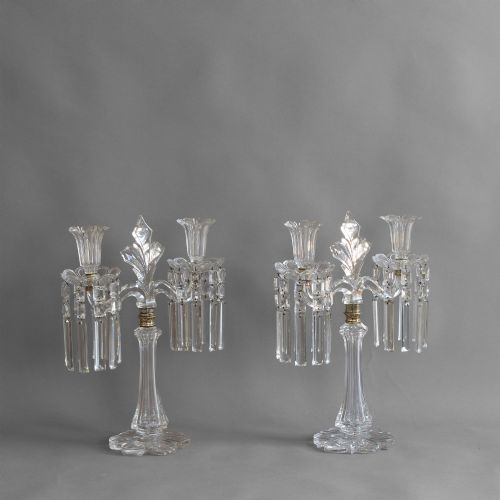
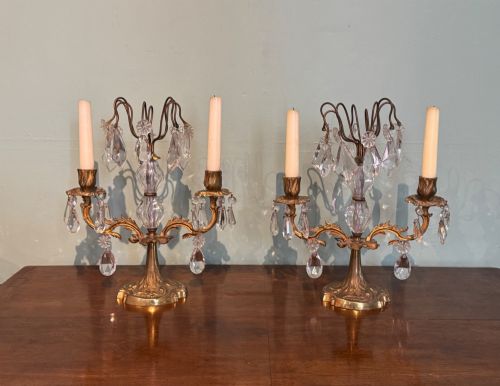
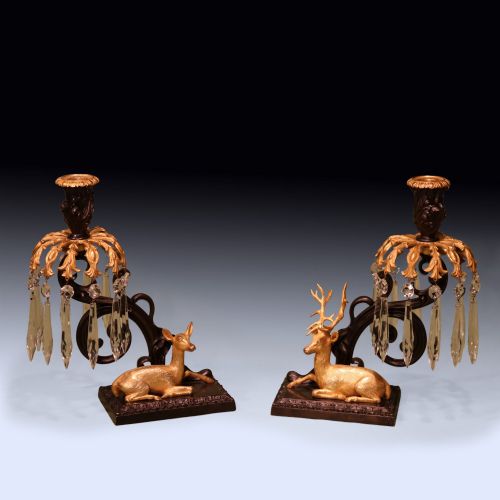


French Crystal Candelabra
These French crystal candelabra bring weight and brilliance to a room, catching the daylight by afternoon and throwing points of fire across the walls by candle or lamp light.
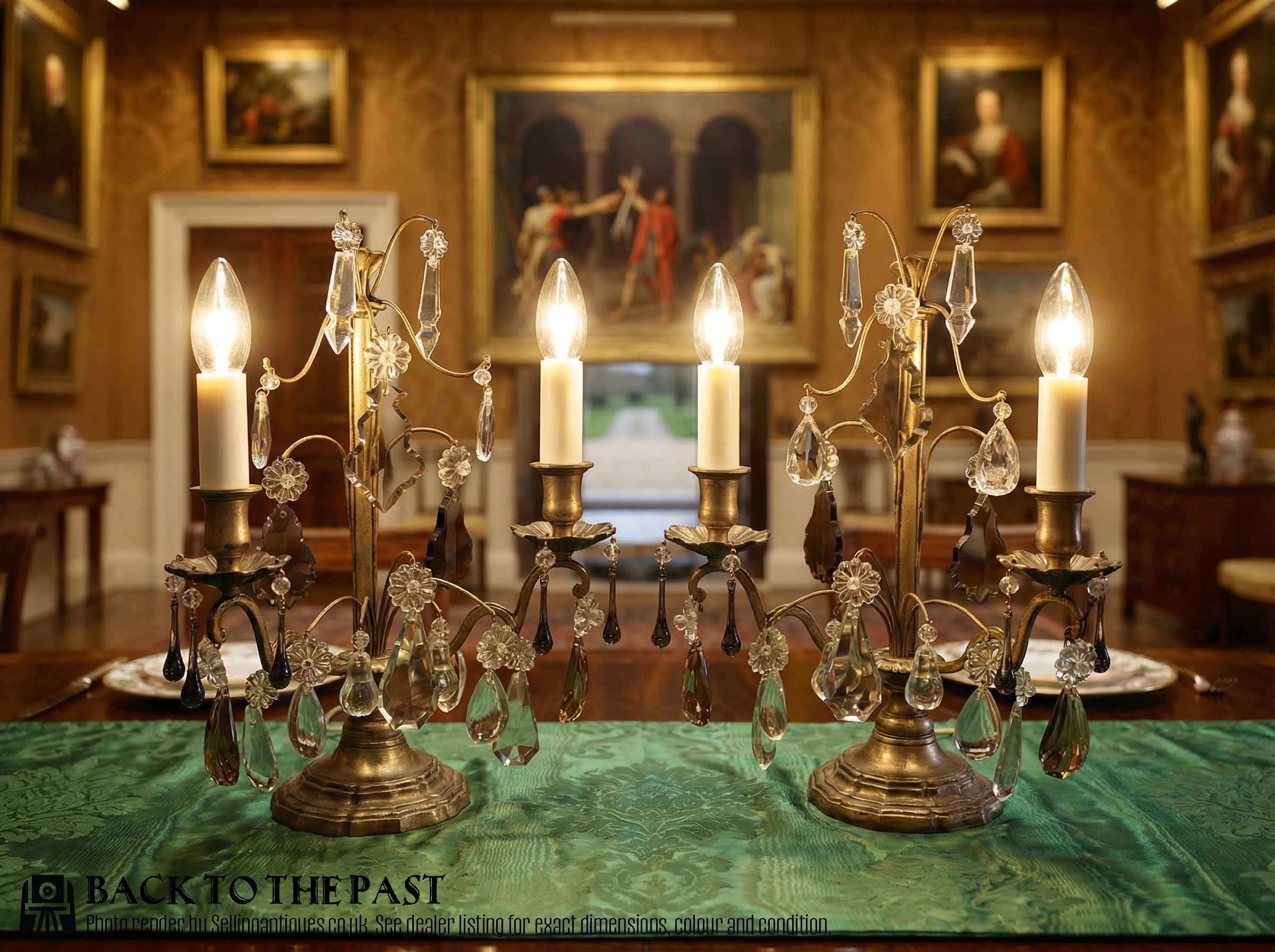
French Crystal Candelabra
When you search for French crystal candelabra, you are looking at branched candleholders, girandoles and table lustres that combine heavy metal mountings with prisms, pendants and drops of cut glass. The versions you will most frequently meet on this page date from the nineteenth and early twentieth centuries, spanning periods from Regency and Louis XVI style through to later gilded and silvered brass designs.
Many of these pieces take the form of paired table lamps or multi-armed candelabra, while others appear as wall sconces or hanging chandeliers equipped with cut glass drops. They draw on French Rococo, Empire and Chateau aesthetics, bringing together cast bronze, ormolu, brass and marble with sparkling crystal elements.
Materials and construction
Makers built these pieces around robust metal frames of cast brass, gilt-brass, ormolu and bronze, often integrating green marble bases or silvered metal details. The structural arms and backplates were cast and chased before being polished or gilded to hold the weight of the candle sockets.
The characteristic sparkle comes from suspended elements of cut crystal and glass, including teardrop pendants, beads and lustres wired or pinned directly to the metalwork. These transparent drops refract the flame of candles or the light from early electric fittings.
Listings feature periods spanning from Regency and Edwardian eras through to 1930, utilising materials such as cut glass, ormolu, gilt-brass and green marble.
What separates the finest examples
Quality in these pieces rests upon the crispness of the casting in the ormolu or gilt-bronze mounts and the depth of hand-cutting in the crystal drops. Heavier, more detailed chasing on figural elements such as stags, cherubs or rococo scrollwork denotes a finer workshop hand.
The completeness and integrity of the glass hanging drops also set standards, alongside the weight and stability of the underlying brass or bronze frames. Finer candelabra show deliberate proportion between the metal structure and the quantity of suspended crystal.
The French Crystal Candelabra Glossary
- Candelabra
- A branched candlestick designed to hold multiple candles at once. They often feature central shafts decorated with crystal drops.
- Lustre
- A candelabra, candlestick or lamp hung with cut glass pendants that reflect and multiply the light. They were popular in grand interiors throughout the nineteenth century.
- Ormolu
- Gilded bronze used extensively for decorative mounts on nineteenth-century French metalwork. It provides a warm, durable gold-coloured surface.
- Girandole
- A branched wall sconce or table candelabra featuring mirrors or reflective crystal elements to enhance the illumination. They often appear paired in domestic settings.
- Birdcage
- A style of chandelier or candelabra framework constructed with concentric rings and vertical wires supporting tiers of crystal drops. This open metal cage creates a tiered cascading effect.
French Crystal Candelabra: Frequently Asked Questions
How do I clean crystal drops?
Remove the crystal pendants gently from the metal frame if possible, or clean them in situ using a mild solution of warm water and a little washing-up liquid. Wipe each piece dry with a lint-free cloth to restore the sharp refraction without stressing old wire fixings.
Take care not to submerge or wet the gilt brass or ormolu mounts directly, as moisture can damage old gilding. A soft dry brush works best for dusting the intricate cast metalwork between the glass elements.
Were these pieces electrified later?
Many surviving examples have been adapted to electricity over the decades, converting original candle sockets into table lamps or wiring them as small chandeliers. Such conversions range from simple concealed cords to more integrated fittings added during the twentieth century.
Collectors often encounter both unadapted candle-bearing candelabra and electrically converted table chandeliers on the market. Checking the wiring configuration helps determine whether a piece retains its original setup or has been altered for modern use.
How do I identify a Louis XVI style piece?
Louis XVI style pieces rely on classical restraint, symmetry and straight lines rather than the exuberant asymmetrical curves of earlier Rococo designs. You will often see architectural motifs, urns, swags and beaded borders cast into the brass or ormolu mounts.
This aesthetic returned to popularity during the nineteenth century, meaning many pieces carrying these motifs date from that later revival era rather than the eighteenth century itself. The presence of crisp cast brass and machine-cut crystal usually points to these nineteenth-century manufacturing methods.
Where should I place a candelabra?
These pieces suit positions where natural light or evening illumination can catch the cut glass drops, such as on a dining sideboard, a mantelpiece or a central hall table. Pairs look particularly balanced when arranged symmetrically on either side of a mirror or fireplace.
Because many examples are heavy and feature delicate hanging lustres, they require a stable surface away from busy household traffic. Wall-mounted sconces need secure fixings into solid masonry or studwork to support the combined weight of metal and crystal.