
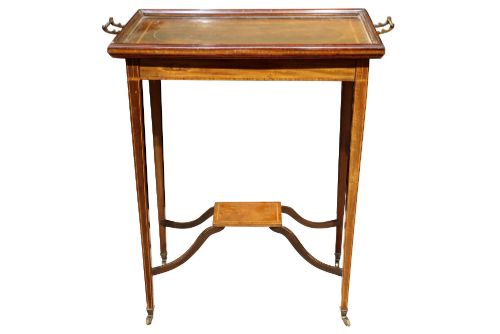
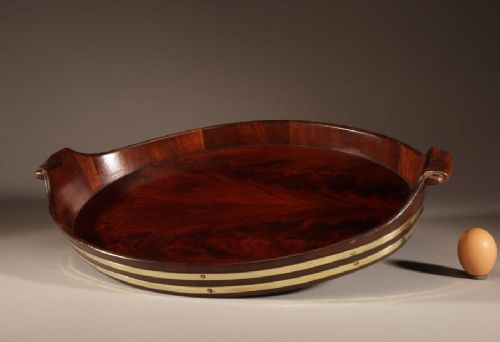


Brass Gallery Server
A brass gallery server brings fine timbers and gleaming metalwork together to anchor a dining room or hall with quiet authority.
Brass Gallery Server
When you search for a brass gallery server, you are looking at substantial case furniture designed for the dining room or hall, where a raised metal rail holds items securely in place during service. The pieces on this page span the Georgian, Regency, Victorian, and Edwardian periods, taking the form of sideboards, serving tables, and occasional pieces.
Mahogany is the dominant timber across these listings, often enriched with satinwood, rosewood, burr walnut, or boxwood inlay. Servers appear in straight, bow front, and serpentine shapes, reflecting shifts in taste from the eighteenth century through to the revival styles of the late nineteenth and early twentieth centuries.
How They Were Made
Cabinetmakers constructed these servers using solid primary timbers and secondary woods, employing frame and panel methods for stability. Surfaces were frequently veneered with figured mahogany or exotic woods, then hand-polished to a deep lustre.
Brass galleries were cast, turned, or shaped into spindles and rails, then fitted securely into the top surface of the timber. Inlaid details utilised contrasting woods such as boxwood and satinwood, meticulously cut and set by hand into precise channels.
Form variations include sideboards, serving tables, drinks tables, and occasional tray top tables fitted with brass galleries.
What Varies in Quality
The quality of a brass gallery server rests on the selection of timber and the precision of its construction. Highly figured mahogany veneers and delicate, well-executed string inlay distinguish the finest examples from plainer utility pieces.
The weight, casting quality, and integrity of the brass gallery itself mark the difference between standard production and superior craftsmanship. Original fittings that remain firm and well-integrated indicate a higher grade of manufacture.
Gillows·Mack Williams And Gibton·Howard And Sons·H Mower And Stephenson
The Brass Gallery Server Glossary
- Brass gallery
- A low metal rail or fence fitted to the top surface of a serving piece. It prevents dishes and glassware from sliding off during use.
- Server
- A form of side table or sideboard intended for holding food, drink, and tableware during a meal. These pieces often feature shallow depths compared to full dining sideboards.
- Inlay
- A decorative technique where contrasting materials are set into hollowed-out portions of the wood base. Common examples include boxwood lines and satinwood shells.
- Serpentine
- A front profile that curves outward in the centre and inward towards the ends, creating a flowing, undulating line. This shape demands high skill from the cabinetmaker.
- Pedestal sideboard
- A form featuring distinct flanking pedestals joined by a central table section, popular during the Georgian and Regency periods.
Brass Gallery Server: Frequently Asked Questions
What is a brass gallery server?
A brass gallery server is a dining room or hall piece equipped with a raised metal rail around the top surface. It combines storage with a secure top for displaying silver and serving dishes.
These pieces range from formal Georgian serving tables to Edwardian occasional designs, uniting practical function with decorative woodwork.
How do I date a mahogany server?
Dating relies on observing the timber choice, construction methods, and prevailing decorative style of the period. Regency pieces often display bold rosewood veneers, while Georgian examples lean towards solid figured mahogany.
Secondary woods inside drawers and the style of the brass gallery provide further clues to the decade of manufacture.
Where should I place a server?
A server suits dining rooms, large hallways, or drawing rooms where surface space and subtle storage are required. Their shallow footprint allows them to sit comfortably against walls without dominating the room.
The brass gallery makes them particularly useful for holding bottles and glassware safely.
Are these pieces suitable for daily use?
These servers were built to withstand active household service and remain robust functional items today. Routine care involves simple dusting and occasional wax polishing to protect the timber surface.
Care should be taken with the brass gallery to maintain its integration with the wood top.