




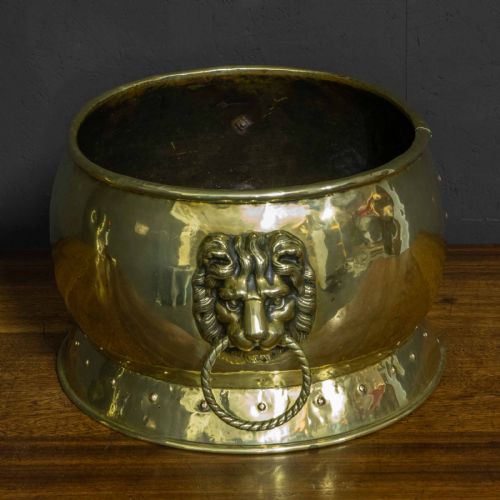
Brass Firewood Container
A brass firewood container brings heavy metal warmth to a hearth, combining practical fuel storage with decorative presence.
Brass Firewood Container
A brass firewood container serves as a sturdy receptacle for logs and kindling beside the fireplace. The pieces gathered under the brass firewood container heading span the nineteenth and early twentieth centuries, encompassing Victorian examples and Arts and Crafts productions.
Most entries take the form of log bins, buckets, coal receivers, and jardiniere vessels. Makers utilised brass alongside copper, iron, and tin to fashion these robust hearth accessories.
How they were made
Artisans constructed these vessels using heavy sheet brass and copper, frequently employing riveted joints to secure the body and handle attachments. Metal panels received hand embossing or hammering to create surface decoration.
Many examples incorporate contrasting metal bands, such as copper bands around brass bodies or iron handles, demonstrating careful assembly for daily hearth utility.
Brass Firewood Container Retail Price Guide 2026
Typical asking prices for brass firewood container among the pieces listed under this phrase on Sellingantiques today, from the lower quarter to the upper quarter. They describe what is for sale here now, not the wider market.
What varies in quality
Quality rests in the thickness of the metal sheet and the integrity of the riveted construction. Finer examples display crisp, hand-embossed detailing rather than flat, machine-pressed surfaces.
Proportion and the weight of handles and bases separate standard utility items from more ambitious decorative vessels intended for prominent Victorian drawing rooms.
Henry Loveridge
The Brass Firewood Container Glossary
- Log bin
- A deep vessel designed specifically to hold firewood beside a hearth. These containers often feature reinforced rims and sturdy carrying handles.
- Embossing
- A technique where a pattern is raised in relief from the reverse side of the metal sheet. This creates decorative surfaces on nineteenth-century vessels.
- Riveting
- A method of joining metal plates by inserting a pin through overlapping sheets and hammering the end flat. It provides both structural strength and visual detail.
- Jardiniere
- An ornamental pot or container originally intended for plants, frequently adapted as a log bucket or coal receiver.
Brass Firewood Container: Frequently Asked Questions
How do I clean a brass firewood container?
Use a soft cloth and mild soapy water to remove dust and soot from the surface. Avoid harsh chemical cleaners that strip the historic patina.
Dry the metal thoroughly after washing to prevent spotting. Let natural handling maintain the aged character of the brass.
Can I actually put logs inside these containers?
These vessels were built for domestic fuel storage and easily hold firewood. The robust metal construction withstands the weight of heavy logs.
Lay logs in carefully to avoid denting the interior base. Keep the interior dry to prevent moisture damage.
What is the difference between a log bin and a coal scuttle?
Log bins are generally open-topped cylindrical or bucket-shaped vessels designed for stacking wood. Coal scuttles often feature angled mouths and specific spouts for pouring small fuel.
Log bins prioritize capacity and stable bases. Coal scuttles focus on controlled fuel delivery to the grate.
How do I date a Victorian brass log bin?
Examine the construction methods, particularly the rivets and handle mounts. Hand-hammered surfaces and heavy copper banding typically indicate nineteenth-century manufacture.
Compare the decorative motifs against established Victorian and Arts and Crafts design periods. Makers marks, where present, offer definitive production eras.