
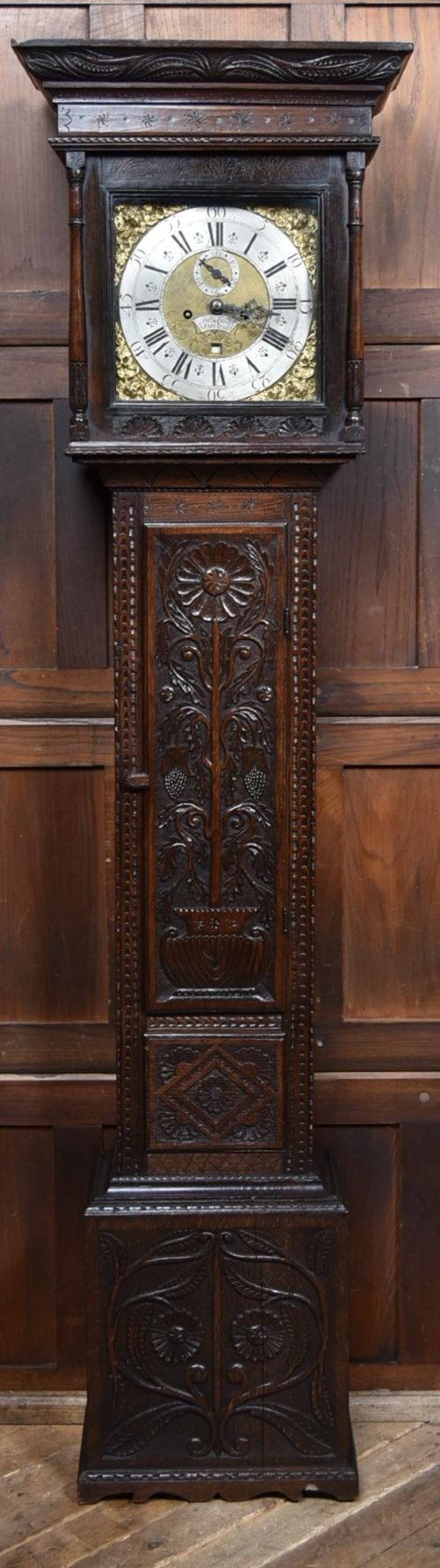
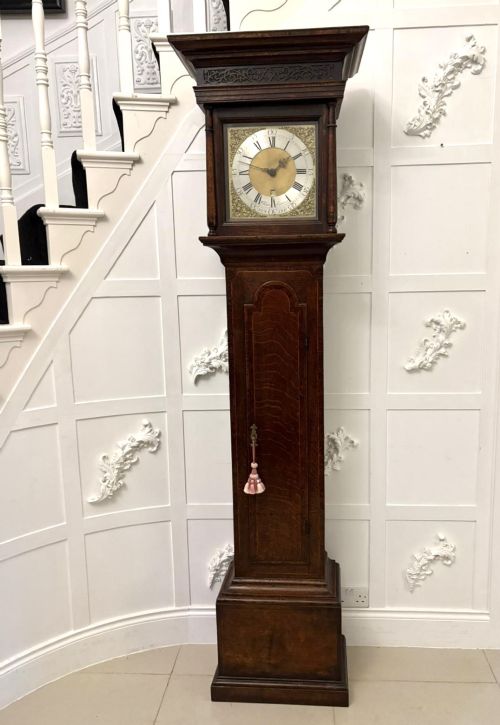


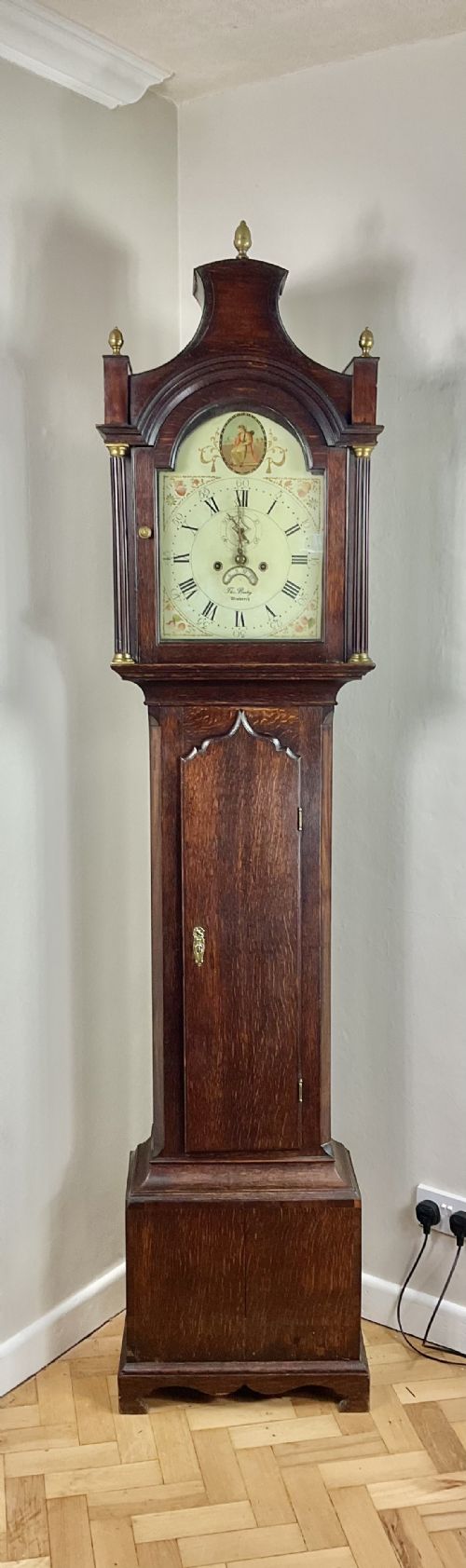


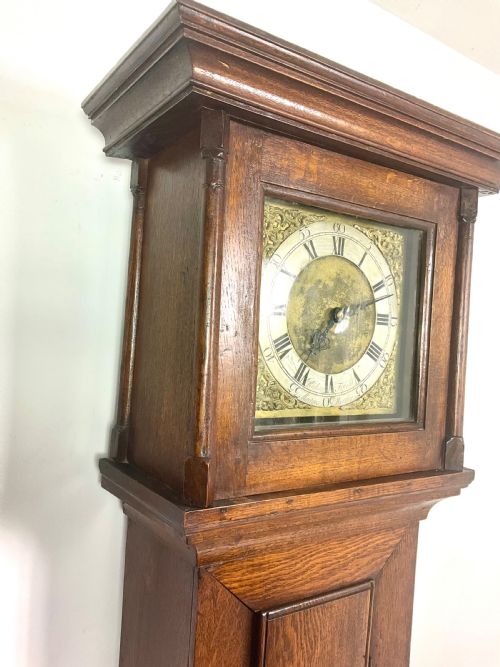


Brass Face Tall Clock
These brass face tall clock examples are substantial timekeepers in wood cases, prized for their traditional regional movements and brass dials.
Brass Face Tall Clock
A brass face tall clock is a tall floor-standing timepiece housing an exposed brass dial within a wooden enclosure. The form spans the eighteenth and nineteenth centuries, including pieces from the Georgian and George III periods alongside later revivals.
The versions most commonly met on this page are constructed from oak, mahogany, or walnut. Makers ranged from provincial English towns to Dublin, Macclesfield, and Scottish burghs, marking their dials with regional pride.
Cases vary from small slim proportions to taller architectural formats. Regional cabinet-making traditions dictate the choice of timbers, such as burr oak, red walnut, or standard oak.
What varies in quality
Quality rests in the harmony of the timber selection and the precision of the brass dial engraving. Pieces utilising burr oak, walnut, or red Walnut demonstrate greater ambition in material choice.
The partnership between the maker's signature on the dial and the execution of the timber case defines the standing of the piece. Regional variations show distinct local standards in carving and proportion.
Several makers squeezed their entire workshop reputations onto a single brass plate, leaving their hometowns immortalized in metal.
Jn° Smith Macclesfd·William Betagh Dublin·David Morice·Samuel Young·John Pollard of Crediton·Robert Thomson·George Clapham·Jonathan Blake Fulham·Thomas Baker·Samuel Whalley·Richard Watkin
The Brass Face Tall Clock Glossary
- Longcase clock
- An alternative term for a tall floor-standing clock housed in a wooden case. These pieces are also frequently described as grandfather clocks.
- Brass face
- The visible dial plate constructed from brass, typically featuring engraved chapter rings and maker details. This metal surface provides the primary visual focus of the clock.
- Eight day
- A movement type requiring winding once a week. This indicates a more complex gear train than thirty-hour variants.
- Fusee
- A conical pulley mechanism used in some movements to maintain even driving force as the mainspring unwinds. It represents a higher grade of clockwork engineering.
- Grandmother clock
- A smaller scale version of the traditional tall clock. These reduced proportions suit lower ceiling heights while retaining standard mechanical functions.
Brass Face Tall Clock: Frequently Asked Questions
How do I wind a tall clock?
Winding involves using a key to draw up the weights or wind the springs inside the trunk. Care must be taken not to overwind the movement.
Consult the specific mechanism type to determine whether it requires daily, weekly, or monthly attention.
Where should I place a tall clock?
Position the piece against a sturdy interior wall away from direct sunlight and major heat sources. Stable temperatures prevent timber movement in the case.
Ensure the floor surface is level so the pendulum swings evenly and keeps accurate time.
How do I identify the period?
Examine the timber species, case proportions, and dial engraving style. Eighteenth-century examples often feature simpler oak construction while later pieces introduce mahogany and walnut.
Maker signatures on the brass dial provide a direct link to historical records and working dates.
What is the difference between a grandfather and grandmother clock?
Grandfather clocks are standard full-height tall clocks designed for high ceilings. Grandmother clocks are smaller scaled variants built to a reduced height.
Both use the same basic mechanical principles and brass dial configurations.