


Brass Castor Games Table
These brass castor games tables combine folding tops and mobility, offering formal hospitality and evening entertainment during the Regency and Georgian periods.
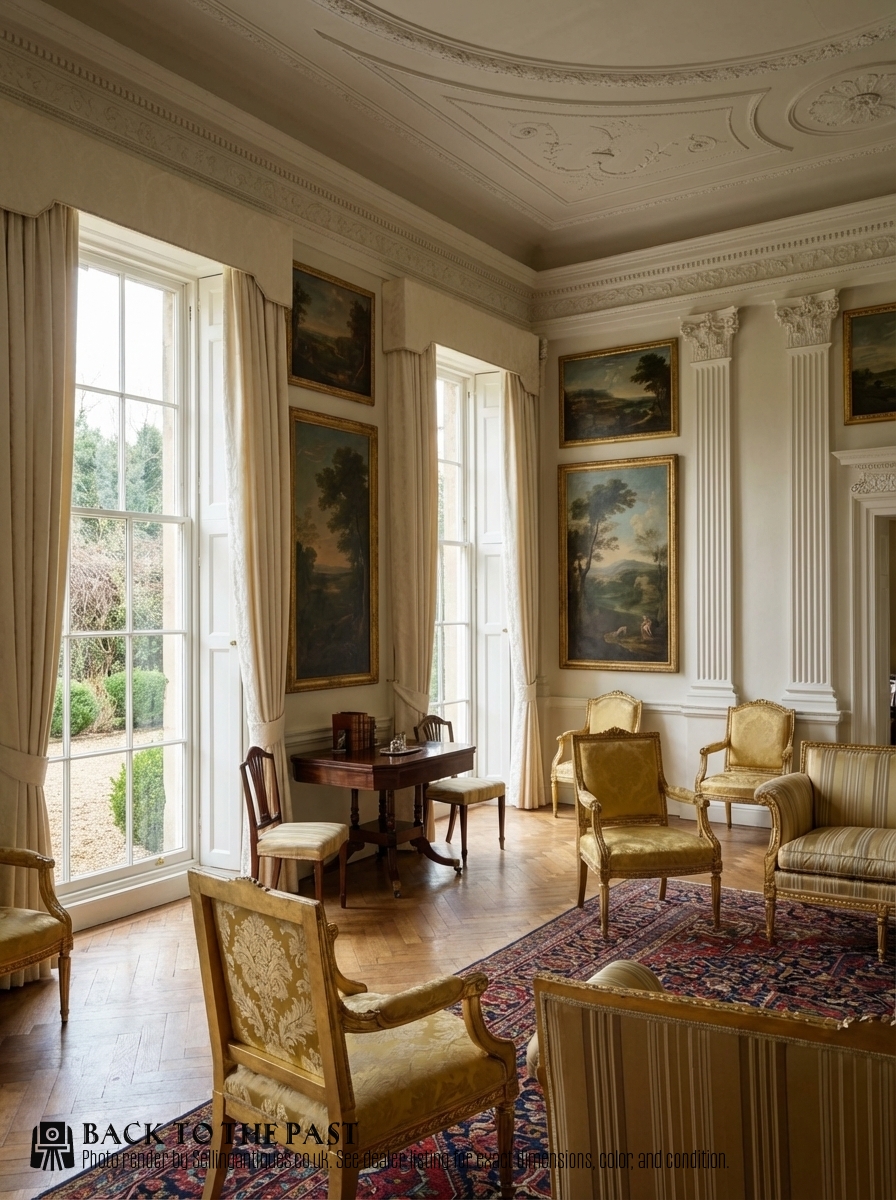
Brass Castor Games Table
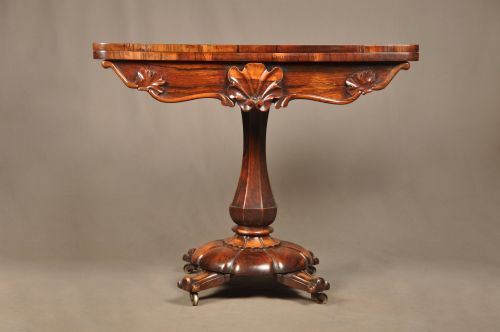
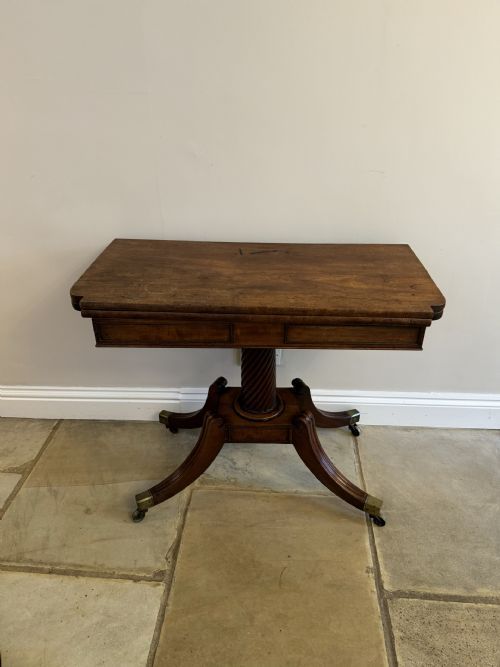
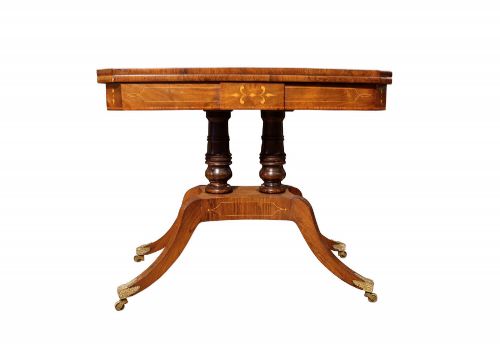
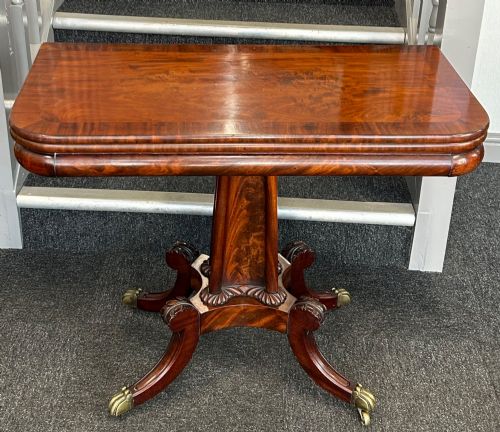
A brass castor games table sits primarily within the Regency and Georgian periods, manifesting as card tables, tea tables, and fold-over occasional pieces. The most common version met on this page is the fold-over card table in mahogany or rosewood, supported on pedestal bases or pillars fitted with brass castors.
Makers adapted these versatile surfaces for dual purposes, serving as tea tables by day and card tables by night. Side tables and console tables appear alongside pairs of tables designed to stand symmetrically in a reception room.
The design vocabulary draws heavily upon Sheraton Revival, William IV, and Grand Regency styles, demonstrating how makers balanced practical utility with formal elegance.
Materials and Construction
Working surfaces frequently incorporate wool baize or lined interiors designed for card playing, concealed beneath hinged fold-over tops that pivot or rotate to open. Cabinetmakers employed solid construction methods alongside figured veneers to create stability in tables that needed to move easily on their brass castors.
Periods represented span from Georgian and Regency eras through to William IV and later Sheraton Revival interpretations.
Craftsmanship and Material Selection
The distinction between tiers of quality rests upon the selection of timber figures, such as highly grained rosewood or figured mahogany, paired with refined brass inlay rather than simple painted lines. Superior examples display precise cabinetwork in the pivoting mechanisms of fold-over tops and the crispness of inlaid ebony and boxwood stringing.
Proportion and decorative restraint dictate the standing of a piece, where restrained brass sabots and well-turned pedestals elevate an item above simpler utilitarian versions.
William Trotter of Edinburgh·Gillows
The Brass Castor Games Table Glossary
- Brass castor
- A small swivelling wheel mounted in a brass housing attached to the foot of a table leg, allowing smooth movement across carpets and floors. They became standard on many formal tables of the Regency period.
- Fold-over top
- A hinged tabletop that doubles the surface area when opened out, commonly found on card and tea tables to conceal the baize-lined playing surface when closed.
- Wool baize
- A dense, durable woven wool fabric used to line the playing surfaces of card tables, providing a soft texture for handling cards.
- Sabot
- A decorative or protective brass mount fitted to the foot or lower section of a furniture leg.
- Stringing
- Thin inlaid lines of contrasting timber, such as ebony or boxwood, used to outline panels and edges on tabletops and friezes.
Brass Castor Games Table: Frequently Asked Questions
What is a brass castor games table?
A brass castor games table is a fold-over surface designed for cards or tea, mounted on wheels for mobility around a drawing room.
These pieces date predominantly from the Georgian and Regency periods, constructed in timbers like mahogany and rosewood.
How were these tables used originally?
Owners used them for evening card games such as whist, utilising the fold-over top to save space during the day.
They doubled as tea tables or side tables when closed against a wall.
How do I identify a Regency table?
Regency tables display classical proportions, dark timbers like rosewood and mahogany, and brass inlay or brass castor mounts.
Stylistic cues include Sheraton Revival influences and ebony stringing details.
Can I use a card table every day?
These tables function well for daily use if the hinges and folding mechanisms are handled with care.
The brass castors allow the table to move without straining the joints.