
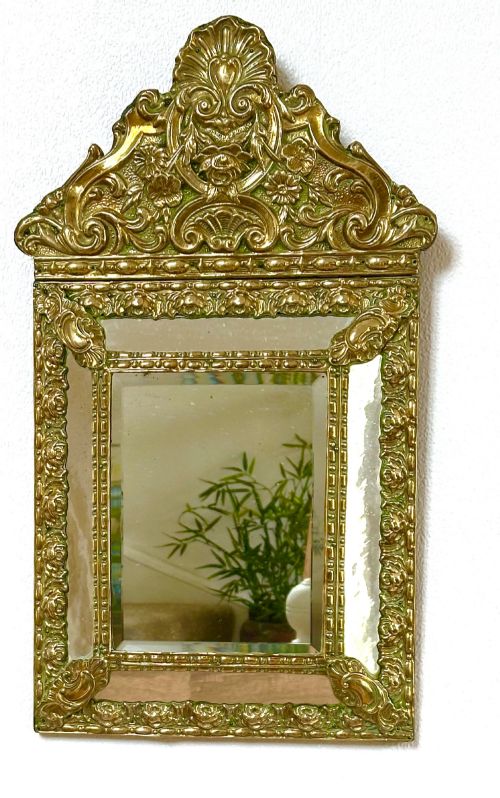
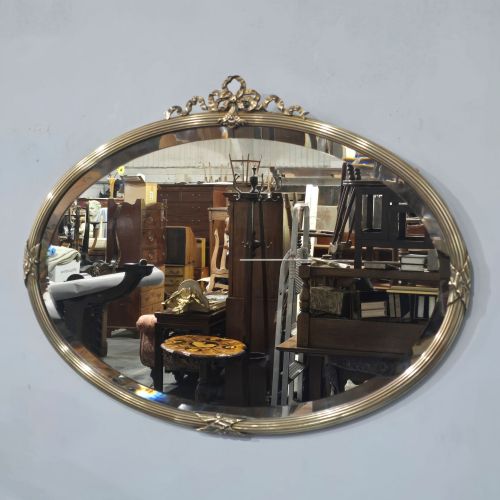


Brass Bevelled Mirror
A brass bevelled mirror brings weight and sharp reflection to a room, combining heavy cast or spun metal with thick, angled glass.
Brass Bevelled Mirror
A brass bevelled mirror draws the eye through its heavy metal frame and distinctively angled glass edge, appearing across Victorian, Edwardian, and later twentieth-century periods. These pieces take many forms, from wall-hanging ovals and circles to dressing table mirrors, fire screens, and standing cheval mirrors.
Victorian examples dominate the selection, often featuring embossed cushion frames or cast brass mounts. Alongside these, Edwardian and Art Nouveau variants introduce beaten surfaces and flowing floral motifs into domestic halls and parlours.
The evidence shows forms that serve practical domestic roles, such as hall stands and table mirrors, alongside decorative wall pieces. Makers also utilised alternative supports like mahogany and leather to mount the brass and glass plates.
Materials and construction
Makers constructed these pieces using heavy brass frames, frequently cast, embossed, or hand-beaten to create texture around the glass. The metal supports house thick mirror glass, cut with a sloping bevel along the perimeter to catch the light.
Wood and leather occasionally back or frame the metal components, with mahogany appearing alongside giltwood and base metals. Structural elements often include brass hooks, pins, and cast mounts to secure the heavy glass plates safely within their surrounds.
Assessing quality in metal and glass
Quality rests on the depth of the metalwork and the clarity of the glass. Finely cast or deeply repoussé brass frames show crisp detail in the motifs, whereas simpler stamped metal lacks that same physical presence.
The bevel on the glass plate itself distinguishes standard production from finer work. A wide, clean-angled bevel reflects light evenly and requires skilled hand-grinding, marking out the better examples in any collection of these mirrors.
The Brass Bevelled Mirror Glossary
- Bevel
- The sloping edge ground along the perimeter of the mirror glass. This angled cut catches and refracts light differently than a flat edge.
- Repoussé
- A metalworking technique where the brass is hammered from the reverse side to form a raised design on the front. This appears frequently on Edwardian and Arts and Crafts frames.
- Cushion mirror
- A frame style with a rounded, pillowed profile that swells outward toward the edge. These often feature brass mounts and corners.
- Girandole
- A decorative wall mirror fitted with one or more candle sconces attached to the frame. The brass or gilt arms reflect the candlelight across the room.
- Cheval mirror
- A freestanding full-length mirror suspended within a vertical frame. They allow the glass to tilt on pivot pins.
Brass Bevelled Mirror: Frequently Asked Questions
How do I date a brass mirror?
Dating relies on the style of the frame and the mounting techniques used at the back. Victorian and Edwardian pieces often show distinct cast brass motifs or hand-beaten Arts and Crafts details.
Later pieces from the Art Deco period introduce circular geometry and streamlined metal frames. Examining the type of screw fixings and the backing boards helps narrow down the era.
Where should I hang a heavy brass mirror?
These mirrors require solid fixings into wall studs or masonry because the cast brass and thick bevelled glass add considerable weight. Hallways and fireplace mantels provide traditional settings that support their visual heft.
Ensure the hanging wire or integrated brackets match the weight of the specific frame. Secure wall anchors prevent the piece from shifting over time.
Can I use a fire screen mirror?
Fire screen mirrors served originally to block unlit hearths during warmer months while reflecting light into the room. Today, they function well as floor-standing decorative accents.
Their sturdy feet and protective brass or wooden frames allow them to stand independently against a wall or in an empty fireplace recess.