


Bowed Front Writing Table
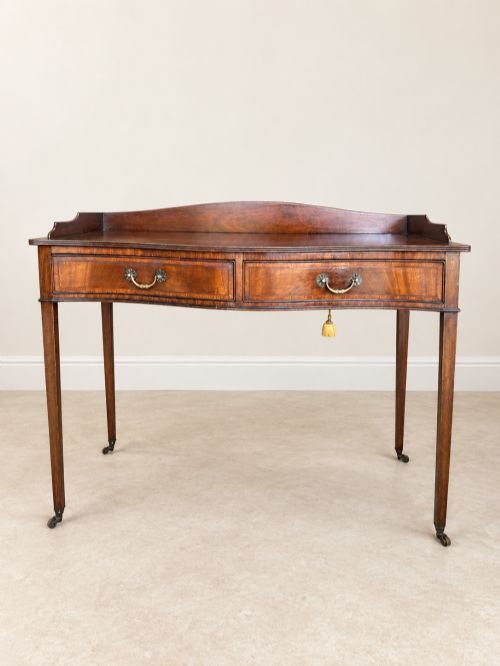
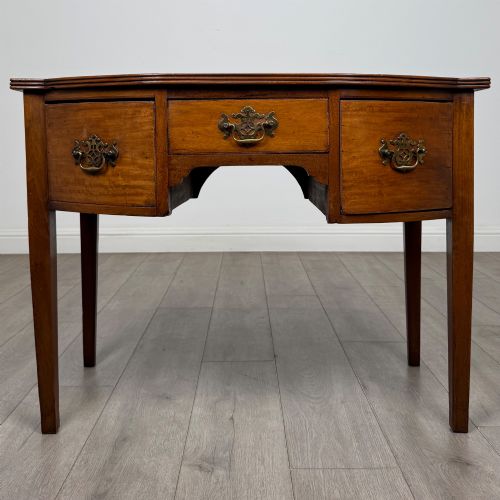
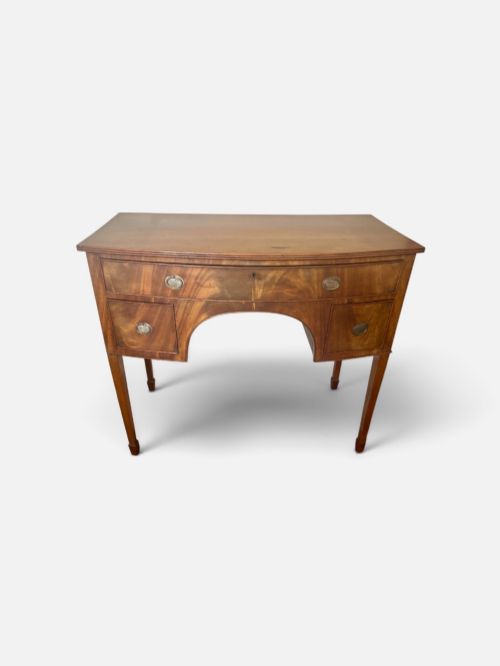
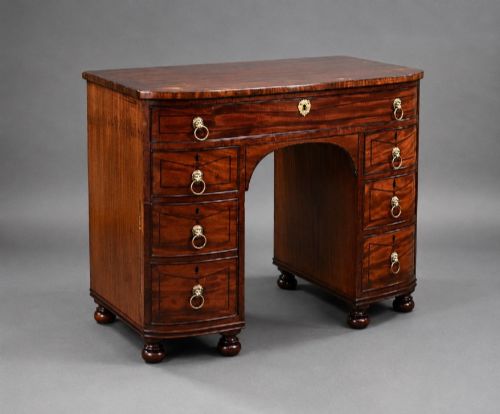
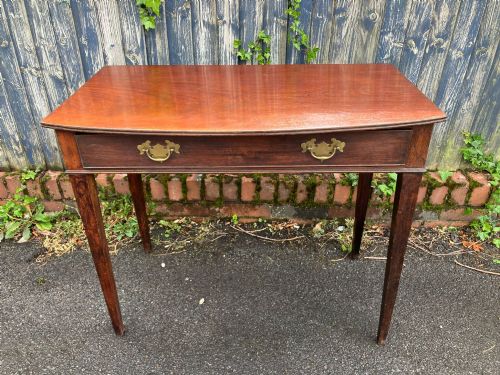
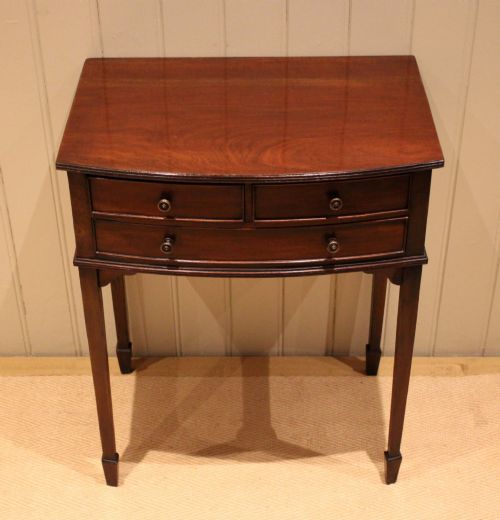
These bowed front writing table pieces offer curved mahogany lines and drawers, serving as practical desks or side tables for daily study.
Bowed Front Writing Table
A bowed front writing table brings a curved mahogany facade to domestic study spaces, appearing across Georgian, Regency, Victorian, and Edwardian periods. These versatile items function as writing desks, dressing tables, side tables, or console tables depending on their specific construction and drawer configuration.
The pieces on this page span genuine 18th-century Georgian examples alongside later 19th-century interpretations, Edwardian pieces, and revival items from the early 20th century. Forms range from simple single-drawer side tables to multi-drawer desks, dressing chests, and occasional sideboard variants.
Materials and Construction
Makers built these pieces primarily from solid mahogany and flame mahogany veneer, occasionally incorporating burr walnut for distinct surface grain. Boxwood and ebony stringing, along with general wood inlay, decorate the drawer fronts and borders on revival and Sheraton Revival pieces.
Functional details include brass hardware for handles and pulls, leather writing inserts on desk surfaces, and inset marble tops on specific 19th-century variants. Joinery adheres to period standards, accommodating the curved front profile through specialised bending and veneering techniques.
Maples provided marble tops for tables, proving Victorians liked to mix cool stone with warm mahogany.
Evaluating Quality and Craftsmanship
Quality rests upon the selection of timber, particularly the depth of the flame mahogany veneer and the precision of the boxwood or ebony inlay. Superior examples display careful alignment of the curved drawers and crisp execution of period details rather than heavy-handed restoration.
The integrity of the internal drawer construction and the original condition of brass hardware and leather inserts dictate the standing of an individual piece. Finer items balance structural utility with refined proportions across the curved front.
Maples
The Bowed Front Writing Table Glossary
- Bow front
- A convex curved front cabinet or table design that projects outward in an arc. This shape softens the room and provides extra depth in the centre of the piece.
- Flame mahogany
- A veneer cut from the branch junction of a mahogany tree, creating a distinctive flamed or feathered grain pattern. Cabinet makers prize this figure for decorative drawer fronts.
- Stringing
- Thin inlaid lines of contrasting timber, such as boxwood or ebony, used to outline panels and drawers. It defines the geometric borders on Sheraton Revival and inlaid pieces.
- Pedestal desk
- A heavy freestanding writing desk supported by two pedestals containing banks of drawers. Twin pedestal versions offer substantial storage beneath the writing surface.
Bowed Front Writing Table: Frequently Asked Questions
How do I date a bowed front writing table?
Dating relies on identifying the secondary timbers, construction methods, and characteristic styling of periods like Georgian, Regency, or Edwardian production. Details such as inlay patterns and hardware provide further clues to age.
Compare the drawer linings and overall proportions against known period examples to confirm whether an item dates to the 18th century or is a later revival piece.
What is the difference between a writing table and a dressing table?
Writing tables focus on a flat surface and drawers for correspondence, while dressing tables historically incorporated compartments or were paired with mirrors for personal grooming.
Many surviving pieces served dual purposes over their lifetimes, meaning surface wear and internal drawer layouts guide their current attribution as desks or dressing furniture.
How do I care for a mahogany writing table?
Protect the polished mahogany and leather surfaces by keeping the table away from direct sunlight and excessive heat sources that cause wood to warp and leather to crack. Regular dusting with a soft cloth maintains the finish.
Apply quality beeswax sparingly when the timber appears dry, avoiding modern silicone sprays that damage antique polish over time.
Are these tables suitable for daily use?
Most of these mahogany tables offer sturdy construction and functional drawers that easily accommodate modern writing implements, laptops, or daily administrative tasks. Their compact footprints suit various room layouts.
Take care with leather inserts by using blotters and coasters to prevent moisture rings or ink stains on the writing surface.