


Bow Front Wardrobe
A bow front wardrobe offers curved grandeur and generous storage, combining practical capacity with striking neoclassical or modernist silhouettes.
Bow Front Wardrobe
A bow front wardrobe delivers a projecting, convex curved front that softens the substantial mass typically associated with tall bedroom storage furniture. When you search for this phrase, you encounter large architectural pieces designed to command a room while offering deep internal capacity.
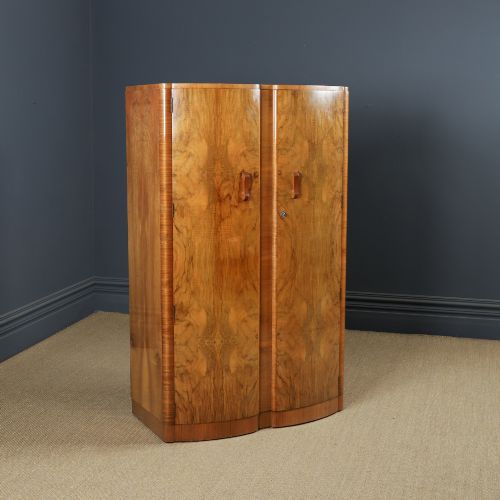
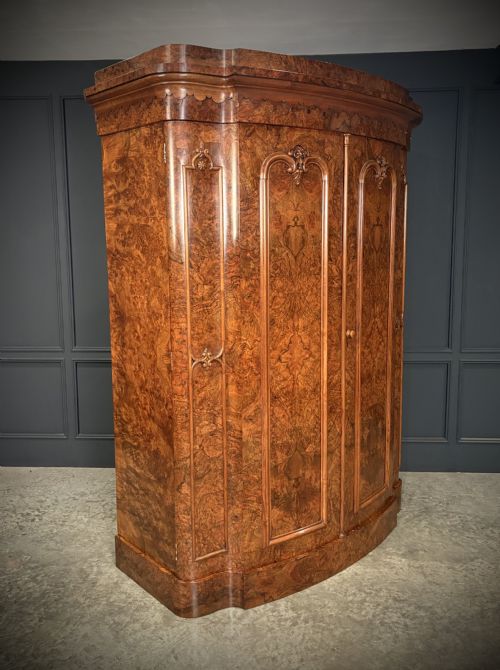
The selection ranges from Georgian flame mahogany originals and Victorian multi-door compactums to Edwardian inlaid satinwood examples and 1930s Art Deco burr walnut designs. On this page, you are most likely to meet Edwardian mahogany iterations alongside substantial early twentieth century walnut models.
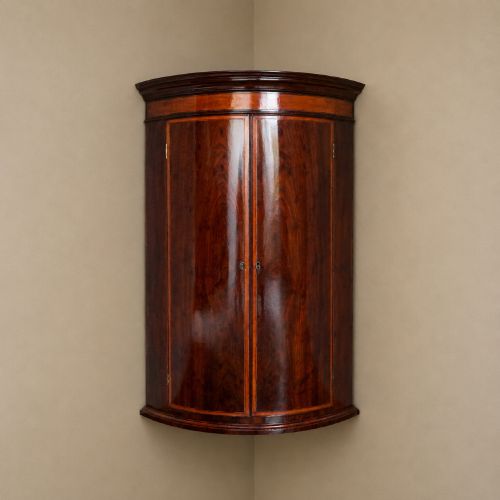
Beyond standard double and triple door wardrobes, the broader category encompasses hanging corner cabinets, linen presses, and compact gents' fitted compartments. Each variant utilises the signature convex curve to catch light and break up the flat planes of a traditional bedroom interior.
Materials and construction
Cabinet makers constructed these curved carcasses using solid timbers like mahogany or walnut as a stable structural base, overlaid with decorative veneers including flame mahogany, burr walnut, and figured walnut. Achieving the distinctive convex sweep required specialist steam bending or multi-layered laminating techniques before applying the face veneers.
Fine details such as boxwood stringing, brass handles, and mirror doors frequently complement the primary timber surfaces. The interior fittings often incorporate solid oak or mahogany drawer boxes, sliding linen trays, and hanging rails tailored to the specific period of manufacture.
The listings span eight distinct decades of cabinet making, ranging from 1780s George III designs to 1930s Art Deco creations.
Evaluating craftsmanship and condition
The distinction between standard commercial output and superior craftsmanship rests in the selection and book-matching of decorative veneers across the curved doors. Master cabinet makers aligned grain patterns meticulously so that the sweeping facade appeared balanced and continuous.
Structural integrity in a curved piece depends entirely on how the carcase timbers respond to humidity over decades. Finer examples retain smooth-running drawers, unwarped doors that close flush against the curved frame, and original brass hardware without excessive replacement.
Gillows·Heals·Maples & Co·Waring & Gillows
The Bow Front Wardrobe Glossary
- Bow front
- A convex, outwardly curved front elevation that projects forward from the corners of the cabinet. This contour defines the primary aesthetic of the furniture.
- Flame mahogany
- Timber veneer sliced from mahogany logs where the grain creates a distinctive, flame-like pattern with shimmering light refraction. It was heavily favoured across Georgian and Edwardian cabinet making.
- Burr walnut
- Wood harvested from walnut tree growths or burls, yielding intricate, swirling grain patterns filled with knots and eyes. It provides a luxurious surface texture on Art Deco and Edwardian pieces.
- Linen press
- A tall storage piece featuring upper sliding trays or shelves enclosed by doors, positioned above a chest of lower drawers. They served originally to store folded linens flat before hanging clothes became standard.
- Compactum
- A multi-functional wardrobe designed to combine hanging space, drawers, shelves, and sometimes shoe racks within a single integrated unit. They represent late Victorian and Edwardian efficiency in bedroom furniture.
- Stringing
- Fine, contrasting lines of inlay, often made from boxwood, embedded into the primary timber surface to create geometric borders and panels.
Bow Front Wardrobe: Frequently Asked Questions
How do I fit a heavy wardrobe?
Most large wardrobes of this scale dismantle into distinct sections, including the cornice, base, and side carcases, to ease transport and assembly in upper rooms. Careful leveling on site ensures the curved doors hang evenly and latch correctly.
Professional delivery and installation teams usually handle the bolting together of structural carcases to protect fragile walnut or mahogany veneers from accidental strain.
What fits inside these historical pieces?
Interiors vary significantly depending on the decade of manufacture, with older Georgian presses featuring sliding trays for folded textiles while Edwardian and Art Deco editions prioritize vertical hanging space. Many incorporate fitted compartments, tie racks, and internal shoe storage.
Buyers planning to use them for modern clothing should check internal depths, as antique hangers can occasionally prove too wide for shallow Georgian carcases.
How do I date a curved wardrobe?
Stylistic markers offer clear chronological clues, such as the symmetrical satinwood inlay typical of Edwardian pieces versus the bold, unadorned burr walnut veneers characteristic of 1930s Art Deco design. Construction methods, drawer linings, and internal locking mechanisms also help narrow down the decade.
Examining the backboards and screw types provides further confirmation, as machine-sawn timber and Phillips screws point firmly towards twentieth century production.
Can I place one in a modern bedroom?
The warm tones of polished mahogany and figured walnut complement contemporary neutral interiors by adding organic texture and historical contrast. Their imposing height and curved facades work particularly well as focal points against plain walls.
Sizing requires careful measuring of ceiling heights and floor space to accommodate the swinging arc of the doors and the convex projection into the room.