

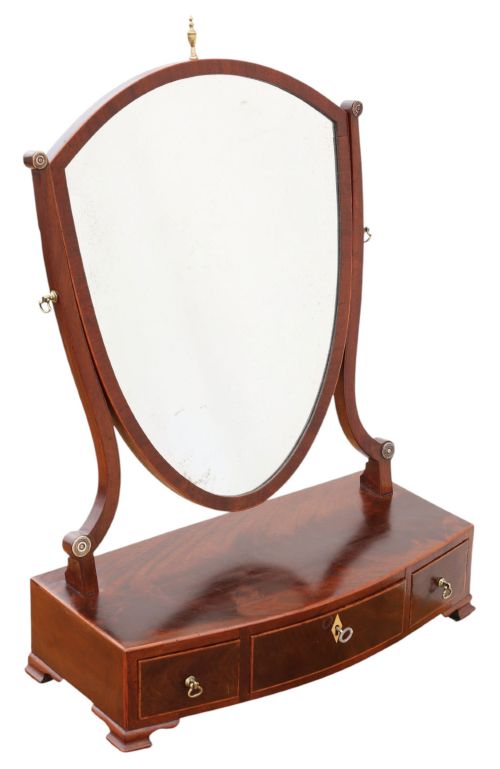


Bow Front Toilet Mirror
These bow front toilet mirror pieces bring Georgian and Regency proportions to a dressing table, combining practical glass with useful drawer space.
Bow Front Toilet Mirror
A bow front toilet mirror sits upon a chest or dressing table, offering an adjustable glass plate above a curved set of small drawers. These pieces emerge primarily from the Georgian, Regency, and Edwardian eras, reflecting the domestic habits of those periods.
Most examples found here present a mahogany structure, frequently employing flame veneers or box base compartments. The curved front distinguishes them from flat-fronted counterparts, softening the lines of the dressing table.
The form functions as both a mirror and a miniature chest, providing storage for small valuables while maintaining a compact footprint. Buyers meet both oval and shield-shaped glass plates within these historical categories.
How they were made
Cabinet makers constructed the curved bases of a bow front toilet mirror using solid mahogany and thin veneers, often selecting flame mahogany to create movement across the front drawers. Brass frequently appears as small knobs, escutcheons, or pivotal screw fixtures supporting the swing frame.
The glass plates are silvered mirrors held within upright arms, allowing the user to tilt the reflection to various angles. Bone details sometimes accent the key escutcheons on the drawer fronts, adding subtle contrast to the dark wood.
Bow Front Toilet Mirror Retail Price Guide 2026
Typical asking prices for bow front toilet mirror among the pieces listed under this phrase on Sellingantiques today, from the lower quarter to the upper quarter. They describe what is for sale here now, not the wider market.
The small drawers within the base were originally sized to hold pocket watches, rings, and patches.
What varies in quality
The depth of figure in the mahogany veneer distinguishes standard items from superior pieces, particularly where flame grain covers the curved drawer fronts. Finer examples display precise dovetail joinery in the box base and well-proportioned upright supports.
The originality of the glass plate and the matching character of the brass hardware influence the integrity of the piece. Subtle details such as bone escutcheon inserts and clean lines in the curve of the base mark the work of skilled cabinet makers.
The Bow Front Toilet Mirror Glossary
- Bow front
- A convex curved front that projects outward in the centre, common in cabinet furniture of the Georgian and Regency periods.
- Flame mahogany
- A veneer cut from the fork of a mahogany tree where the branches join the trunk, producing a distinctive flickering flame pattern.
- Toilet mirror
- A small mirror designed to stand on a dressing table or chest of drawers, often incorporating small drawers in its base.
- Swing mirror
- A glass plate mounted on pivots between two upright posts, allowing it to tilt back and forth.
- Box base
- The lower section of a toilet mirror that incorporates one or more small drawers within a rectangular housing.
Bow Front Toilet Mirror: Frequently Asked Questions
Where do you place a bow front toilet mirror?
These mirrors suit the top of a chest of drawers, a dedicated dressing table, or a sideboard in a bedroom or hallway.
Their compact base allows them to sit securely on flat surfaces while offering useful storage in the small drawers below.
How do you date a bow front toilet mirror?
Dating relies on timber selection, construction methods, and the overall style of the base and mirror frame.
Georgian and Regency pieces tend to show denser mahogany figures and hand-cut dovetails, whereas Edwardian revivals employ later manufacturing techniques.
What is the difference between a toilet mirror and a dressing mirror?
The terms often describe the same object, though toilet mirrors historically sat on a dressing chest where people performed their morning toilet.
Both types feature a pivoting glass plate mounted above a set of small drawers.
Can the mirror angle be adjusted?
The glass plate swings between two vertical uprights on metal pivot screws or pins.
Tightening or loosening these side fixtures allows the user to set the glass at the preferred viewing angle.