
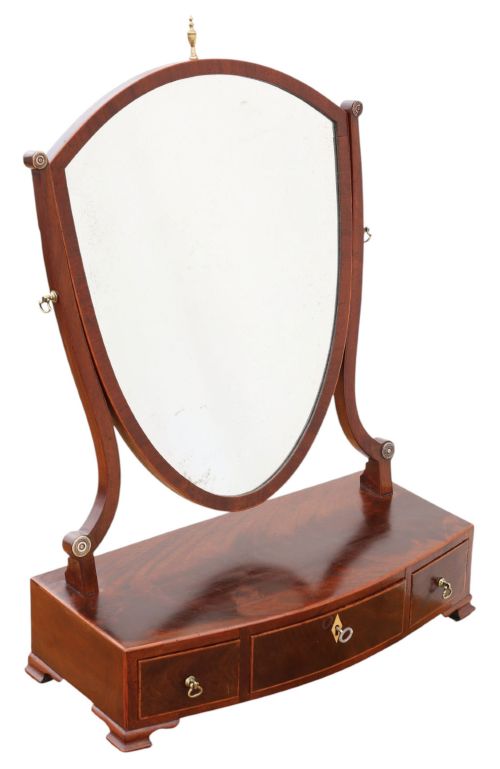


Bow Front Mirror
A bow front mirror brings curved mahogany and clear reflection to a chest or dressing table, offering both utility and a distinct period silhouette.
Bow Front Mirror
A bow front mirror typically sits upon a small box base equipped with drawers, designed to stand on a dressing table or chest during the Georgian and Regency periods. The curved front softens the geometry of a bedroom or parlour, a shape that makers repeated through the Victorian era and into Edwardian revivals.
While most examples function as toilet or dressing mirrors, the broader category also includes larger display cabinets and wardrobes that incorporate the same characteristic curved profile. The version most frequently encountered on this page is the tabletop toilet mirror with a box base and small drawers beneath the swing glass.
Materials and construction methods
Makers relied primarily on solid mahogany and flame mahogany veneers, sometimes enhanced with satinwood stringing or bone inlay to define the curved edges of the box base. The glass itself is held within an upright frame, often oval or shield-shaped, supported by brass pivots that allow the mirror plate to tilt.
The box bases commonly feature dovetailed joints and small turned feet or bracket feet, housing between one and three small drawers for trinkets. Cabinetmakers selected timbers with strong grain patterns to catch the light across the curved surfaces.
Secret compartments hidden behind the tiny drawers occasionally turn up, designed for storing hidden love letters.
Distinctions in craftsmanship
The quality of a bow front mirror depends largely on the selection of timber, particularly the use of figured flame mahogany on the curved drawer fronts and the fineness of any inlay work. Superior pieces display crisp dovetailing, well-proportioned brass fittings, and harmonious proportions between the mirror frame and the box base.
Later revivals or simpler utility pieces often lack the subtle sweep and carefully matched veneers found on Georgian and Regency examples. The integrity of the original mirror plate and the smoothness of the pivoting mechanism also separate standard workshop output from finer cabinetmaking.
The Bow Front Mirror Glossary
- Box base
- A small cabinet or plinth beneath the mirror plate containing one or more drawers. This structure provides stability and weight to counter the tilted glass.
- Shield mirror
- A mirror plate shaped like a heraldic shield, popular during the Georgian period. It is typically mounted on upright arms above a serpentine or bow-fronted base.
- Flame mahogany
- Mahogany veneer cut across the fork of the branch to produce a flamy, feather-like pattern. Makers prized this timber for prominent display surfaces.
- Stringing
- A narrow line of contrasting wood or bone inlaid into the surface of the cabinetwork. It outlines panels and edges to give geometric definition.
- Swing mirror
- A mirror plate hung on pivots between two upright posts so the angle can be adjusted. This mechanism permits the user to alter the reflection.
Bow Front Mirror: Frequently Asked Questions
Where were these mirrors placed?
These mirrors were designed to sit atop dressing tables, sideboards, or chests of drawers in bedrooms and dressing rooms. Their compact box bases allowed them to be moved easily around the room to catch the best light.
In modern homes, they function well on top of modern chests or deep windowsills, providing useful surface storage in their small drawers while reflecting light into smaller spaces.
How do I date a bow front mirror?
Dating relies on examining the construction of the drawers, the timber used, and the shape of the mirror frame. Georgian and Regency pieces often feature hand-cut dovetails and subtle flame mahogany veneers.
Later Victorian and Edwardian revival pieces tend to have heavier framing, machine-sawn elements, and sometimes different secondary woods inside the drawer construction.
What are the drawers used for?
The small drawers within the box base were originally intended to hold personal items such as rings, pins, cosmetics, and small trinkets. They keep the dressing surface tidy.
Even today, these shallow compartments remain practical for storing small everyday accessories or stationery.
Are the mirror plates original?
Many older mirrors have replacement glass because original mirror plates silvering degrades over centuries of exposure to moisture and light. A replacement plate is common and often chosen to restore clear reflection.
When original glass survives, it may show minor foxing or light distortion, which many collectors value as proof of age.