

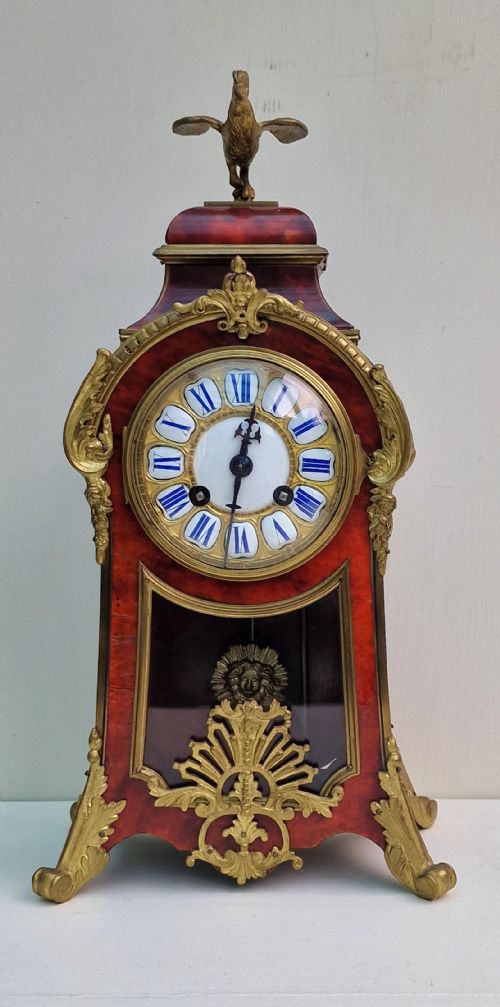
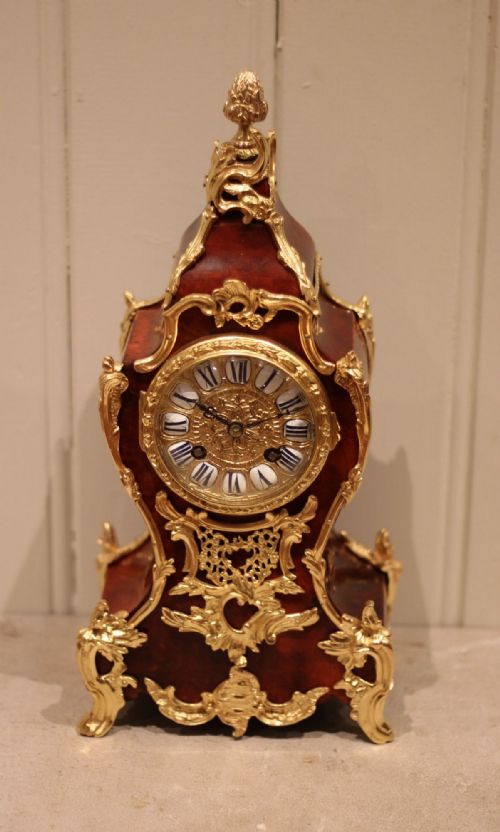


Boulle Mantel Clock
A boulle mantel clock brings the grandeur of French marquetry and gilt mounts to a room.

Boulle Mantel Clock
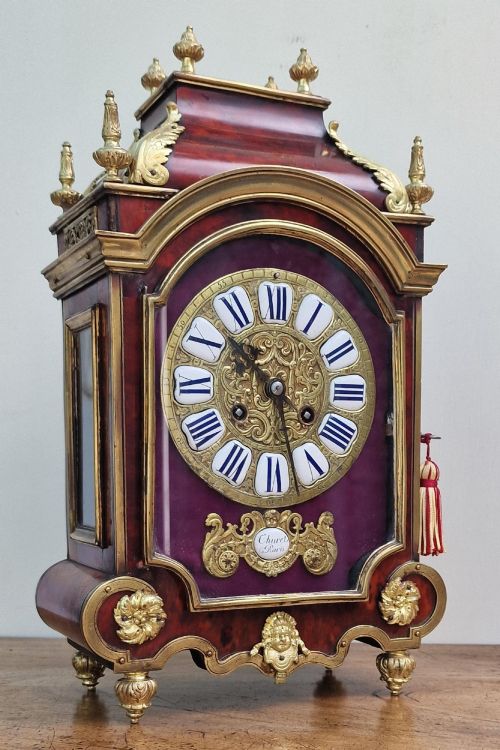
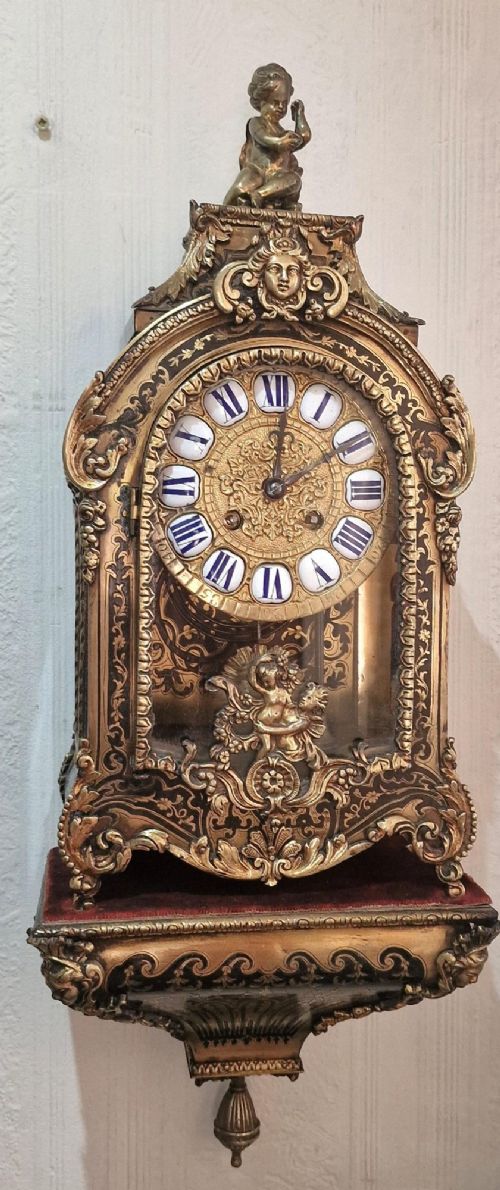
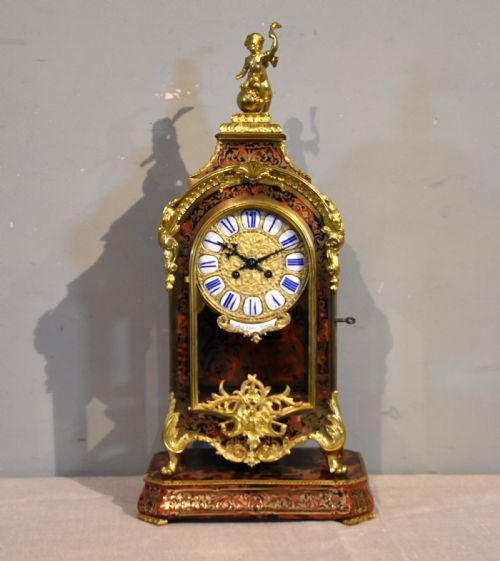
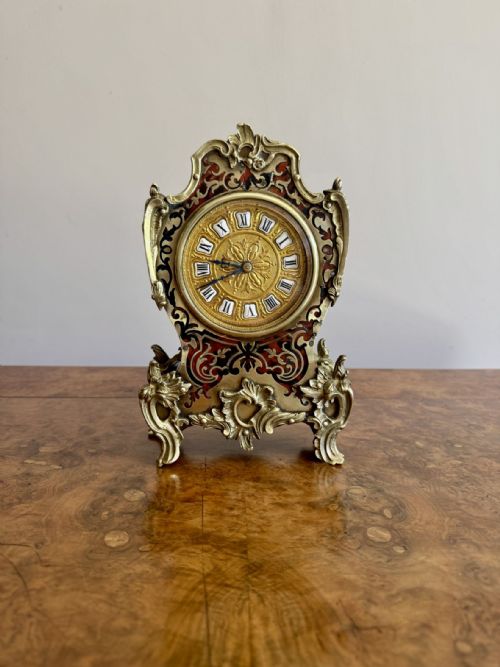
A boulle mantel clock is an ornamental timepiece decorated with tortoiseshell and brass marquetry, often styled after the court taste of Louis XIV or Louis XV. These pieces range from compact table clocks to grand bracket clocks accompanied by matching pedestals.
Most examples seen here belong to the nineteenth century, particularly the Victorian era and the decades around eighteen-eighty, reflecting a widespread revival of French baroque and rococo design. Makers working in Paris and London produced these elaborate objects for wealthy interiors.
Forms vary from waisted cases and traditional mantel models to tall pedestal clocks fitted with eight-day movements. Green and red tortoiseshell variations appear alongside standard dark shell, paired with cast or chased ormolu mounts.
Materials and technique
The technique relies on tortoiseshell veneer combined with cut brass inlay, a method of marquetry popularized by seventeenth-century cabinetmaker André-Charles Boulle. Craftsmen cut layered sheets of metal and shell together to create matching positive and negative patterns known as first-part and contre-partie.
Gilt bronze and ormolu mounts frame the glazed doors, dials, and feet, providing sculptural contrast to the dark polished wood and tortoiseshell surfaces. Enamel cartouches on the clock faces indicate hours, driven by mechanical movements housed inside ebonised or stained timber carcases.
Materials recorded across the selection include ebonised wood, glass, gilt bronze, and both red and green tortoiseshell veneer.
What separates the finest examples
Quality rests on the crispness of the brass engraving and the depth of the tortoiseshell beneath the polished surface. Finer makers employed thicker plates of brass and richer shell, ensuring the marquetry retains sharp edges rather than rounded lines.
The artistic merit of the cast ormolu mounts distinguishes standard production from exceptional work, as does the reputation of the movement maker. Comprehensive ensembles including original wall brackets and matching pedestals represent the highest tier of survival.
Thuret·Samuel Marti·A.D. Mougin·Payne London·Vincenti·Japy Frères·Charles Hour·Richard & Co Paris·Vieyres & Repingon Paris·R Fage, Paris
The Boulle Mantel Clock Glossary
- Boulle
- A style of marquetry using brass and tortoiseshell inlaid together in elaborate scrolling patterns. It takes its name from Louis XIV's cabinetmaker, André-Charles Boulle.
- Ormolu
- Gilt bronze mounts cast and chased to decorate the corners, feet, and bezels of furniture and clocks. The process involves applying a mercury and gold amalgam to bronze.
- Bracket clock
- A portable clock designed to sit on a wall bracket or table rather than a floor. Many historical examples include their matching wall support.
- Cartouche
- Enamelled individual plates indicating the numbers on a clock face. They are pinned to the dial background rather than painted directly onto a single disc.
- Fusee
- A conical pulley connected to the mainspring by a cord or chain. It ensures even power distribution to the movement as the spring winds down.
Boulle Mantel Clock: Frequently Asked Questions
How do I wind a boulle clock?
Most nineteenth-century models utilise an eight-day mechanical movement wound with a matching key inserted into the dial holes. Care must be taken not to overwind the mainspring.
Moving the hands requires gentle handling, particularly around delicate enamel cartouches and intricate brass marquetry.
What is the difference between red and green boulle?
Red boulle incorporates tortoiseshell treated with a reddish backing or natural warm tones beneath the brass inlay. Green variants achieve their distinctive colour through pigmented backing materials placed under translucent shell.
Both styles were produced during the nineteenth-century revival periods alongside traditional dark tortoiseshell.
Where should I place a bracket clock?
Bracket clocks are designed to sit securely on sturdy furniture or their dedicated wall brackets. Because of their weight and projecting ormolu mounts, stability is essential.
Placement away from direct sunlight and heat sources protects the tortoiseshell veneer and ebonised wood carcases from warping or fading.
How do I identify the period of a French clock?
Makers' marks stamped on the back plates of the movement provide reliable dates and origins. Stylistic details like Napoleon III proportions or Louis XIV mounts also point to specific decades.
Construction methods, such as the use of cut brass and cast bronze, help separate nineteenth-century revivals from later interpretations.