
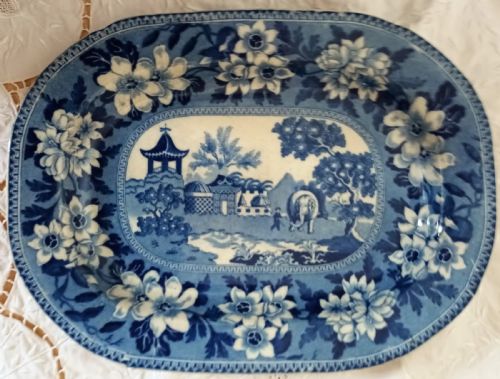


Blue White Willow Pattern
Blue white willow pattern ceramics bring timeless narrative scenes to the table, uniting traditional earthenware forms with rich cobalt pigment designs.

Blue White Willow Pattern
When you search for blue white willow pattern, you encounter a range of domestic ceramic wares spanning the eighteenth, nineteenth, and early twentieth centuries. These objects include plates, serving platters, tureens, cheese domes, and chestnut baskets created in both Georgian and Victorian contexts.
The version you are most likely to meet on this page is the nineteenth-century earthenware plate or platter, decorated with transfer-printed cobalt scenes derived from traditional Chinese motifs. Alongside classic willow designs, the evidence shows related pictorial patterns such as elephant, zebra, buffalo, and tower designs executed in the same palette.
Originating in English potteries, these pieces served the daily dining needs of households through multiple generations, shifting from pearlware bodies to ironstone and porcelain as manufacturing techniques evolved.
Materials and production methods
Potters constructed these items primarily from earthenware, pearlware, and ceramic bodies, often applying a clear glaze over the shaped clay. Early examples feature tin glaze or pearlware glaze, while later Victorian pieces utilise ironstone and porcelain.
Makers applied the iconic decoration using cobalt pigment through transfer-printing techniques, pressing paper prints onto the biscuit fired clay before glazing and firing the piece in a kiln.
Listings include items spanning the eighteenth, nineteenth, and twentieth centuries, produced in earthenware, pearlware, ironstone, and porcelain.
Evaluating the craftsmanship
Quality in these ceramics rests upon the crispness of the transfer print and the stability of the glaze, where finer examples maintain sharp lines without blurring or pooling of the cobalt pigment. The weight and balance of the earthenware body, alongside the finesse of moulded details like pierced rims or fitted lids, also distinguish superior items.
The consistency of the ceramic body and the purity of the white ground beneath the blue print indicate the skill of the pottery, separating standard utility wares from exhibition pieces.
John Rogers and Son·Spode·Swansea Dillwyn and Co·Royal Worcester
The Blue White Willow Pattern Glossary
- Pearlware
- A refined earthenware developed in the late eighteenth century featuring a subtle bluish glaze that pooled in recesses to mimic Chinese porcelain.
- Transfer printing
- A mechanical decoration method where an engraved copper plate applied ink to tissue paper, which was then transferred onto the unglazed ceramic surface.
- Tin glaze
- An opaque white glaze containing tin oxide, used on early earthenware to provide a smooth ground for painted or printed cobalt designs.
- Earthenware
- A porous ceramic body fired at lower temperatures, commonly used for domestic plates, platters, and tureens before being sealed with a vitreous glaze.
- Ironstone
- A heavy, durable type of feldspathic earthenware patented in the nineteenth century to resist chipping and cracking during heavy dining use.
Blue White Willow Pattern: Frequently Asked Questions
How do I date a willow pattern plate?
Dating relies on examining the ceramic body, glaze composition, and any maker marks pressed or printed on the base. Pearlware bodies and bluish glazes typically point toward the late eighteenth or early nineteenth century.
Heavier ironstone bodies and brighter white glazes generally indicate a mid to late Victorian origin. Comparing the style of the transfer print and the rim shape to documented pieces helps narrow the decade further.
Were these blue and white pieces used daily?
Most of these ceramics were manufactured as robust domestic items intended for regular dining and food service. Platters, plates, and tureens handled heavy daily use in Georgian and Victorian households.
Finer decorative pieces, such as pierced chestnut baskets or cheese domes, saw more specialised service during formal meals. Their survival demonstrates both their utility and the care taken by successive owners.
What is the difference between pearlware and ironstone?
Pearlware is a refined earthenware from the Georgian era featuring a delicate, slightly bluish glaze designed to mask the yellowish tint of the underlying clay body. It tends to be lighter and more refined in its feel.
Ironstone, developed later in the nineteenth century, is a much denser and heavier ceramic designed for durability. It provides a whiter, harder surface that withstood the rigours of large Victorian family dining.
How should I care for antique transferware?
Wash these pieces gently by hand using warm water and a mild detergent, avoiding modern dishwashers that can craze the antique glaze. Sudden temperature changes should also be avoided to protect the ceramic body from thermal shock.
Display or store them securely on stable surfaces, using padded plate hangers if mounting them on walls. Careful handling preserves both the glaze and the delicate cobalt transfer print for the future.