


Blue Gilded Ginger Jar
These blue gilded ginger jar pieces bring rich cobalt palettes and bright metallic highlights to any room.
Blue Gilded Ginger Jar
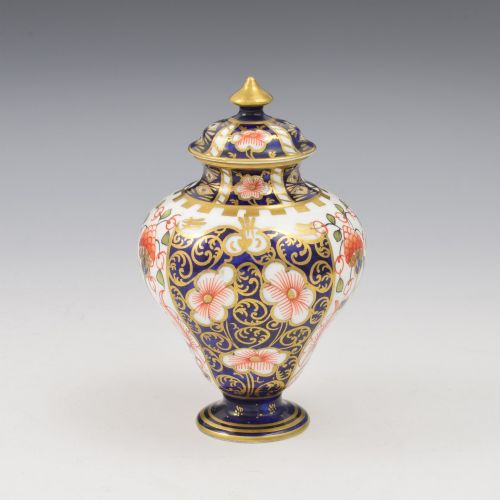
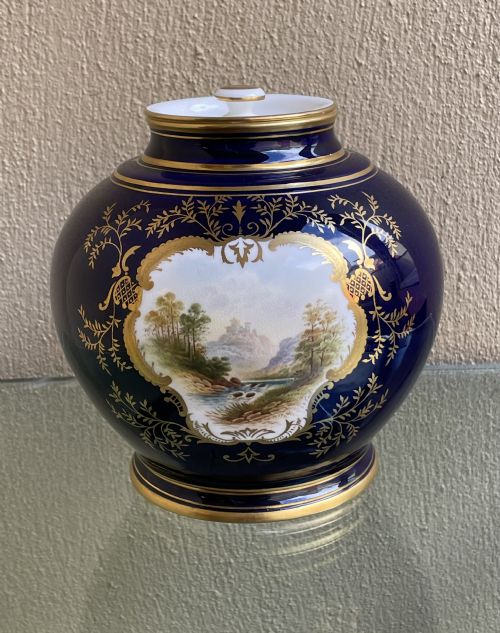
When you search for a blue gilded ginger jar, you are looking at lidded vessels spanning the 18th century, the Victorian and Edwardian eras, up to the 1920s. These pieces encompass Japanese Imari imports, Chinese blue and white forms, and European responses from factories such as Royal Crown Derby, Booths, Coalport, Dresden, and Carlton Ware.
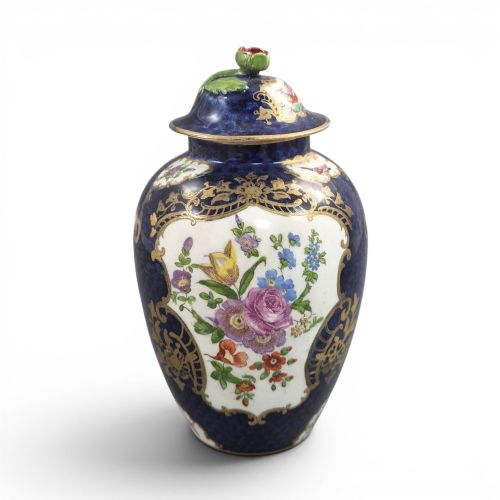
The objects themselves take the form of covered vases, urns, table lamps, and traditional jars originally designed for storing spices. You will frequently encounter Japanese Imari examples alongside English earthenware and porcelain interpretations featuring scale blue grounds, exotic birds, and intricate hand-painted motifs.
Quality differences
The crispness of the hand-painted cobalt and the precision of the gold leaf application define the finer examples. Well-executed pieces show steady brushwork in Japanese Imari styles or detailed bird motifs against scale blue grounds.
The survival of the matching lid alongside the jar significantly influences the standing of the piece. Potteries using superior paste and controlled kiln temperatures produce crisper forms with intact, brilliant gilding.
Listings feature pieces spanning the 18th century through to the 1920s, utilising porcelain, earthenware, enamel, and gold leaf.
Royal Crown Derby·Booths·Coalport·Fielding’s Crown Devon·Wolfsohn Dresden·Samson·Carlton Ware
The Blue Gilded Ginger Jar Glossary
- Imari
- A style of Japanese export porcelain featuring deep underglaze blue combined with iron red and gold highlights. This aesthetic heavily influenced European potteries during the 18th and 19th centuries.
- Ironstone
- A heavy, durable type of earthenware patented in the 19th century to imitate porcelain. It provides a robust body for large lidded vases and decorative jars.
- Scale blue
- A patterned dark blue ground resembling fish scales, famously utilised on English porcelain. It creates a rich textured backdrop for painted panels of exotic birds.
- Enamel
- Opaque glass-like material fused to the ceramic surface during firing. It adds raised coloured details to the cobalt and gilded designs.
- Gilding
- The application of gold leaf or gold paint to the ceramic body. This technique frames the blue panels and highlights the contours of the cover and vase.
Blue Gilded Ginger Jar: Frequently Asked Questions
What were ginger jars used for?
Original ginger jars served to transport and store spices, herbs, and preserved ginger shipped from East Asia to Europe. As Chinese and Japanese porcelain grew in popularity during earlier centuries, these practical containers became decorative display pieces.
European factories soon adopted the sturdy bulbous shape for domestic interiors, producing lidded vessels purely for ornamental display on mantelpieces and sideboards.
How do I style a ginger jar at home?
Place a lidded jar on a wooden console table or inside a cabinet where the blue glaze and gold leaf can catch natural light. Pairing matching items creates symmetry on a mantelpiece or flanking a fireplace.
Ensure the surface is stable, as these ceramic and porcelain vessels carry considerable weight, particularly when the matching lid is in place.
How do I tell Japanese Imari from European copies?
Examine the weight, paste, and base markings of the vessel to identify its origin. European factories often marked their porcelain with specific factory ciphers, whereas older Japanese pieces display characteristic spur marks and unglazed foot rims.
The iron red and cobalt blue tones on Japanese Imari typically exhibit a distinct depth under the glaze compared to later revival styles made in France or England.
What is the difference between porcelain and ironstone?
Porcelain is a vitrified ceramic material made from kaolin, fired at high temperatures until it becomes non-porous and semi-translucent. It rings when struck and offers a refined, delicate body.
Ironstone is a dense, opaque earthenware developed to resist chipping while mimicking the appearance of true porcelain. It provides a heavier, sturdier structure suitable for large decorative urns and jars.