
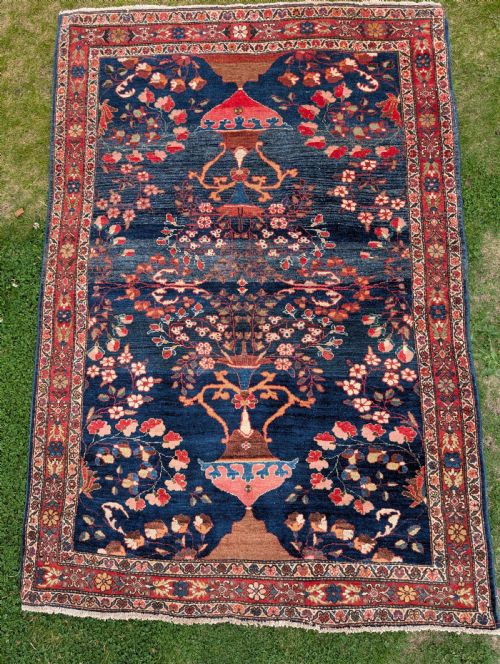
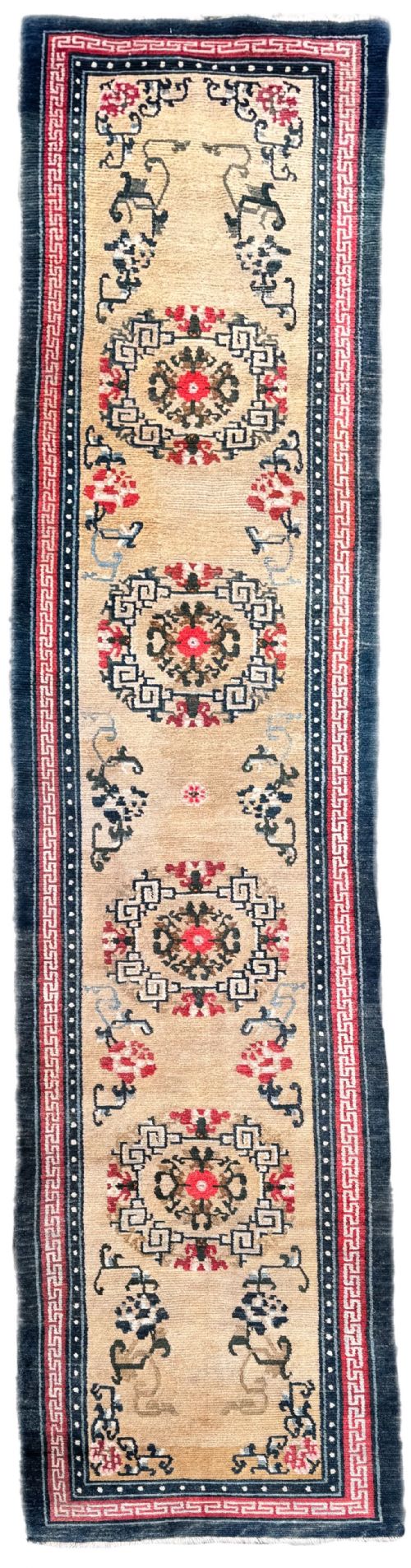
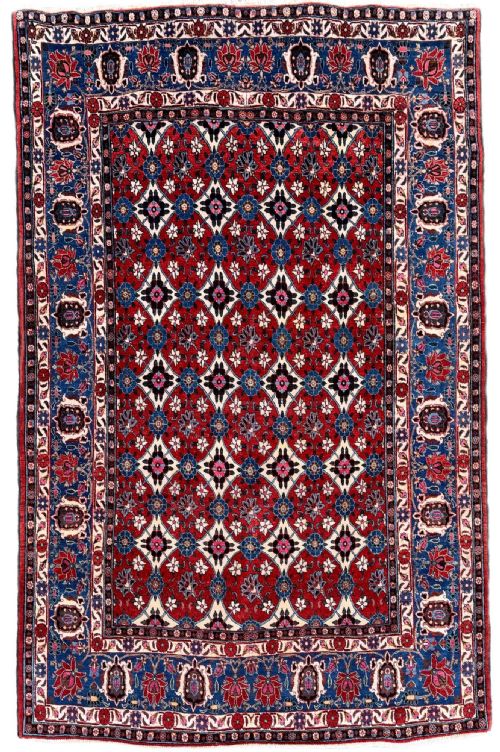
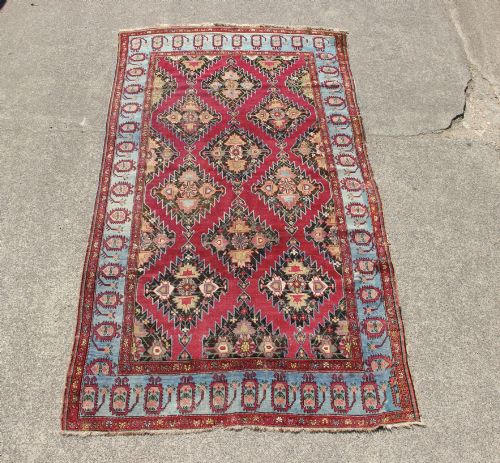


Blue Border Rug
These antique blue border rug examples bring hand-knotted Persian and Anatolian artistry into domestic spaces with rich indigo framing.
Blue Border Rug
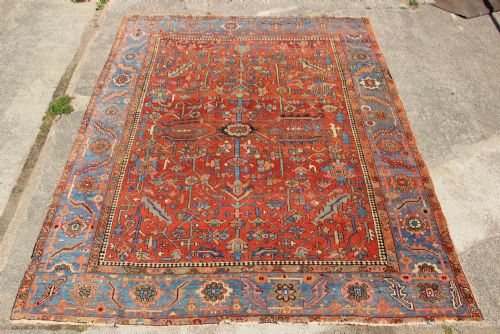
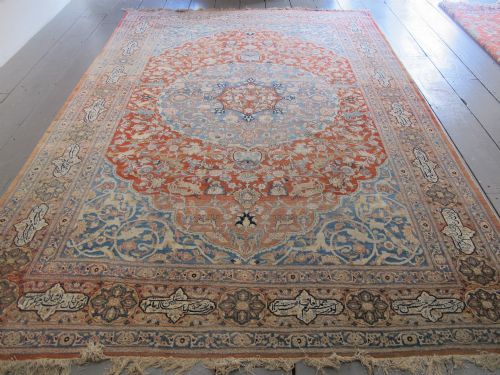
A blue border rug encompasses hand-knotted floor coverings hailing from nineteenth and early twentieth century workshops across Persia, the Caucasus and Anatolia. These pieces typically display traditional field designs enclosed by distinctive indigo or sapphire framing bands that anchor the overall composition.
Buyers browsing this selection most frequently encounter antique carpets originating from regions such as Sultanabad, Tabriz, Karabagh and Ushak. Dating predominantly from the eighteen-eighties up to the nineteen-twenties, these woven textiles utilise durable wool foundations to create resilient floor coverings.
Stylistic origins range from classic Persian and Ziegler aesthetics to Ottoman and Caucasian influences. Each piece showcases regional dyeing traditions and characteristic motifs that reflect the specific village or city workshop where the weavers knotted the pile.
Construction and materials
Weavers constructed these carpets using traditional hand-knotting techniques on foundation threads formed from tightly spun cotton. The pile itself consists of natural sheep wool, selected for its resilience and ability to absorb dye uniformly across the surface.
Dyers utilised natural organic substances to achieve the deep blue tones found in the characteristic borders, often combining plant-derived indigos with madder roots and walnut husks for contrasting field colours. Skilled artisans then clipped the wool pile by hand to achieve an even, wearable surface texture.
Blue Border Rug Retail Price Guide 2026
Typical asking prices for blue border rug among the pieces listed under this phrase on Sellingantiques today, from the lower quarter to the upper quarter. They describe what is for sale here now, not the wider market.
A persistent nineteenth-century weaver managed to misplace a single border rosette, leaving behind a delightful permanent signature in the indigo wool.
Assessing quality and execution
Quality in these woven works rests upon the density of the knotting and the precision with which the workshop executed the border geometry. Finer knot counts allow for sharper curvilinear lines in Persian Ziegler and Tabriz designs, whereas coarser structures appear in robust village carpets.
The depth and saturation of the natural dyes separate standard examples from superior specimens. Master dyers achieved nuanced abrash colour variations within the blue borders that impart a vibrant, luminous character to the wool pile over decades of ageing.
The Blue Border Rug Glossary
- Abrash
- A natural variation in shading across the wool pile caused by distinct dye batches or changes in yarn lots during weaving. This subtle tonal shift is a hallmark of genuine hand-dyed antique textiles.
- Sultanabad
- A West Persian weaving centre renowned for large-scale floral patterns and room-size carpets produced for Western markets during the late nineteenth century. These pieces often feature spacious fields balanced by strong, structured borders.
- Ziegler
- A commercial design classification originating from a nineteenth-century Swiss firm operating in Persia. It denotes room-sized carpets with softened palettes and sweeping, open floral compositions.
- Pile
- The vertical or slanted upright loops of wool that form the usable surface of a rug. The condition and height of this wool layer dictate the texture and durability of the textile.
- Warp and Weft
- The structural foundation threads of a hand-knotted carpet. The warp runs vertically along the length while the weft crosses horizontally to secure the rows of knots.
Blue Border Rug: Frequently Asked Questions
How do I care for an antique wool rug?
Regular gentle vacuuming without a rotating power brush helps remove embedded dust from the wool pile safely.
Professional specialist cleaning is recommended every few years to preserve the natural dyes and structural integrity.
Where were these carpets originally woven?
Production centres span traditional weaving regions in Persia, including Sultanabad, Tabriz, and Karabagh, alongside Anatolian workshops in Ushak.
Each region developed distinct regional motifs and knotting structures that distinguish its origin.
What period do these rugs date from?
The inventory on this page primarily spans the late nineteenth century through to the nineteen-twenties.
Examples from eighteen-eighty to nineteen-twenty showcase traditional vegetable dyeing techniques and hand-spun wool construction.
How do I identify a Ziegler rug?
Ziegler carpets typically feature generous, open floral layouts adapted from classic Persian designs to suit European drawing rooms.
They are further distinguished by softened colour palettes and balanced border proportions.