



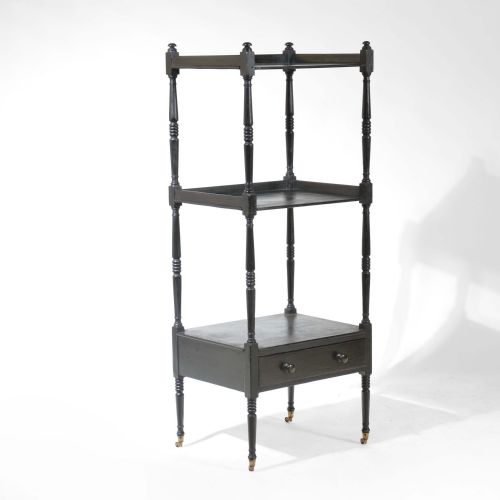


Black Wood Drawers
Black wood drawers are solid storage pieces finished in dark tones or ebonised surfaces that bring grounded weight to a room.
Black Wood Drawers
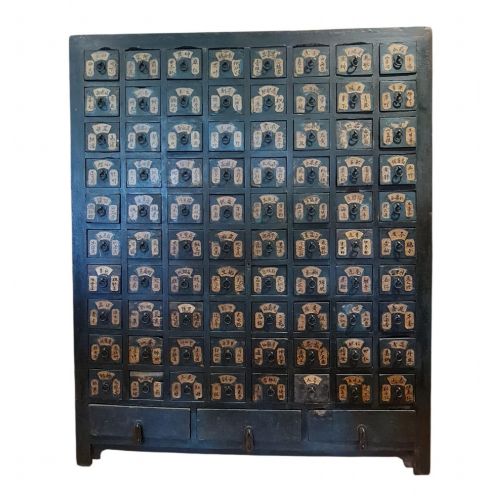
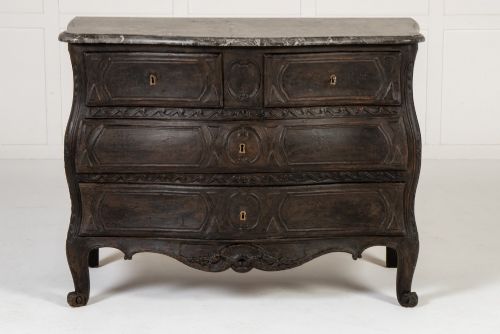
Black wood drawers encompass dark storage furniture found across various periods including the 18th century, 19th century, Georgian, and Victorian eras. Buyers searching for black wood drawers will encounter pieces ranging from English ebonised whatnots and small chests to French ebonised bombe commodes and Chinese apothecary cabinets.
The selection on this page leans heavily toward provincial European commodes, English ebonised items, and Asian cabinetry like Japanese tansu chests and Chinese medicine cabinets. These items serve functional storage roles while offering striking dark silhouettes rooted in traditional craftsmanship.
How they were made
Construction relies primarily on traditional timbers such as oak, elm, and birch, often treated with ebonised finishes, paint, or specialised surface treatments to achieve deep dark tones. Workshops combined these woods with robust metal, brass, or iron hardware to secure multiple drawers and compartments.
Techniques varied by region, from the curved bombe shaping seen in French commodes to the intricate multi-drawer joinery of Chinese apothecary cabinets and Japanese step chests. Surfaces were frequently painted or ebonised by hand to give the timber a uniform dark appearance.
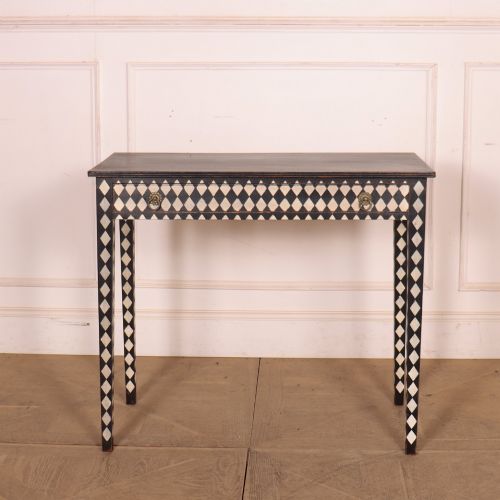
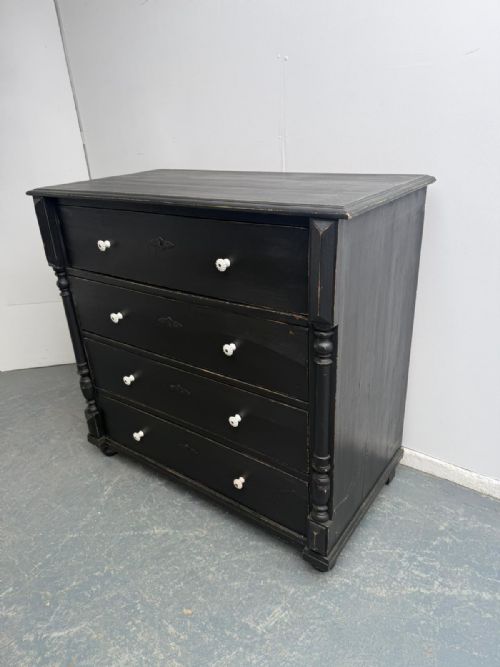
Object types include chests of drawers, apothecary cabinets, step chests, and side tables.
What varies in quality
Quality in black wood drawers rests on the integrity of the timber construction, the stability of the frame, and the condition of the dark finish or paintwork. Pieces with well-preserved ebonisation or original paint display greater authenticity and visual depth.
The sophistication of the hardware, such as brass pulls or iron mounts, and the precision of the drawer joinery distinguish standard utilitarian storage from finer decorative examples. Regional craftsmanship also plays a role, with complex forms like serpentine fronts and bombe curves requiring higher woodworking skill.
Trussant & Cie
The Black Wood Drawers Glossary
- Ebonised
- Wood treated with a dark stain or finish to imitate expensive ebony. This technique was popular in various periods to give standard timbers a formal black appearance.
- Bombe
- A bulging, outward-curving chest or commode shape associated with continental furniture. It requires advanced carpentry to construct curved drawers and frames.
- Commode
- A low chest of drawers or cabinet originating in France. They often feature decorative painted surfaces or shaped fronts.
- Tansu
- Traditional Japanese mobile storage cabinetry built from wood with iron hardware. They were used for various domestic storage needs, including step configurations.
- Serpentine
- A furniture front characterised by a wavy line with a convex centre flanked by concave sides. This shape adds fluid movement to case pieces.
Black Wood Drawers: Frequently Asked Questions
What periods do these drawers come from?
The pieces span the 18th century, 19th century, Georgian, and Victorian eras, alongside specific dates like 1860 and 1900. Styles range from English traditional and French provincial to Chinese Qing dynasty and Japanese Edo period.
This broad chronological spread means construction methods and decorative details vary significantly depending on the specific region and decade of origin.
How do I care for ebonised wood surfaces?
Ebonised and painted wood surfaces require gentle dusting with a soft, dry cloth to prevent scratching the dark finish. Avoid placing them in direct sunlight or near heat sources to protect the timber and paint.
Applying a suitable wax occasionally can help maintain the sheen of the wood without building up heavy residues on the dark surface.
Where were apothecary cabinets used?
Apothecary cabinets with numerous small drawers were utilised in traditional pharmacies and medical shops to organise herbs, powders, and remedies. Their dense grid of compartments allowed practitioners to sort diverse ingredients efficiently.
Today, these cabinets are adapted for domestic spaces to store small household items, collections, or stationery.
What is a step chest?
A step chest, or kaidan tansu, is a traditional Japanese storage unit built in a staircase shape. They were designed to serve a dual purpose as functional storage drawers and as physical stairs to access loft spaces.
Their distinct stepped profile makes them a sculptural focal point in modern rooms while offering practical concealed compartments.