
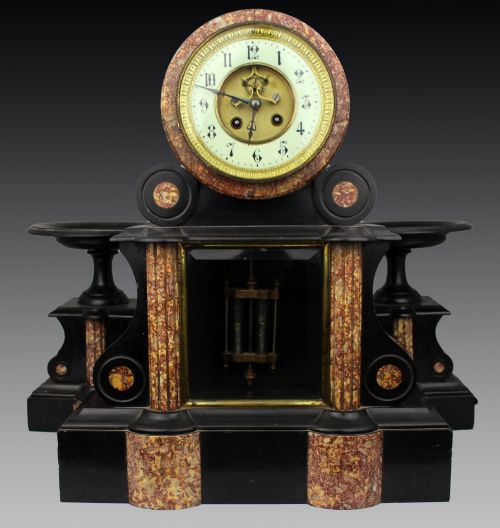
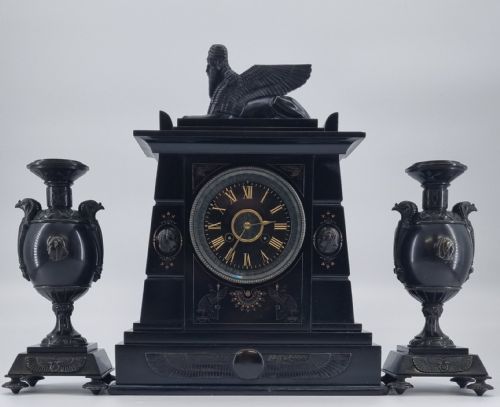


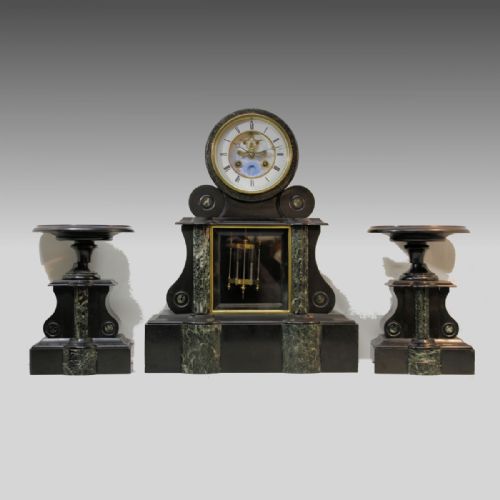

Black Marble Garniture Set
A black marble garniture set brings monumental presence and heavy architectural weight to a mantelpiece, combining a central clock with matching side pieces.
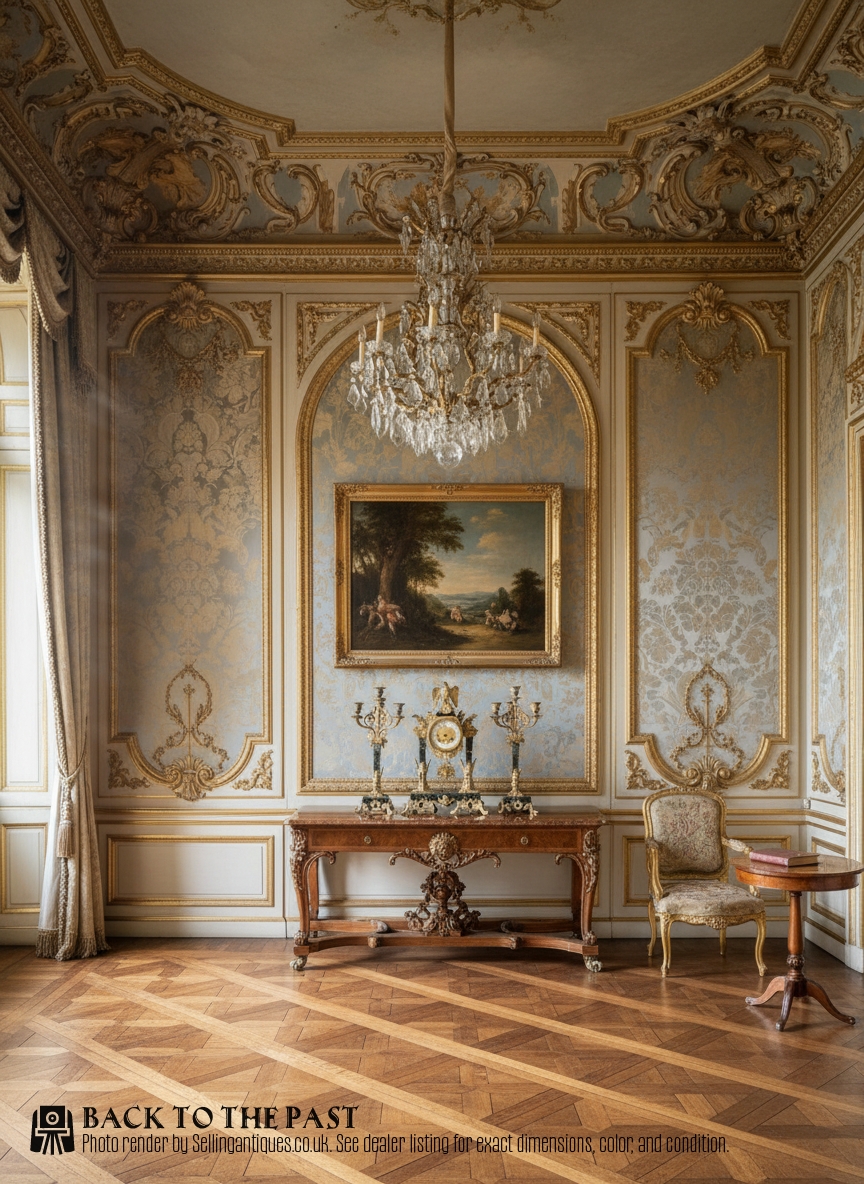
Black Marble Garniture Set
A black marble garniture set comprises a central mantel clock accompanied by matching side ornaments, designed to anchor a fireplace or large sideboard with symmetrical gravity. These sets emerge primarily from the nineteenth century, spanning periods from the 1860s through to later interpretations in the 1930s.
The forms encompass traditional mantel clocks alongside paired garnitures, executed in styles that stretch from French Empire and Victorian Classical Revival to Egyptian Revival and Art Deco. On this page, visitors encounter pieces utilising black slate alongside variegated marble and solid black marble.
Makers and workshops integrate contrasting metals such as brass, bronze, and patinated bronze into the stonework. The arrangements serve both a decorative and a timekeeping function, dominating interior display surfaces with substantial mineral mass.
Materials and construction methods
Masons shaped heavy blocks of black marble and black slate into architectural cases, frequently incorporating variegated marble for visual contrast. These stone bodies house mechanical movements designed to run for eight days.
Foundries cast decorative mounts in brass, bronze, and patinated bronze, securing them directly to the stone housings. Glass covers protect the clock dials, while specialised complications such as penny moon phases appear in select examples.
Elephants occasionally join the timekeeping, marching across Art Deco stone bases as unexpected sentinels of the mantel.
Distinctions in craftsmanship and design
Superior sets display crisp architectural moulding and tightly fitted stone joints, whereas lesser examples show simple slab construction with minimal detailing. The integration of cast bronze or brass elements dictates the overall sculptural ambition of the garniture.
Movement sophistication sets high-grade items apart, particularly those featuring complex dial work like moon phases rather than standard timekeeping. The weight and selection of the marble or slate body also govern the visual authority of the set.
Japy Frères
The Black Marble Garniture Set Glossary
- Garniture set
- A matched decorative arrangement consisting of a central clock and flanking side ornaments. These pieces are designed to be displayed together on a mantelpiece.
- Black slate
- A dense, fine-grained metamorphic rock utilised extensively for nineteenth-century clock cases. It provides a uniform dark surface that mimics or substitutes for true black marble.
- Penny moon dial
- A specialised clock face mechanism that displays the lunar phases through a small aperture. This complication adds significant mechanical interest to a mantel clock.
- Patinated bronze
- Bronze treated with chemical solutions to produce a specific surface coloration or aged finish. This metalwork frequently accents the dark stone bodies of French clock sets.
- Egyptian Revival
- A nineteenth-century decorative style incorporating motifs from ancient Egypt such as sphinxes, obelisks, and hieroglyphs. It appears on architectural clock garnitures from around 1860.
Black Marble Garniture Set: Frequently Asked Questions
What is a black marble garniture set?
A black marble garniture set is a matching group of decorative mantel objects consisting of a central clock and two flanking ornaments. They are constructed from heavy stone and metal.
These assemblies were created to dominate interior spaces, particularly fireplace mantels, utilising symmetrical arrangements and architectural styling.
How do you style a garniture set?
These sets require a deep mantelpiece or a sturdy sideboard capable of supporting substantial stone weight. The central clock stands flanked symmetrically by the two matching side pieces.
Because of their dark mineral surfaces and metallic mounts, they anchor traditional or eclectic rooms with strong vertical and horizontal lines.
How do you date a marble clock set?
Dating relies on stylistic clues such as Egyptian Revival motifs, French Empire influences, or later Art Deco geometric forms. Movement types and accompanying bronze work also help narrow the period of manufacture.
Physical indicators like slate composition versus variegated marble give further context to whether an item originates from the mid nineteenth century or the early twentieth century.
What materials make up these clock sets?
The primary structure consists of black marble, black slate, or variegated marble. These dense stones form the heavy architectural cases for the clocks and side ornaments.
Metal components including brass, bronze, and patinated bronze are applied as decorative mounts, while glass protects the clock faces.