


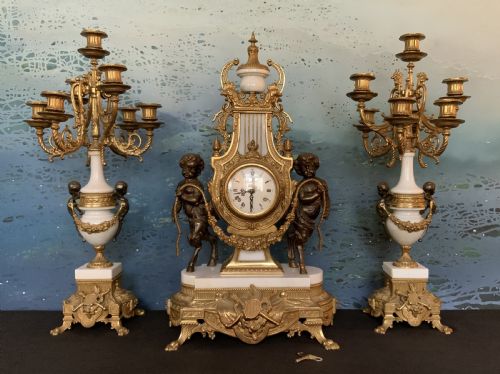


French 8 Day Mantel Clock
A french 8 day mantel clock brings mechanical precision and substantial weight into a room, driven by a movement that requires winding just once a week.
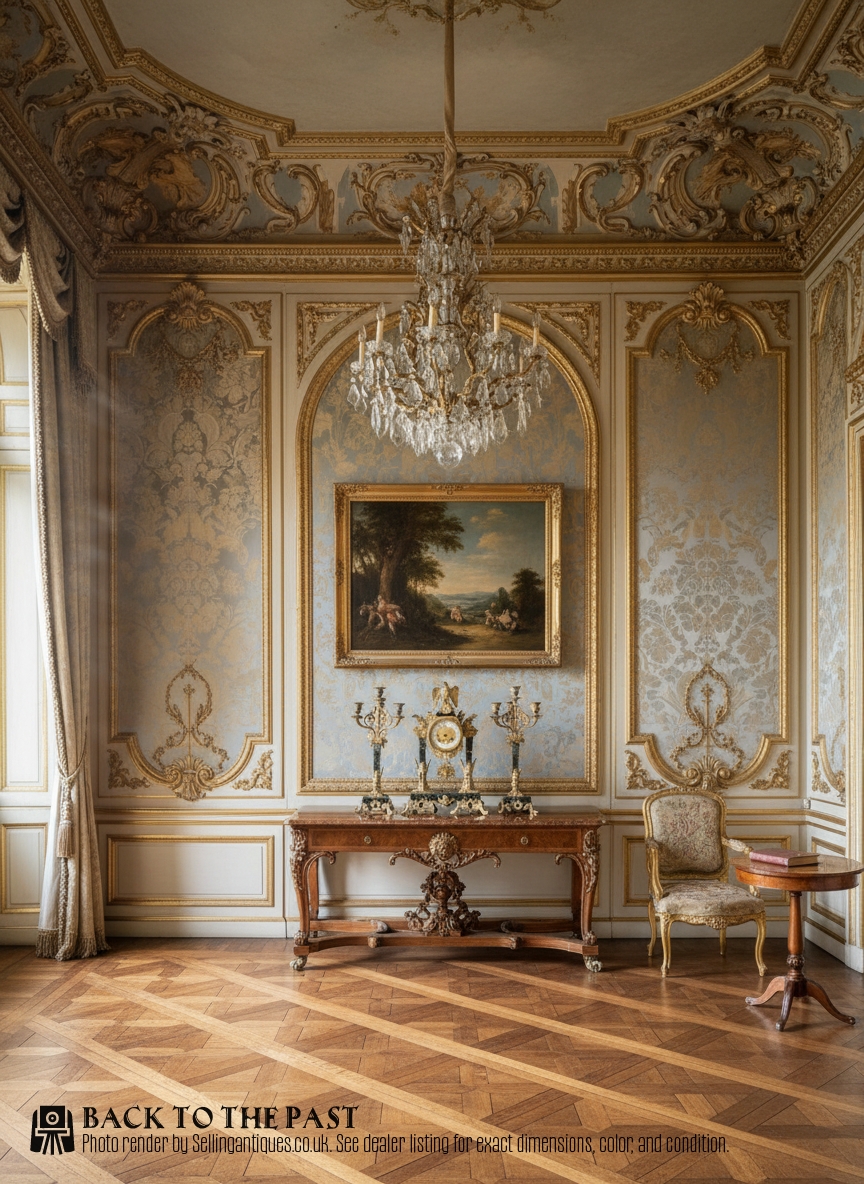
French 8 Day Mantel Clock
When you search for a french 8 day mantel clock, you encounter heavy architectural cases and portable carriage pieces spanning the nineteenth century and the Edwardian era. The most common form on this page is the nineteenth-century mantel clock, often housed in marble, black slate, or ornate ormolu.
Makers housed these eight-day movements in diverse styles ranging from strict Neoclassical symmetry to elaborate French Rococo Revival and Boulle marquetry. Alongside mantel pieces, the selection frequently includes gorge case carriage clocks and multi-piece garniture sets featuring matching candelabra.
The architectural presence of these objects reflects their original domestic role as both precision timekeepers and sculptural centerpieces. Whether rendered in bronze, alabaster, or inlaid rosewood, each piece demonstrates the mechanical ambition of period horology.
Materials and Construction
Horologists and case makers relied on heavy combinations of cast bronze, ormolu, marble, and slate to give these mantel clocks structural permanence. Movements were engineered to run for eight days between windings, frequently utilising enamel dials and brass backplates.
Decorative surfaces display skilled craftsmanship in gilt brass, hand-engraved carriage clock cases, and intricate tortoiseshell or kingwood marquetry. Foundry work by makers such as Charpentier utilised fire-gilding and cast bronze to achieve deep relief and detailed figural ornamentation.
Listings feature marble, ormolu, black slate, and porcelain materials spanning the Victorian and Regency periods.
Distinctions in Quality
The upper tier of these clocks is distinguished by the crispness of the ormolu casting, the depth of the engraving on carriage clock gorge cases, and the structural integrity of heavy marble or slate bodies. Lesser examples often feature simplified cast metal elements and routine movements lacking the refinement of signed Parisian makers.
Horological quality hinges on the original movement, where signed escapements and striking trains by makers like Drocourt, Henri Jacot, or Japy Freres elevate a piece above unmarked alternatives. The harmony between the decorative case and the mechanical standard defines the standing of each clock.
Drocourt Paris·Henri Jacot Paris·Philippes Paris·Mappin and Webb·Charpentier Foundry·Thos Agnew and Sons·Japy Freres
The French 8 Day Mantel Clock Glossary
- Gorge case
- A stepped brass carriage clock case with distinctive moulded pillars at the corners. This housing style is typical of fine nineteenth-century travel timepieces.
- Boulle
- A form of marquetry utilising tortoiseshell and brass inlay, named after the cabinetmaker André-Charles Boulle. It creates a striking pattern of dark shell and polished metal.
- Garniture
- A set consisting of a central clock flanked by matching decorative objects such as candelabra or urns. These sets were designed to sit symmetrically on a mantelpiece.
- Ormolu
- Gilded bronze used extensively for decorative mounts and cast figures on nineteenth-century clock cases. The technique involves applying a gold amalgam to a bronze base.
- Grande-Sonnerie
- A complex striking train mechanism that chimes the hours and quarters automatically on every quarter-hour. It represents a high standard of mechanical capability.
French 8 Day Mantel Clock: Frequently Asked Questions
How do I wind an 8 day clock?
Use the matching key on the winding squares located on the dial face, turning gently until resistance indicates the mainspring is fully tensioned.
Take care not to over-wind the movement, as this places undue stress on the brass gears and historical springs.
What is a garniture clock set?
A garniture comprises a central mantel clock accompanied by two matching side pieces, usually vases or candelabra made from the same material.
These sets were created to unify the decor of a nineteenth-century mantelpiece with balanced proportion and matching metalwork.
How do carriage clocks differ from mantel clocks?
Carriage clocks are compact, portable timepieces equipped with folding handles and protective travelling cases for use during journeys.
Mantel clocks are heavy architectural objects designed to remain stationary on a fireplace shelf or furniture top.
How can I identify the period of a clock?
Examine the case style, materials, and dial construction against historical design movements like Regency, Victorian revival, or Empire.
Signatures on the movement backplate or dial often provide a reliable indicator of the active working decade.