




Black Gold Credenza
These black gold credenza selections bring together rich ebonised woods, brass, and ormolu mounts to anchor a room with nineteenth-century gravitas.
Black Gold Credenza
A black gold credenza search reveals sophisticated nineteenth-century and Regency cabinetry designed for display and storage in formal rooms. These pieces encompass side cabinets, pier cabinets, breakfront side cabinets, and display cabinets created during the Victorian and Napoleon III periods.
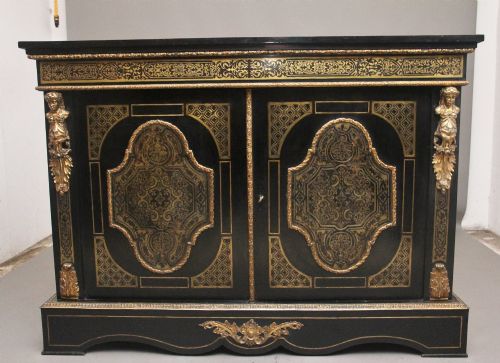
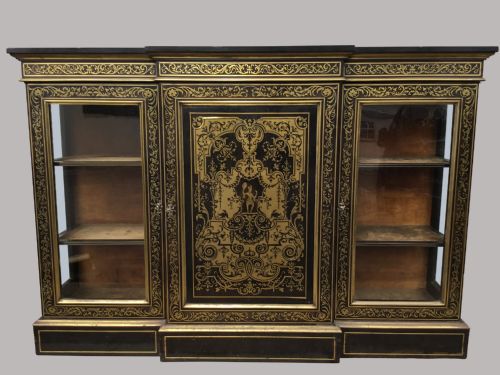
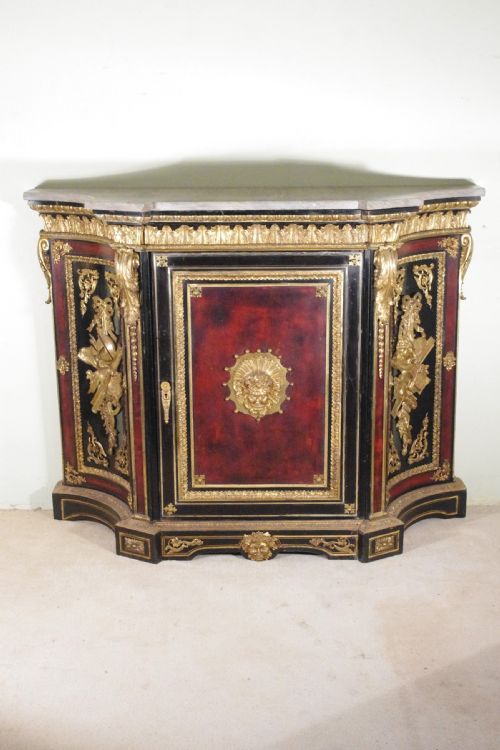
The versions most commonly met on this page are ebonised wood cabinets featuring intricate brass and tortoiseshell Boulle marquetry or gleaming ormolu mounts. Makers utilised contrasting dark finishes and metallic detailing to create striking silhouettes across French and English designs.
Makers also produced Chinoiserie and Japanned variations alongside classical French Napoleon III and Victorian revival pieces. Each form serves as a substantial focal point, often topped with marble or housing interior shelving behind glazed or panelled doors.
How they were made
Cabinet makers constructed these pieces from solid woods, finishing the exteriors with dense ebonisation to mimic the deep black appearance of ebony. They applied elaborate Boulle marquetry using brass and tortoiseshell to create shimmering surface patterns across the doors and panels.
Craftsmen mounted cast ormolu and gilt bronze details to frame the corners, doors, and cornices, adding sculptural definition. Marble tops completed many of the French and English side cabinets, providing a durable and polished upper surface.
Cabinet forms on this page include side cabinets, pier cabinets, breakfronts, and display units with Chinoiserie and Boulle revival styles.
What varies in quality
The refinement of the ormolu mounts and the precision of the brass inlay set exceptional pieces apart from standard workshop production. Superior cabinets display crisp chasing on the gilt bronze and meticulous alignment within the Boulle marquetry.
The choice of secondary materials and the integrity of the ebonised finish dictate the overall calibre of the cabinet. Finer examples incorporate decorative elements like Sevres style porcelain plaques or integrated marble tops that remain flush and well-fitted to the carcase.
The Black Gold Credenza Glossary
- Ebonised Wood
- Timber treated to achieve a dark, glossy black finish resembling ebony. This technique was widely utilised in nineteenth-century furniture to provide high contrast against metallic mounts.
- Boulle
- An elaborate marquetry technique using brass and tortoiseshell inlaid in opposing positive and negative patterns. Named after the French cabinet maker Andre-Charles Boulle, it defines many nineteenth-century revival pieces.
- Ormolu
- Gilt bronze mounts cast and chased to adorn furniture corners, feet, and friezes. The metal provides rich golden highlights against dark ebonised wooden surfaces.
- Pier Cabinet
- A narrow display cabinet specifically built to stand against the wall space between windows. These tall, upright forms often feature glazed doors for showcasing porcelain or silver.
- Chinoiserie
- European decorative style reflecting Chinese artistic motifs and lacquerwork. It appears on Regency and later twentieth-century cabinets through painted or lacquered scenes.
Black Gold Credenza: Frequently Asked Questions
What is a black gold credenza?
A black gold credenza refers to nineteenth-century dark ebonised cabinets enhanced with gilt bronze, brass, or ormolu mounts. These pieces include side cabinets, pier cabinets, and breakfront forms designed for formal interiors.
They combine deep black wooden surfaces with metallic highlights, reflecting the tastes of the Regency, Victorian, and Napoleon III periods.
Where were these cabinets placed?
These cabinets typically stood against primary walls in formal reception rooms, dining rooms, or parlours. Pier variants specifically occupied the narrow wall spaces situated between large windows.
Their primary function combined display behind glass doors with concealed storage for household valuables or porcelain collections.
How do I care for ebonised wood?
Ebonised surfaces require gentle dusting with a soft cloth to prevent the accumulation of abrasive particles. Avoid using harsh chemical sprays or silicone polishes that can degrade the dark finish over time.
Maintain stable room humidity to protect both the wooden carcase and delicate brass or tortoiseshell Boulle inlay from expansion and cracking.
How do I identify a Napoleon III cabinet?
Napoleon III cabinets are characterised by lavish ornamentation, including heavy ormolu mounts, ebonised finishes, and intricate Boulle marquetry. Many examples also incorporate marble tops and Sevres style porcelain plaques.
This mid-nineteenth-century French style revived earlier monarchical aesthetics with an emphasis on dramatic contrast and rich surface decoration.