
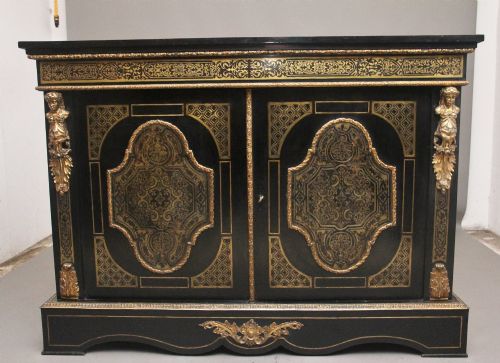
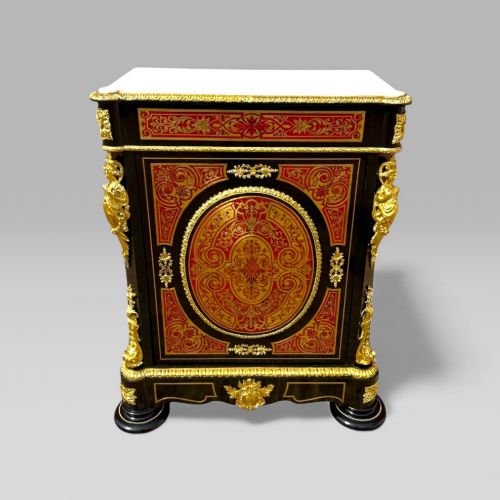

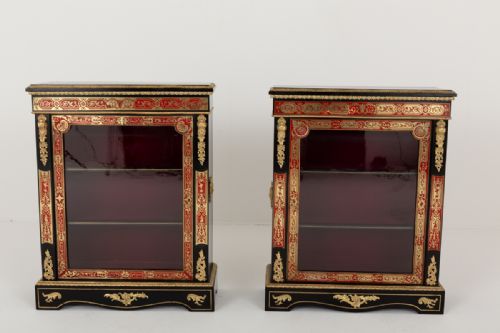


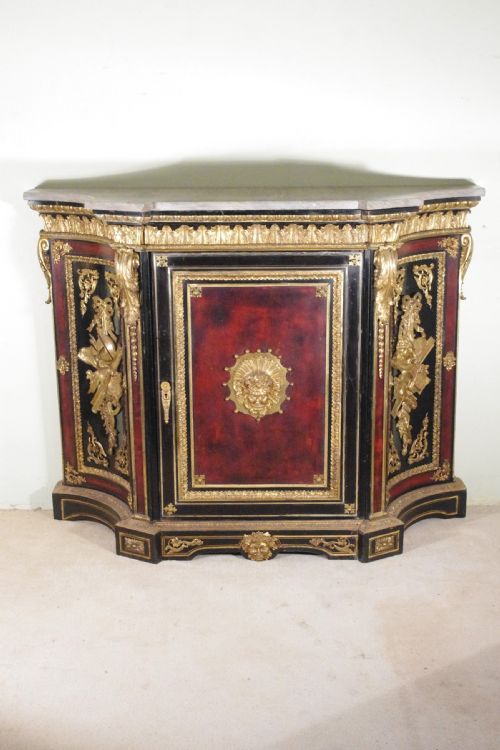


Ebonised Boulle Side Cabinet
These ebonised boulle side cabinet pieces bring striking contrast and French Revival opulence to an interior through meticulous brass and tortoiseshell inlay.
Ebonised Boulle Side Cabinet
An ebonised boulle side cabinet represents the height of nineteenth-century French Revival taste, combining dark timber surfaces with intricate metal and tortoiseshell ornamentation. These pieces primarily date from the nineteenth century, including specific years like 1850, 1860, 1870, and 1880, aligning with the Victorian and Napoleon III periods.
The forms vary across side cabinets, pier cabinets, credenzas, and display cabinets, often featuring serpentine fronts and integrated marble tops. Buyers frequently encounter matched pairs alongside individual credenzas and pier cabinets designed to anchor a formal room.
Originating largely from French design idioms such as Louis XVI style alongside Victorian interpretations, these items serve as both functional storage and dramatic focal points. The visual weight of the ebonised wood provides a stable visual anchor for the luminous brass and tortoiseshell marquetry.
Materials and construction methods
The foundational structure relies upon ebonised wood, frequently paired with walnut beneath the dark finish, shaped into cabinets and credenzas. Craftsmen applied delicate brass and tortoiseshell inlay across the surfaces, creating elaborate patterns characteristic of boulle work.
Mounts cast in ormolu and gilt bronze accent the corners, borders, and feet, providing structural framing and metallic contrast. Marble tops appear frequently, fitted precisely to the serpentine or straight profiles of the cabinet carcasses alongside glass panels in display variations.
Several matched pairs survive intact, proving that nineteenth-century drawing rooms truly loved symmetry.
Distinctions in craftsmanship and materials
Quality rests upon the precision of the brass and tortoiseshell marquetry, where tight joints and crisp cutting separate superior execution from simpler production. The finesse of the engraved details within the brass inlay reveals the hand of a more accomplished artisan.
The weight and chasing of the ormolu and gilt bronze mounts determine the refinement of the piece, as sharper, hand-finished mounts contrast with softer cast alternatives. Furthermore, the selection of the underlying timber and the depth of the ebonised finish dictate the overall aesthetic success of the cabinet.
The Ebonised Boulle Side Cabinet Glossary
- Ebonised wood
- Timber treated to resemble ebony, providing a deep black matte or polished surface that accentuates metallic inlay. This finish became a cornerstone of nineteenth-century cabinetmaking.
- Boulle work
- A form of marquetry utilising brass and tortoiseshell developed during the reign of Louis XIV and revived intensely during the nineteenth century. The technique involves cutting contrasting sheets simultaneously.
- Ormolu
- Gilded bronze mounts applied to furniture edges, feet, and friezes for decorative enhancement and edge protection. The term derives from the French for milled gold.
- Pier cabinet
- A narrow cabinet specifically designed to stand against the wall space between windows. These pieces often feature glass doors and marble tops.
- Credenza
- A larger side cabinet format used for storage and display, frequently fitted with multiple doors and rich metal mounts. They anchor formal reception rooms with substantial presence.
Ebonised Boulle Side Cabinet: Frequently Asked Questions
What is an ebonised boulle side cabinet?
These are nineteenth-century storage pieces constructed from dark ebonised wood and decorated with brass and tortoiseshell marquetry in the French manner.
They often incorporate marble tops and gilt bronze mounts, reflecting Napoleon III and Victorian design influences.
Where should I place a pier cabinet?
Pier cabinets suit narrow wall spaces, particularly the sections of wall situated between large windows or doors.
Their shallow depth allows them to fit comfortably without obstructing walkways while displaying decorative objects behind glass.
How do I care for marble topped cabinets?
Marble surfaces require regular dusting with a soft cloth and immediate wiping of any liquid spills to prevent staining on polished stone.
Avoid using acidic cleaners or abrasive pads that can dull the smooth surface finish over time.
How do I identify Napoleon III style?
Napoleon III pieces draw heavily on earlier French royal aesthetics, particularly Louis XIV and Louis XVI revivals, executed during the nineteenth century.
Expect lavish use of boulle marquetry, ebonised surfaces, and exuberant ormolu mounts that prioritize visual richness.
Are these cabinets sturdy enough for daily use?
Nineteenth-century cabinets provide functional enclosed storage, though their delicate tortoiseshell and brass inlay warrants gentle handling.
They function best when placed away from direct sunlight and extreme humidity fluctuations to protect the traditional adhesives and wood movement.