


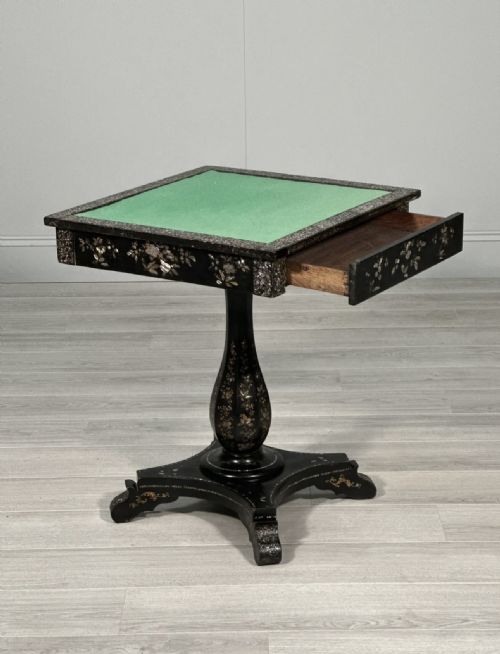

Black Games Table
A black games table brings dark timber, contrasting inlay and clever folding surfaces together for an evening of cards or chess.
Black Games Table
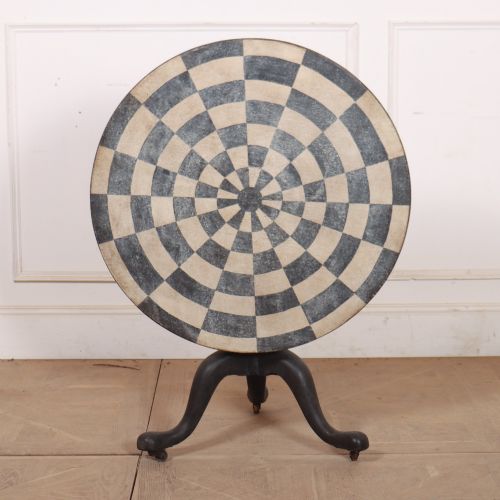
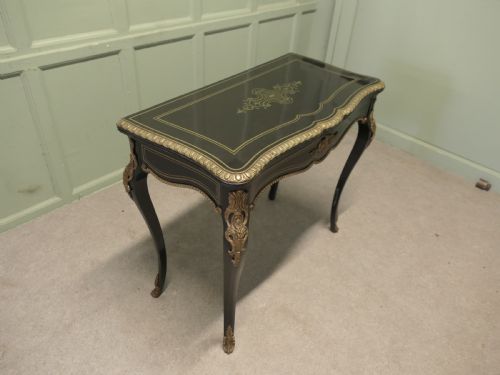
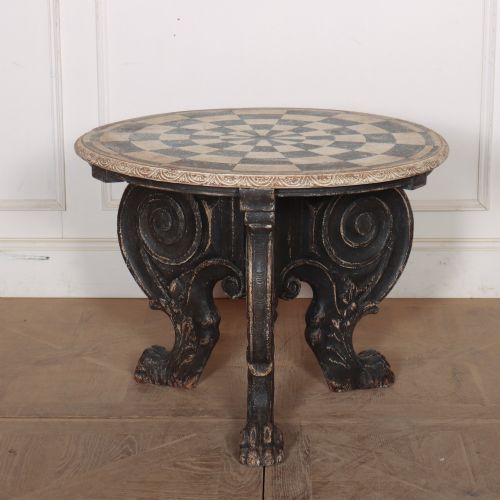
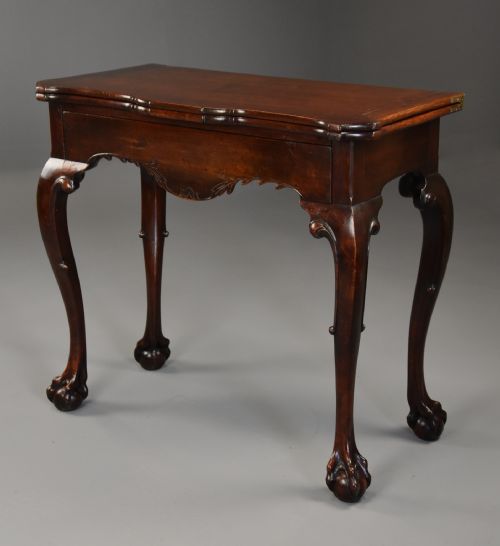
A black games table is a dedicated piece of furniture designed for card playing, chess and social entertainment, usually featuring a folding or pivoting top. When you search for a black games table, you encounter pieces rendered in ebonised wood, dark walnut, lacquer and penwork decoration.
The examples on this page span several distinct historical periods, including the Georgian, Regency and Victorian eras, alongside Edwardian interpretations. You will find tripod designs, envelope tables and folding card tables that double as occasional or tea tables.
Origins vary across English, French, Italian and German workshops, demonstrating diverse approaches to dark-finished gaming furniture. Many retain their original baize or leather playing surfaces beneath the closed top.
How they were made
Cabinetmakers utilised ebonisation processes to stain cheaper timbers like beech or fruitwood to resemble expensive ebony, often pairing the dark finish with brass inlay, penwork or mother-of-pearl. Lacquer and paint provided alternative deep black surfaces for decorative Victorian and Edwardian pieces.
Construction techniques focused on stability and transformation, employing hinged flaps, pivoting tops and delicate tripod bases to support the weight of folding mechanisms. Inlayers integrated brass, boxwood, ebony and mother-of-pearl directly into the dark wooden tops to mark out chess boards or decorative motifs.
A tiny box on this page holds poker chips and Italian silver, proving high stakes happened in small packages.
What varies in quality
The distinction between standard production and top-tier work rests on the crispness of the penwork, the precision of the brass or mother-of-pearl inlay, and the integrity of the ebonised finish. Superior pieces exhibit seamless joints in the folding mechanisms and well-preserved painted or lacquered surfaces.
Cabinetmaking attribution and materials also dictate standing, with solid walnut or fine timber framing outperforming simpler constructions. The subtlety of decorative flourishes, such as parcel gilt accents or finely executed penwork details, separates everyday items from notable examples.
Lamb of Manchester·Howard & Sons·George Merrifield
The Black Games Table Glossary
- Ebonised Wood
- Timber treated with stain or paint to imitate solid ebony, a technique common in Victorian and Regency furniture. It created a sleek, dark surface suitable for contrasting inlay.
- Penwork
- A decoration technique using ink drawn onto a prepared wood surface to create intricate geometric or pictorial designs. Regency tables frequently employed this method for chess boards.
- Baize
- A coarse woollen fabric used to line the playing surfaces of card and gaming tables. It provided a soft, non-slip texture for dealing cards.
- Envelope Card Table
- A square table with four triangular flaps that fold inward to cover the playing surface like an envelope. This form became popular during the Edwardian period.
Black Games Table: Frequently Asked Questions
What is a black games table used for?
These tables served primarily for indoor pastimes such as chess, draughts and card games, offering a stable surface with integrated compartments or folding leaves.
Between games, the tops folded closed or pivoted to function as conventional side or tea tables in the parlour.
How do I identify a Regency penwork table?
Regency penwork pieces feature detailed black ink illustrations drawn directly onto light wood or ebonised grounds, often depicting classical motifs or chess grids.
These designs date from the early nineteenth century and rely on fine hand-drawn linework rather than veneer or marquetry.
Are the playing surfaces original?
Many tables retain their period baize or leather inserts, though heavy use often necessitated replacement over the centuries.
Examining the wear around the edges helps determine whether the playing surface dates to the original manufacture or a later restoration.
How do I care for ebonised wood?
Ebonised surfaces require gentle dusting with a dry microfibre cloth to prevent scratches on the dark finish.
Avoid direct sunlight and harsh chemical cleaners to protect the stain or paint from fading or lifting over time.