
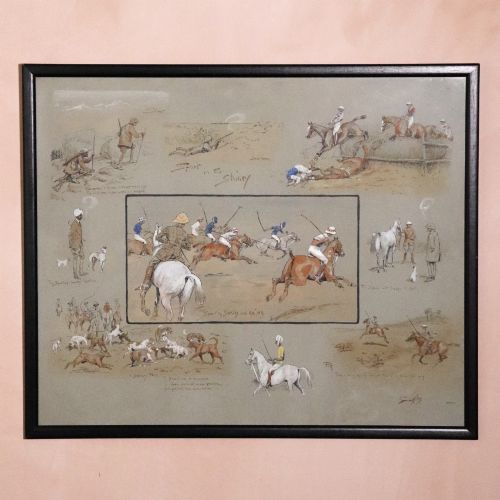


Black Framed Equestrian Picture
A black framed equestrian picture brings the raw energy of the hunting field and the racecourse directly to your walls.
Black Framed Equestrian Picture
A black framed equestrian picture captures the enduring appeal of horses, hounds and riders through historical prints, drawings and paintings. When you search for a black framed equestrian picture, you encounter works spanning from the Georgian era through the Victorian and Edwardian periods up to the mid-twentieth century.
The selections on this page range from hand-coloured engravings and original watercolours to reverse glass paintings and photographic prints. Subjects stretch from named racehorses and fox hunts to military themes and poignant sporting character studies.
Early twentieth-century sporting art dominates the selection, particularly original colour prints by well-known military and hunting artists. These pieces bring a distinct narrative charm, often accompanied by lively handwritten captions or signatures beneath the imagery.
Materials and methods
Artists and publishers utilised paper, wood and glass alongside traditional drawing media including ink, paint, pencil and chalk. Engravings often received meticulous hand-colouring to heighten the drama of the hunt and the rich tones of the horses.
Specialised techniques such as reverse glass painting and eglomise created glossy, reflective surfaces that preserved delicate silhouettes and portraits. Framed behind glass, these works relied on simple wooden mouldings finished in black to contain and frame the action.
Photographic processes and early printing technologies also captured famous racehorses and mounted huntsmen for a growing public. Skilled rubbing techniques recorded large-scale historical subjects like Tang horses onto paper for display.
One cheerful Christmas card from the nineteen-thirties extends festive greetings directly from the hunting field.
Distinctions in quality
Quality rests upon the execution of the hand, whether in the sharp precision of an original engraving or the fluid brushwork of a watercolour. Signed works and original hand-colouring elevate an item above mass-produced decorative plates.
The condition of the paper and the clarity of the underlying ink, pencil or chalk dictate the visual impact of the piece. Crisp lines and stable pigments without heavy fading or excessive foxing maintain the integrity of the original artwork.
The character of the surrounding timber frame and the protection offered by the glass contribute to the overall presentation and preservation of the historic image.
Snaffles·Michael Lyne·Abraham Cooper·Charles Hunt·Francis Calcroft Turner·John Atkinson
The Black Framed Equestrian Picture Glossary
- Engraving
- A printmaking technique where an artist cuts an image into a metal plate to hold ink. Fine lines create detailed and durable representations of horses and riders.
- Eglomise
- A process of applying cold gilding and painting to the rear face of glass. This creates a mirrored, luminous background popular in decorative panels.
- Reverse glass painting
- An artwork applied directly to the back of a pane of glass so the final image is viewed through the front. It yields a distinctive, glossy sheen.
- Horse brass rubbing
- A graphic transfer capturing the raised designs of traditional brass ornaments onto paper using wax or pencil. These large-scale works record historic equine motifs.
- Watercolour
- A painting method using pigment suspended in water-soluble binders on paper. It provides transparent washes that capture the atmosphere of sporting scenes.
Black Framed Equestrian Picture: Frequently Asked Questions
How do I date an equestrian print?
Examine the paper stock, the typography used for captions, and any recorded publishing dates or artist signatures.
Stylistic clues such as Victorian costume or Edwardian sporting attire also help narrow down the decade of production.
Are these works original or reproductions?
The listings feature a mix of original watercolours, hand-coloured period engravings and vintage photographic prints.
Descriptions specify whether an item is a primary drawing, a period printing, or a later eglomise reproduction.
How should I hang sporting art?
Keep these framed pictures away from direct sunlight to protect vulnerable watercolours and tinted paper from fading.
Pairing dark timber mouldings with neutral walls allows the traditional hues of the hunting field to stand out.
What subjects are most common?
Fox hunting scenes, named racehorses, and military equestrian subjects appear frequently across the collection.
Artists often focused on the dynamic movement of hounds and horses during spirited chases across the countryside.