
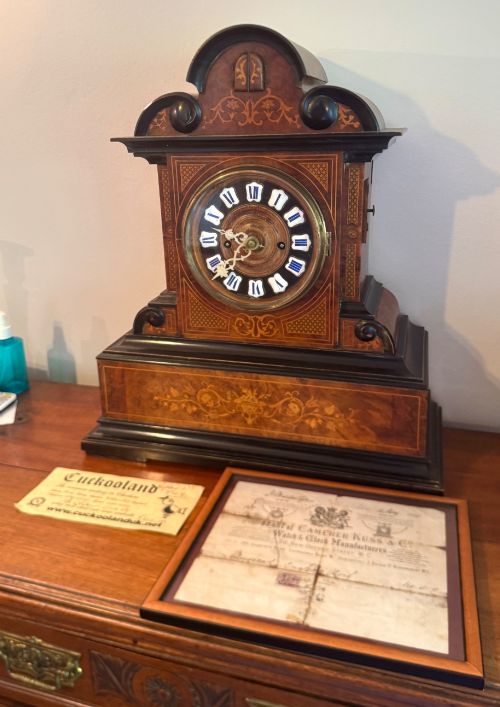


Black Ebonised Table Clock
A black ebonised table clock brings steady mechanics and dark wood presence to a room, drawing the eye with polished timber and bright metal dials.
Black Ebonised Table Clock
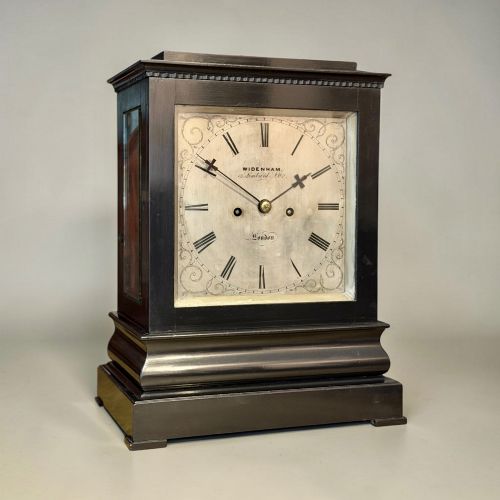
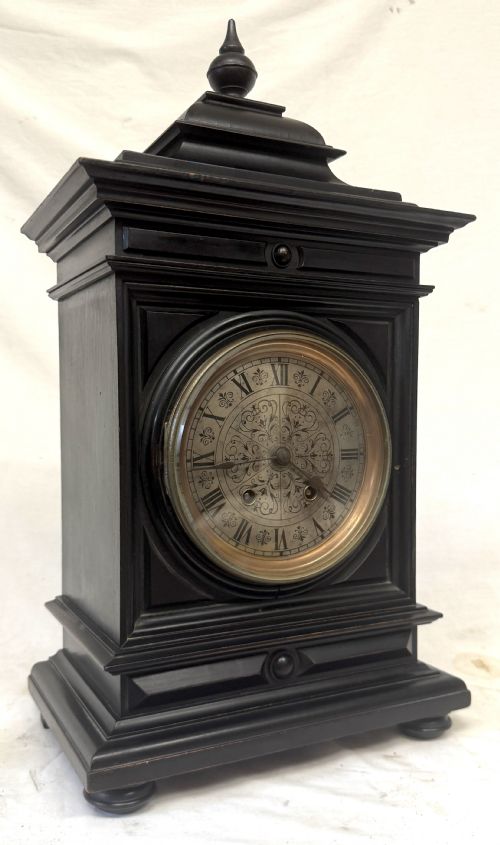
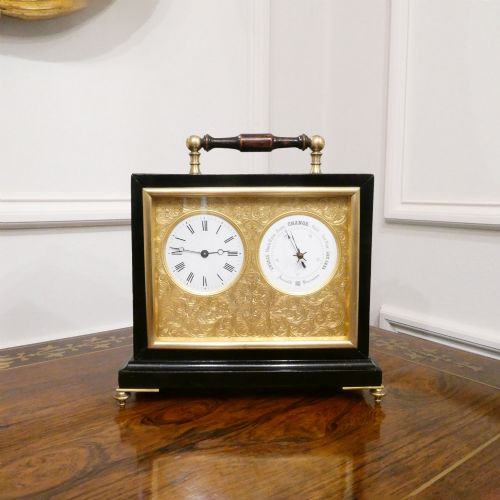
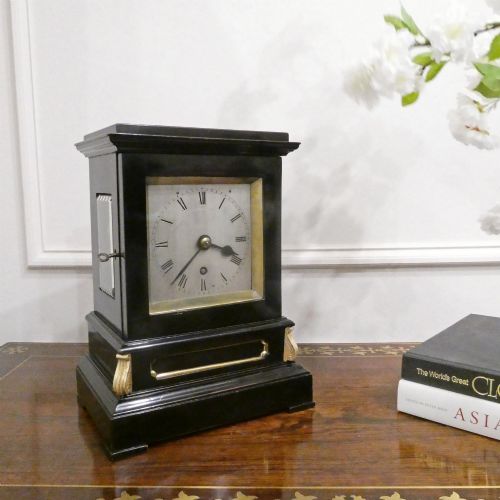
A black ebonised table clock is a timekeeping device housed in timber treated to resemble heavy ebony, appearing frequently in Victorian, Georgian, and Regency forms. Buyers encounter compact bracket clocks, library timepieces, and larger mantel pieces designed to sit securely on flat surfaces.
The objects combine functional movement with architectural presence, utilising glass doors and metal bezels to protect delicate dials. Many examples incorporate striking mechanisms, chiming on bells or gongs to mark the passage of hours.
Makers housed these movements in break-arch, bell-top, or balloon cases shaped from timber, often pairing the dark finish with contrasting mounts. The selection ranges from miniature bracket timepieces to massive musical bracket clocks.
Materials and construction
Craftsmen built the cases primarily from wood treated with ebonising stains to achieve a dense black surface, occasionally incorporating walnut or marquetry inlay. Brass and gilt bronze provide structural and decorative mounts, framing glass panels and dials.
Internal mechanisms rely on brass wheels, steel pinions, and fusee or verge escapements to regulate power from coiled springs or hanging weights. Dials feature silvered metal, enamel, or engraved brass plates marked with numerals and maker signatures.
The selection includes bracket clocks, library timepieces, and mantel clocks housing single, twin, and triple fusee movements.
Judging quality
Quality rests in the crispness of the case moulding and the depth of the ebonised finish, alongside the complexity of the interior movement. Finely hand-engraved backplates and intricate quarter-striking or musical gear trains separate high-output workshop pieces from standard timepieces.
The integration of ormolu mounts, gilt bronze details, and silvered dials indicates superior original commissioning. Proportion and the precision of the joinery in break-arch or bell-top cases further distinguish finer examples.
Widenham of London·Lenzkirch·John Witherston of Hereford·John Bull of Bedford·Henry Jones·Des Granges of London·Phillips Brothers·Thomas A Paris·Richard Rooker·Payne and Co·Grimaldi and Johnson·Somersall London·Andrew Marchant·Berguer of the Strand·William Withers·John Leroux·John Fletcher·Barraud and Lunds·John Taylor·William Smith London·Isaac Hurley·Joseph Lum·D Robertson of Perth·Henry Marc
The Black Ebonised Table Clock Glossary
- Ebonised wood
- Timber treated with stain or pigment to imitate genuine ebony. This finish provides a uniform dark surface popular in 18th and 19th-century cabinet making.
- Fusee
- A conical pulley used in clock mechanisms to maintain equal power as the mainspring unwinds. It ensures consistent force reaches the escapement for accurate timekeeping.
- Verge escapement
- An early type of clock and watch escapement controlled by a balance wheel or foliot. It creates the characteristic ticking sound in older bracket clocks.
- Bracket clock
- A portable spring-driven clock originally designed to rest upon a matching wall bracket. Many examples retain flat bases suitable for placement on tables and mantelpieces.
- Ormolu
- Gilt bronze applied to furniture and clock cases for decorative contrast. The technique involves coating copper alloy with a finely ground mercury and gold amalgam.
Black Ebonised Table Clock: Frequently Asked Questions
How do I wind a fusee clock?
Insert the winding key into the dial aperture and turn it steadily clockwise until resistance signals full tension. Take care not to overwind the mainspring.
Ensure the pendulum or balance wheel remains undisturbed during the process to protect the delicate escapement inside the ebonised case.
Where should I place a table clock?
Select a sturdy surface away from direct sunlight, draughts, and dampness to protect the timber case and internal metalwork. A level mantelpiece or sideboard works well.
Keep the clock away from heavy vibrations that might disrupt the pendulum swing or interfere with the verge or anchor escapement.
What is a single fusee movement?
A single fusee movement uses one conical drum and chain to drive the timekeeping train. It provides steady power without striking complications.
Clocks with this mechanism focus purely on time rather than chiming quarters or playing tunes on bells.