




Black Carved Library Armchair
A black carved library armchair anchors a study with serious presence, offering deep seating and sturdy wooden frames.
Black Carved Library Armchair
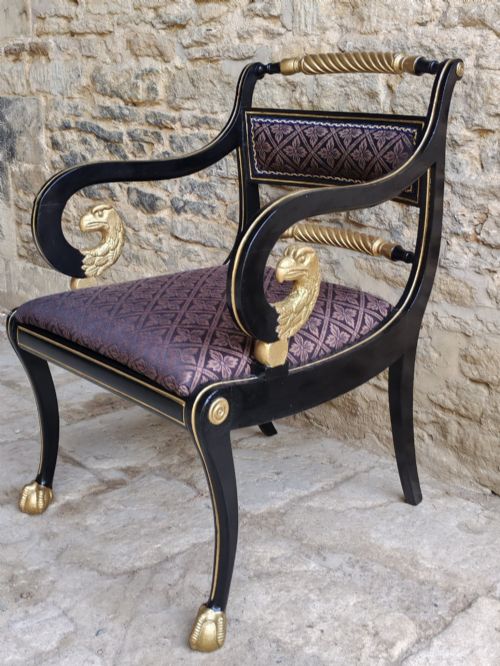
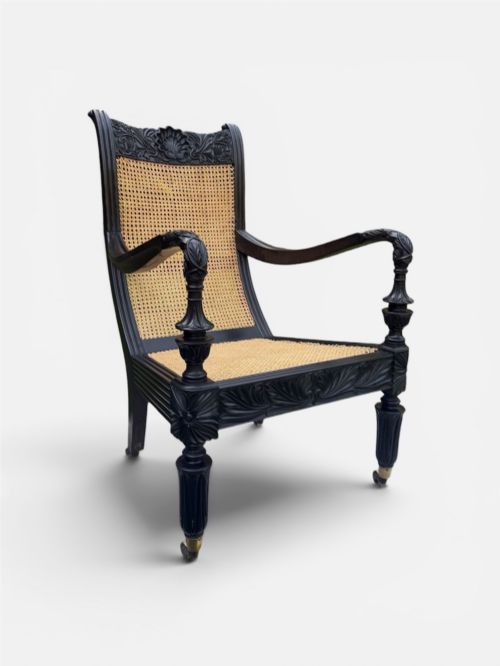
A black carved library armchair brings together functional study seating and decorative woodwork from the Georgian, Regency, and Victorian periods. These heavy armchairs and desk chairs appear in ebonised wood, black lacquered finishes, and solid ebony, alongside dark mahogany, walnut, and oak.
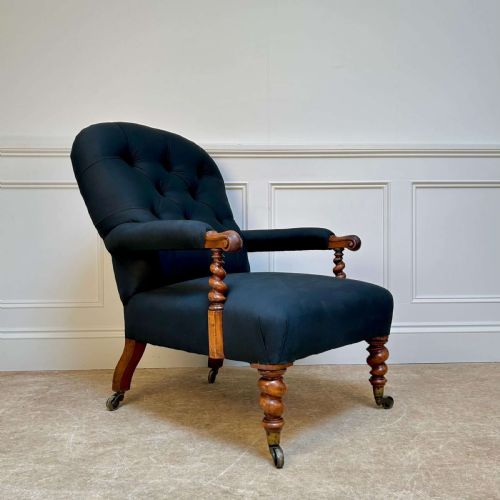
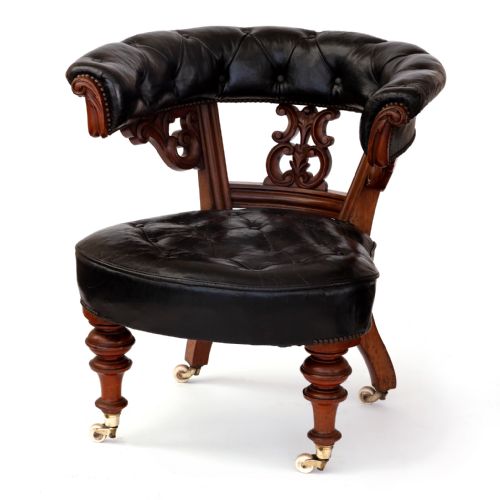
The selection on this page centres on 19th-century interpretations, drawing upon Regency, William IV, and Victorian Gothic Revival styles. You encounter open armchairs, tub chairs, and master's armchairs featuring elaborate hand-carved details and original leather or fabric upholstery.
Materials and construction methods
Cabinetmakers constructed these frames using dense timbers like mahogany, oak, and walnut, frequently applying ebonisation or black lacquer to achieve a uniform dark surface. Hand-carved ornament defined the styles, ranging from classical swags and lambrequin back splats to heavy Gothic tracery.
Seating portions relied on traditional upholstery methods, securing leather and fabric coverings over sturdy frames sometimes accented with brass detailing.
Distinctions in quality and execution
Superior examples separate themselves through the crispness of the hand-carving and the selection of dense, durable timbers beneath the black finish. The depth and precision of ornamental motifs, such as lambrequin back splats or Gothic tracery, indicate the skill of the workshop.
The integration of original materials, including period leather coverings and structural brass elements, elevates an armchair above standard production pieces from the same era.
Hindley & Sons·W & T Avery
The Black Carved Library Armchair Glossary
- Ebonised wood
- Timber treated to resemble ebony through staining or painting. This finish gained popularity during the 19th century to create dramatic contrast in formal interiors.
- Lambrequin
- A decorative motif resembling fabric drapery or leather trimming. In chair design, it often appears carved along the top rail or back splat.
- Gothic Revival
- An architectural and decorative style drawing on medieval forms. Pieces in this manner display pointed arches, heavy tracery, and robust wooden construction.
- Tub chair
- An upholstered armchair with a continuous curved back and arms forming a low, rounded enclosure. This form provides enclosed comfort for reading and study.
Black Carved Library Armchair: Frequently Asked Questions
What defines a library armchair?
A library armchair provides sturdy support and generous proportions designed for prolonged periods of reading and study at a desk or table.
These pieces typically feature substantial wooden frames, upholstered seats, and supportive armrests built to withstand daily use in a private study or library.
How do I identify a Regency library chair?
Regency library chairs date from the early nineteenth century and frequently display classical motifs such as carved mahogany frames and swag back splats.
They often incorporate traditional open arm designs and polished timber surfaces reflecting the neoclassical taste of the period.
Are these chairs suitable for daily use?
Nineteenth-century library armchairs were built for heavy domestic use from dense hardwoods like mahogany, oak, and walnut.
With sound structural frames and durable leather or fabric coverings, they function effectively as daily desk or reading chairs in modern spaces.
What is ebonised wood?
Ebonised wood is timber treated with a dark finish to mimic solid ebony, which was scarce and expensive during the nineteenth century.
This technique allowed cabinetmakers to produce striking black furniture while utilising sturdy structural timbers like mahogany or oak.