


Birch Centre Table
A birch centre table brings pale, figured wood and sculptural form to a room, offering both practical surface space and distinct period character.
Birch Centre Table
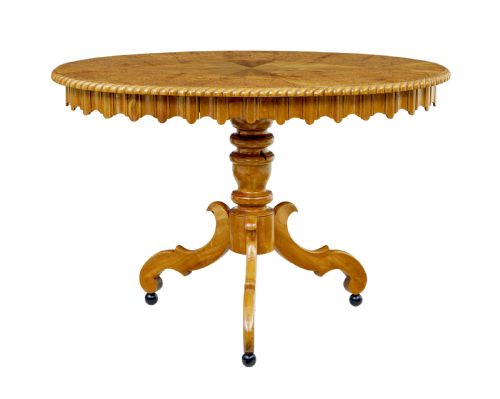
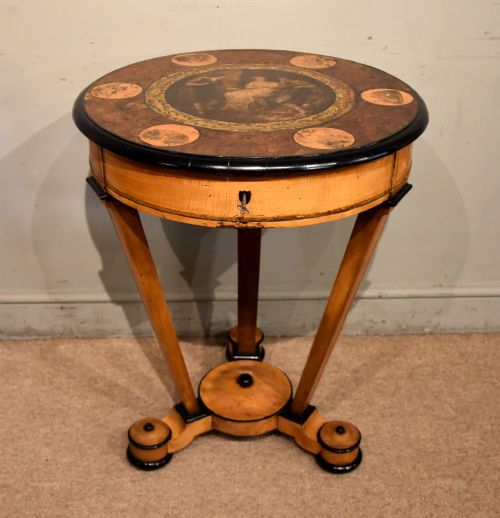
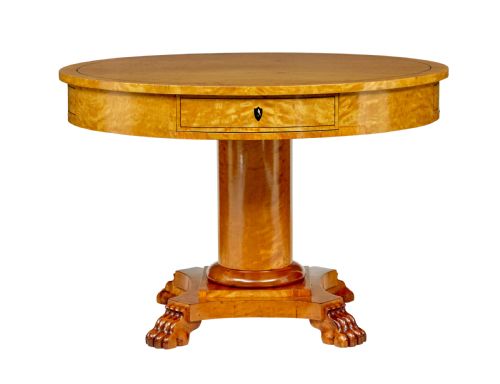
A birch centre table serves as a freestanding focal point in a room, designed to be viewed from all sides rather than pushed against a wall. The pieces found here span the nineteenth century and the twentieth century, taking forms such as circular tables, oval tables, occasional tables, coffee tables, and breakfast tables.
Swedish Biedermeier and Art Deco styles dominate the selection, alongside Victorian and Scandinavian Art Deco pieces. Makers and designers from Sweden and Britain shaped these works, utilising the striking grain of the timber to create functional surfaces for drawing rooms and parlours.
How They Were Made
Cabinet makers utilised birch, satin birch, and burr birch, often applied as fine veneers over stable secondary woods to showcase dramatic, swirling figure patterns. Ebonised wood and ebony details provided sharp tonal contrast, while inlay work added geometric or botanical ornamentation.
Structural elements frequently incorporated brass fittings such as cast solid brass sabots on the feet. Turning, carving, and tilt-top mechanisms required high technical skill to ensure stability alongside decorative elegance.
Periods represented span from the early nineteenth century through to Art Deco production in the 1920s and 1930s.
What Varies in Quality
Quality rests primarily on the choice of timber and the liveliness of the grain figure, where intensely burred or figured satin birch commands greater visual presence than plain stock. The crispness of the carving, the precision of the veneer matching, and the integrity of the original construction dictate the standing of each piece.
Proportion and restraint in ornament separate finer examples from simpler workshop productions. Pieces retaining untouched surfaces and original brass mounts demonstrate superior preservation and craftsmanship.
Cottier and Co
The Birch Centre Table Glossary
- Biedermeier
- A style originating in Central Europe during the nineteenth century characterised by clean lines, utilitarian comfort, and an emphasis on domestic warmth through polished veneers. It largely rejected heavy historical ornamentation in favour of architectural simplicity.
- Burr birch
- A specialised timber growth containing clustered bud formations that create intricate, swirling patterns when sliced into veneer. Cabinet makers prized this wood for its decorative impact on primary table surfaces.
- Satin birch
- A timber featuring a natural golden sheen and shimmering grain that reflects light across the surface. It was frequently selected for high-status nineteenth-century occasional and breakfast tables.
- Sabot
- A protective or decorative metal sleeve fitted to the foot of a table leg. Brass sabots frequently appeared on nineteenth-century art furniture and centre tables.
- Tilt top
- A mechanical table design allowing the top to pivot into a vertical position when not in use. This clever engineering saved floor space in smaller domestic rooms.
Birch Centre Table: Frequently Asked Questions
What is a birch centre table?
A birch centre table is a freestanding piece of furniture designed to sit in the middle of a room rather than against a wall. These tables provide a decorative and practical surface using pale, figured birch timbers.
They appear in various forms, including circular, oval, and drum shapes, originating mainly from nineteenth-century Sweden and twentieth-century design movements.
How do I date a birch table?
Dating relies on stylistic clues, construction methods, and the specific treatment of the wood. Nineteenth-century pieces often display Biedermeier or Victorian proportions, while twentieth-century examples show Art Deco or Scandinavian modernist lines.
Examining the underlying woods and joinery helps confirm the era in which the table was constructed.
How do I care for birch veneer?
Birch veneer requires protection from direct sunlight and excessive moisture to prevent fading and lifting of the delicate wood layers. Regular dusting with a soft, dry cloth maintains the polished finish without harming the timber.
Avoid placing hot items or liquids directly on the surface to preserve the historical polish.
Where should I place a centre table?
A centre table works best in an open space where it can be walked around and viewed from all angles, such as the middle of a living room or a large hallway. Its finished underside and balanced proportions make it suitable as a focal point.
Pairing it with a central lamp or decorative objects enhances its role in the room.