

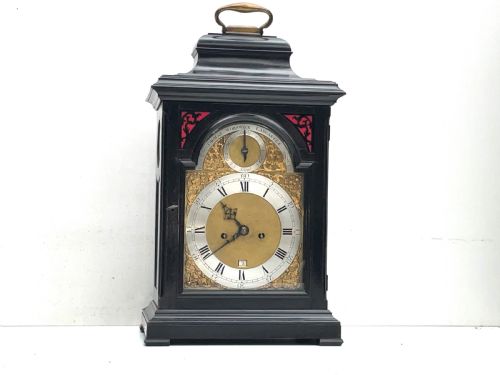


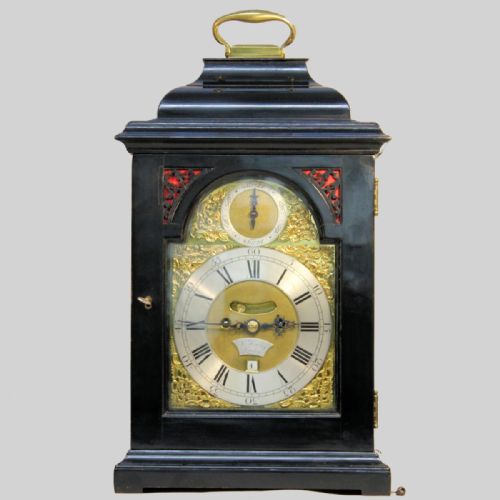


Bell Top Bracket Clock
A bell top bracket clock is a handsome table timekeeper with a distinct flared superstructure, prized for its mechanical ingenuity and presence.
Bell Top Bracket Clock
A bell top bracket clock is a substantial mechanical timekeeper designed to sit on a table, bracket, or mantelpiece. Most examples on this page date from the eighteenth century and the Georgian period, anchored by traditional London makers.
The defining characteristic is the bell top case silhouette, sometimes inverted, housing complex movements like verge escapements, twin chain fusees, and quarter repeating mechanisms. These pieces vary from restrained ebonised wood to figured mahogany and occasional chinoiserie decoration.
How they were made
Cabinetmakers constructed the cases using timbers such as mahogany, walnut, and ebonised wood, often housing the works in architectural proportions. Glazed access doors and brass carrying handles or mounts completed the wooden housing.
Clockmakers fitted brass movements with steel components, silvered metal dials, and enamel elements. Intricate mechanisms like fusee chains and verge escapements regulated the time accurately while driving the striking trains.
Bell Top Bracket Clock Retail Price Guide 2026
Typical asking prices for bell top bracket clock among the pieces listed under this phrase on Sellingantiques today, from the lower quarter to the upper quarter. They describe what is for sale here now, not the wider market.
Quarter repeating mechanisms let owners check the time in pitch darkness simply by pulling a cord.
What varies in quality
Cabinet quality and dial execution also define the hierarchy. Crisp silvered metal engraving, well-preserved ebonised or mahogany cases, and signed dials by established London makers elevate an example.
Somersall London·Andrew Marchant·William Withers·John Fletcher·John Taylor·Watson London·Benjamin Maud·Richard Peckover·James Evans·Isaac Hurley·Joseph Lum
The Bell Top Bracket Clock Glossary
- Bell top
- A case style featuring a stepped or flared dome shape on the upper section, designed to house the bell and sound the hours clearly.
- Verge escapement
- An early mechanical regulating mechanism that controls the release of power in the gear train, paired with a pendulum or balance spring.
- Fusee
- A conical pulley used in mechanical clocks to maintain an even pull on the movement as the mainspring unwinds.
- Quarter repeating
- A mechanism that sounds the hours and the elapsed quarters of the hour on demand when a cord or lever is pulled.
Bell Top Bracket Clock: Frequently Asked Questions
What is a bell top bracket clock?
A bell top bracket clock is a portable mechanical timepiece enclosed in a wooden case with a distinctive curved or stepped upper dome. They were built to sit on tables or wall brackets in prominent rooms.
Most surviving examples originate from eighteenth-century London workshops. They combine fine cabinetmaking in woods like mahogany and ebonised timber with intricate brass and steel movements.
How did people use them historically?
These clocks served as both precision timekeepers and status symbols for wealthy households. Their portable nature allowed owners to move them between rooms as needed.
The striking and repeating mechanisms allowed inhabitants to tell the time in the dark by listening to the bell strikes. They were placed securely on tables or dedicated wall brackets to project the sound.
How do I live with one today?
Living with a bell top bracket clock requires finding a stable surface away from direct sunlight, drafts, and heavy vibrations. Winding the clock regularly keeps the mechanical gear train functioning correctly.
You should consult a professional horologist for periodic oiling and maintenance. Allowing the striking train to chime brings the historical atmosphere of the piece into a modern room.
How do I tell periods apart?
Earlier eighteenth-century pieces often feature ebonised wood cases, verge escapements, and square brass dials signed by London makers. The materials and dial layouts reflect the prevailing tastes of Georgian cabinet design.
Later nineteenth-century and early twentieth-century examples introduce different escapements, such as the tic tac, or alternative decorative schemes like chinoiserie. Examining the wood selection and movement construction helps determine the era of manufacture.