


Barley Twist Stick Stand
These barley twist stick stand examples bring sculptural turned timber and practical hallway storage together, offering a handsome anchor for country house or period interiors.
Barley Twist Stick Stand
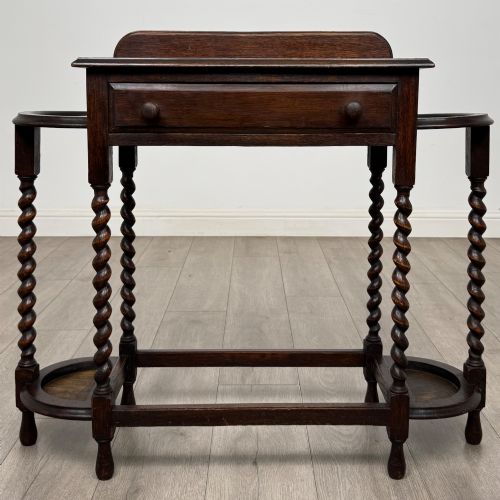
When you search for a barley twist stick stand, you look at hallway furniture designed to hold wet umbrellas and walking sticks without cluttering the floor. The examples seen here combine sturdy structural timbers with the characteristic helical turned column that defines the style.
Most pieces date from the late nineteenth century through to the early twentieth century, spanning Victorian and Edwardian periods as well as the nineteen-twenties. You meet versions in solid oak alongside hybrids that incorporate cane panels, brass fittings, or painted cast iron components.
Makers often integrated these stands into larger hall pieces or built them as freestanding rectangular and square frames. The spiral turning runs through the upright supports, providing a visual rhythm that links practical entryway storage with Jacobean revival decorative tastes.
How they were made
Carpenters shaped the timber frames using seasoned oak, relying on traditional joinery to keep tall uprights stable under the weight of wet umbrellas and heavy walking sticks. Lathes cut the helical barley twist columns, demanding precise hand-guidance to maintain a consistent pitch down the shaft.
Makers incorporated auxiliary materials like woven cane for side panels and cast iron for drip trays or structural bases to handle moisture. Brass details appeared as mounting hooks, rail accents, or reinforcement plates that secured the frame joints against daily wear.
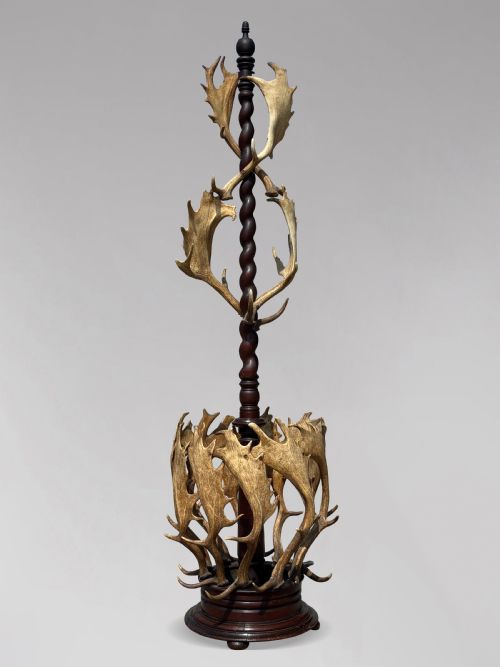
Listings feature oak, brass, cast iron, cane, and antler across Victorian, Edwardian, and nineteen-twenties periods.
What varies in quality
The distinction between standard entryway furniture and superior craftsmanship lies in the depth and sharpness of the timber turning. Hand-cut barley twists display crisp edges and balanced proportions, whereas simpler production pieces show shallower, softer profiling on the column.
Material selection dictates longevity, with dense quarter-sawn oak and heavy cast iron bases outlasting lighter pine or thin softwood substitutes. Integration of secondary elements like woven cane and fitted metal drip trays separates utilitarian utility items from finer country house examples.
J. Parker of Woodstock·T Thomason & Co
The Barley Twist Stick Stand Glossary
- Barley twist
- A decorative turning technique resembling a spiral helix or rope. It became prominent in Jacobean furniture and saw major revivals during the Victorian and Edwardian periods.
- Bergere
- A type of woven cane panelling used for ventilation and decoration on furniture sides. It lightens the visual bulk of heavy timber hall stands.
- Hall stand
- A multi-functional piece of hallway furniture combining coat hooks, mirrors, umbrella storage, and sometimes a glove drawer. It served as a grand reception piece in period homes.
- Cast iron
- A strong, heavy alloy poured into moulds to form rigid structural parts or decorative bases. It provides essential counter-balance and corrosion resistance in umbrella stands.
- Jacobean Revival
- A nineteenth-century design movement copying seventeenth-century English furniture styles. It reintroduces dark oak, deep carving, and spiral turnings into Victorian interiors.
Barley Twist Stick Stand: Frequently Asked Questions
What is a barley twist stick stand?
It is a hallway accessory featuring spiral-turned wooden columns designed to store walking sticks and umbrellas upright.
These pieces use sturdy timber frames combined with metal drip trays to catch water from wet weather gear.
How do I date a stick stand?
Dating relies on timber types, hardware methods, and stylistic cues such as Victorian carving or Edwardian simplicity.
Archival records show these items span the nineteenth century through the early twentieth century, particularly around eighteen-eighty to nineteen-twenty.
Where should I place it?
Position the piece in an entrance hall or porch where guests enter and drop off walking gear.
Ensure there is enough clearance around the stand to allow wet items to dry without damaging surrounding walls.
How do I care for oak and cane?
Maintain the timber with appropriate wax or polish to keep the grain nourished and protected against moisture.
Keep woven cane panels clean with a soft brush and avoid placing soaking items directly against dry wood.