
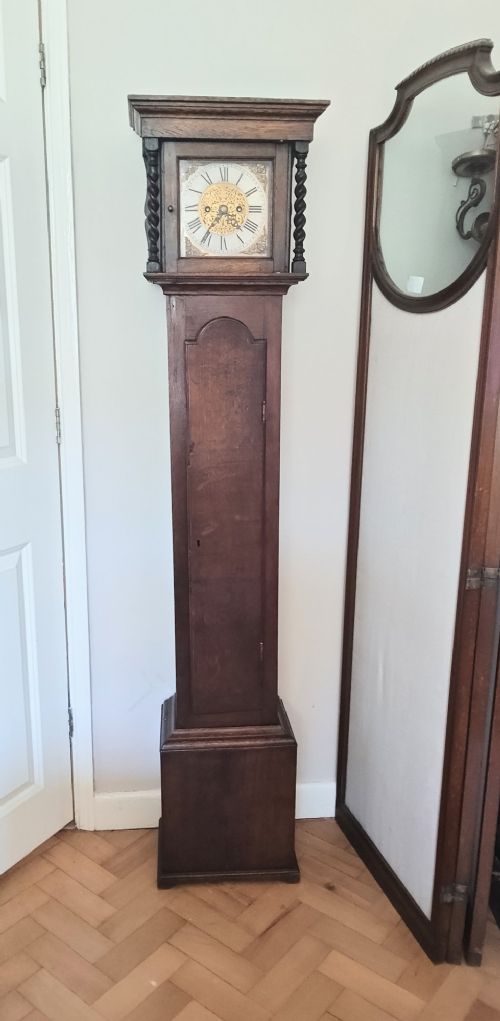
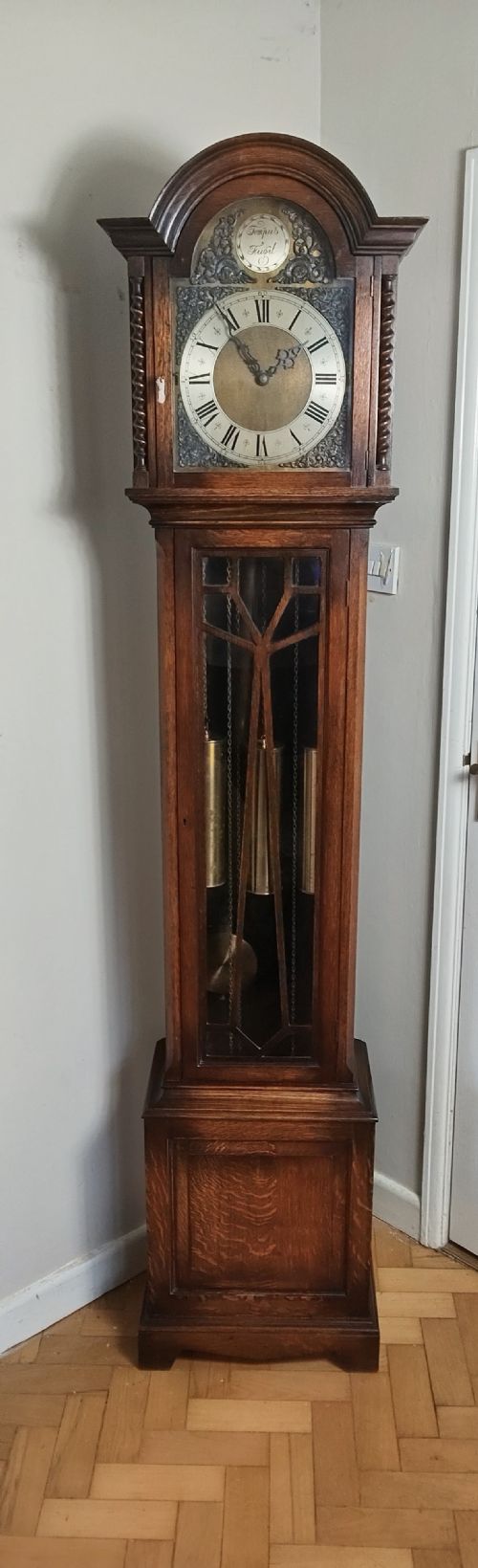
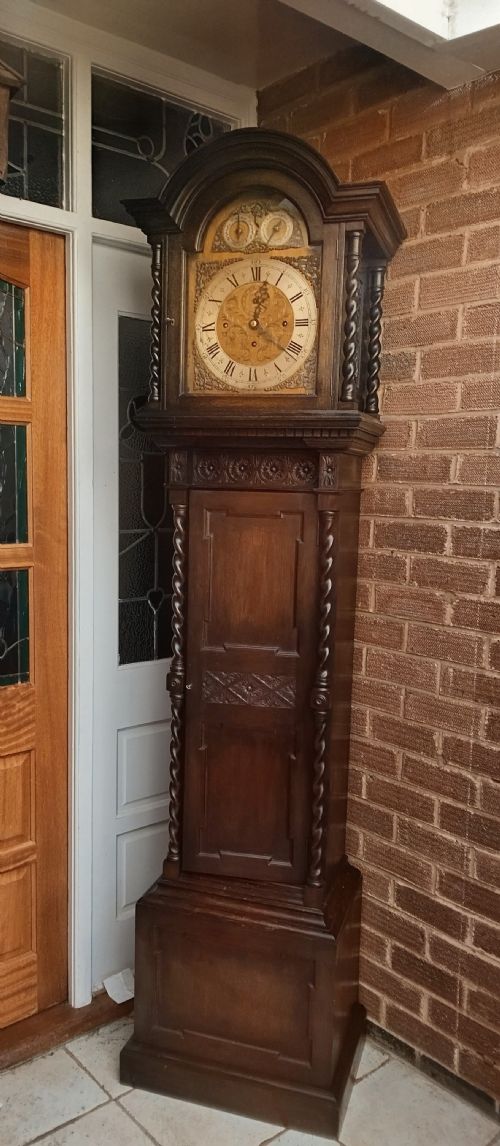
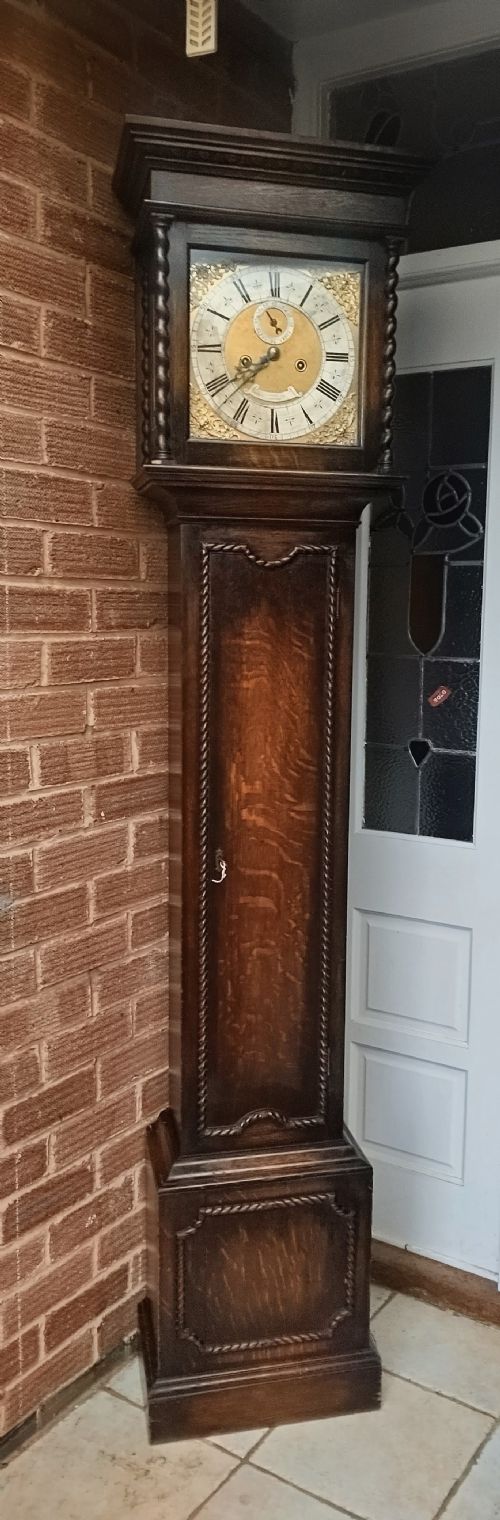


Barley Twist Grandfather Clock
A barley twist grandfather clock brings architectural turnery and rhythmic mechanical timekeeping together in a substantial floor-standing case.

Barley Twist Grandfather Clock
A barley twist grandfather clock comprises tall floor-standing timepieces featuring helical turned columns flanking the dial or trunk door. The selection spans robust oak examples from the Edwardian period and nineteen-twenties alongside smaller scaled grandmother clocks.
Makers housed these movements in diverse regional formats, incorporating styles from seventeenth-century revivals to Edwardian adaptations. Oak and walnut predominate, often enclosing brass dials and glazed doors.
Buyers encounter variations ranging from thirty-hour movements to triple-weight chiming mechanisms. Smaller proportions designated as grandmother clocks appear alongside full-scale longcase clocks.
Materials and Construction
Cabinetmakers utilised solid timbers such as oak, walnut, mahogany, and ebony to construct the tall trunk and hood enclosures. Turned columns were shaped by hand or lathe to create the characteristic helical twist.
Mechanisms combined brass plates, wheels, and painted iron or brass dials with glass viewing panels fitted to the trunk doors. Movement weights were cast in metal to power the timekeeping and chiming trains.
Listings feature oak, walnut, mahogany, and ebony cases housing brass and painted iron dials across seventeenth-century and twentieth-century periods.
Assessing Quality
The refinement of the helical turning on the hood columns and the crispness of the wood carving dictate visual merit. Timber selection, such as figured walnut or quarter-sawn oak, separates standard production from superior cabinetwork.
Complexity of the movement, including triple-weight chiming trains or musical mechanisms by noted makers, elevates the horological status of the piece.
Edward East·Joseph Knibb·William Noke·John Drew·Henry Massy
The Barley Twist Grandfather Clock Glossary
- Grandmother clock
- A smaller version of the traditional longcase clock, typically produced during the twentieth century. These shorter floor clocks suit domestic spaces with lower ceilings.
- Longcase clock
- Alternative term for a grandfather clock, describing a tall floor-standing timekeeper enclosed in a wooden case. The weight-driven movement hangs suspended within the trunk.
- Barley twist
- A decorative helical turning resembling a twisted rope, frequently utilised on the hood columns of these clocks. This woodwork style draws on seventeenth-century Jacobean design traditions.
- Triple weight
- A movement driven by three separate weights operating the timekeeping, striking, and chiming trains. These mechanisms often play Westminster or multiple tunes.
- Dial
- The face of the clock displaying the hours and minutes, constructed from brass or painted iron. Many feature engraved spandrels in the corners.
Barley Twist Grandfather Clock: Frequently Asked Questions
What is a grandmother clock?
A grandmother clock is a scaled-down version of the traditional longcase clock, built with shorter proportions while retaining a weight-driven movement.
These pieces emerged strongly in the twentieth century to fit modern domestic spaces without sacrificing mechanical authenticity.
How do barley twist columns date?
Helical turning originates in seventeenth-century furniture design, particularly during the William and Mary and Restoration periods.
Revival movements in the Victorian era and the nineteen-twenties replicated this turned woodwork on grandfather clock hoods and trunks.
What powers the chiming mechanism?
Triple-weight movements use three suspended metal weights inside the trunk to drive the timekeeping, hour striking, and melody trains separately.
Heavier weights require periodic manual winding using a key or crank inserted through the dial.
Where should I place a longcase clock?
These tall floor clocks require a stable, plumb wall surface away from direct heat sources and dampness to protect the wooden case and movement.
Adequate ceiling height is essential, particularly for full-scale grandfather clocks compared to smaller grandmother variants.