
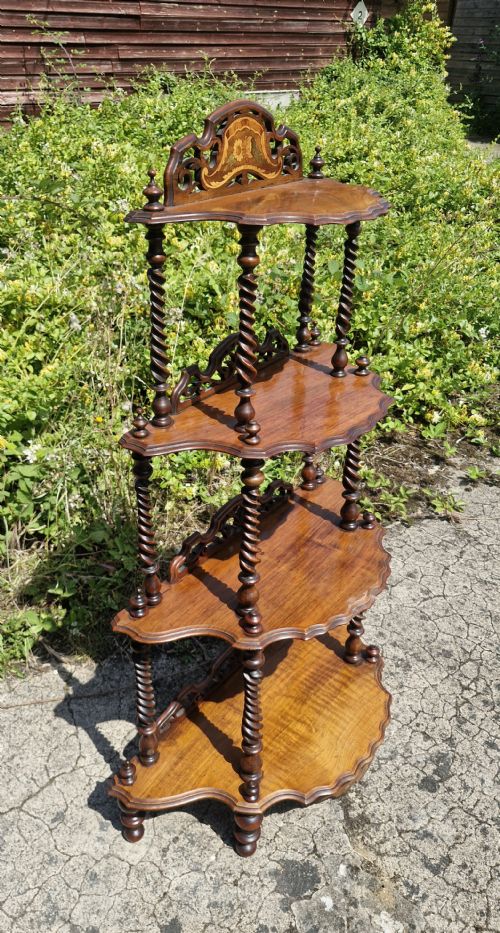
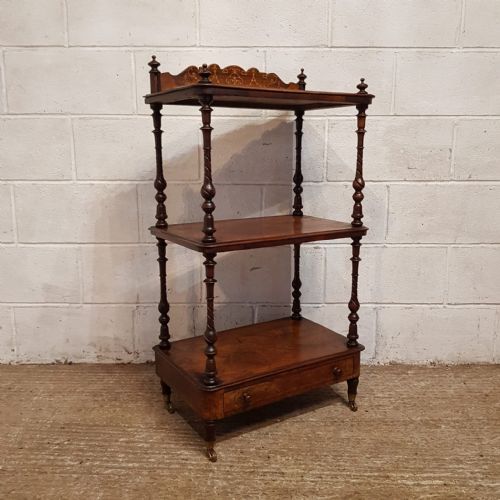


Barley Twist Etagere Stand
These barley twist etagere stand options offer tiered display surfaces shaped by turned columns, perfect for holding books and decorative objects.
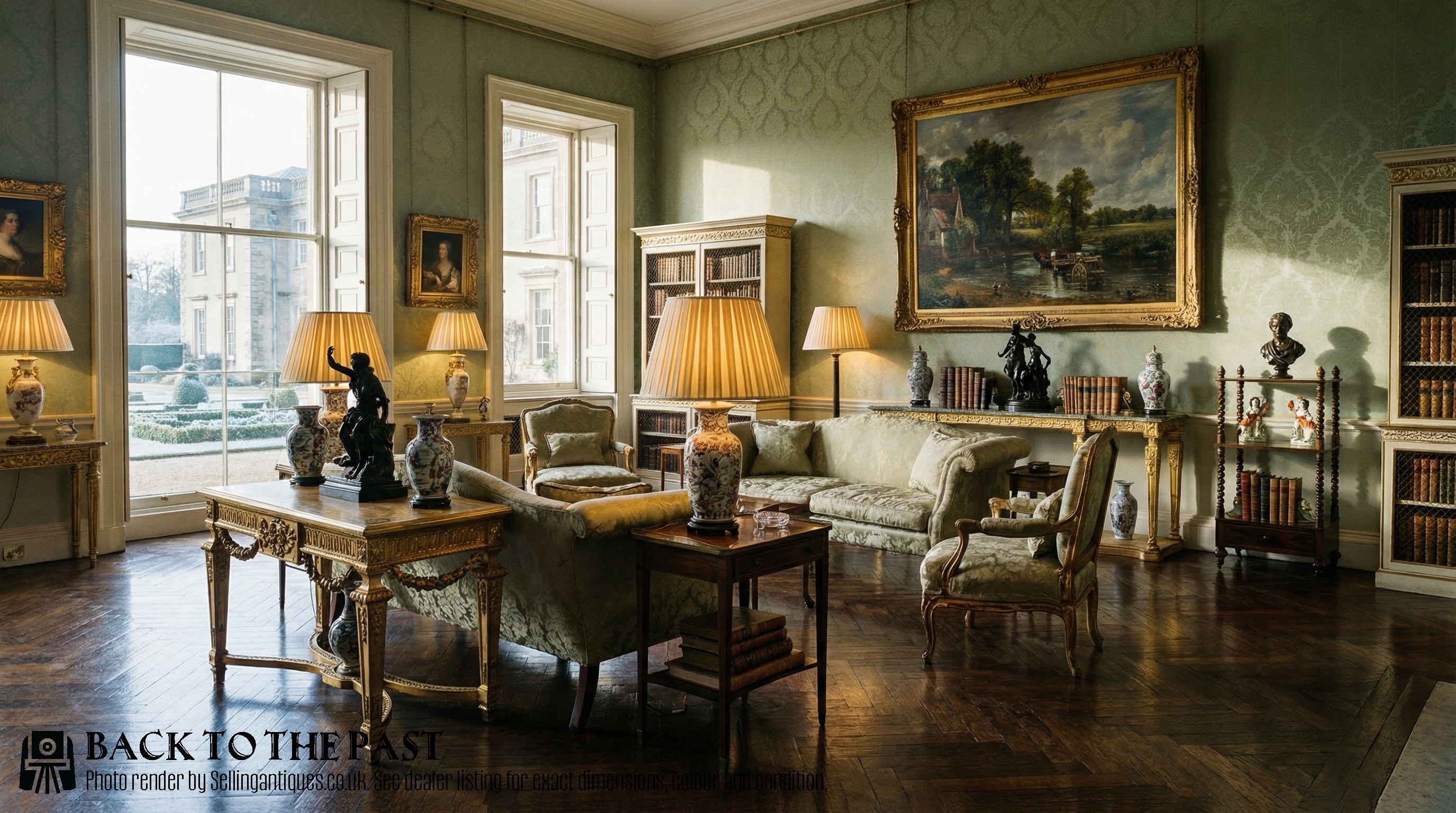
Barley Twist Etagere Stand
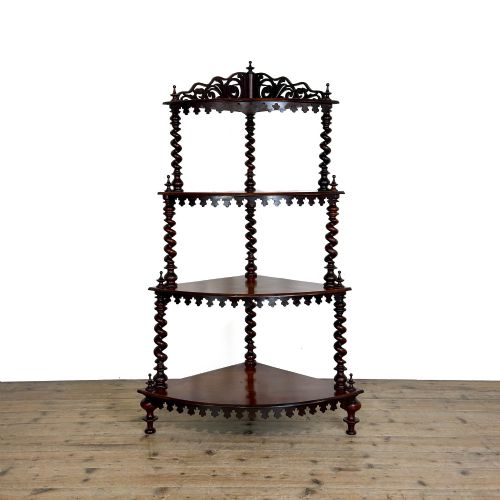
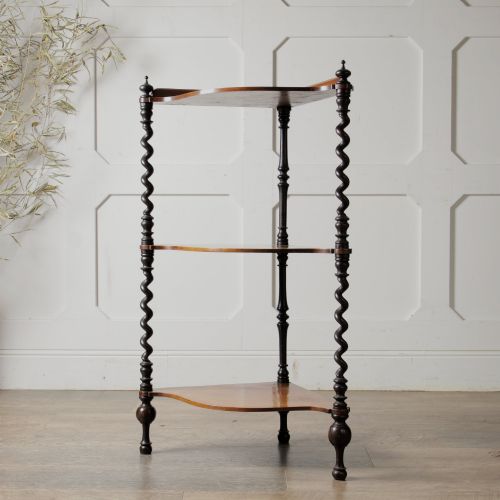
A barley twist etagere stand combines multiple open tiers for display with spirally turned upright supports. These pieces primarily date from the Victorian period and the nineteenth century, taking forms such as corner units, multi-tiered shelving, and occasional drawer-fitted tables.
The version most commonly met on this page is the walnut or rosewood Victorian whatnot with several tiers. These function equally well as corner display stands or freestanding shelving units in a reception room.
Alternative iterations span from Regency rosewood examples to Anglo-Indian padouk pieces and French oak interpretations. Buyers select them for vertical storage that occupies minimal floor space while displaying collections clearly.
Materials and construction methods
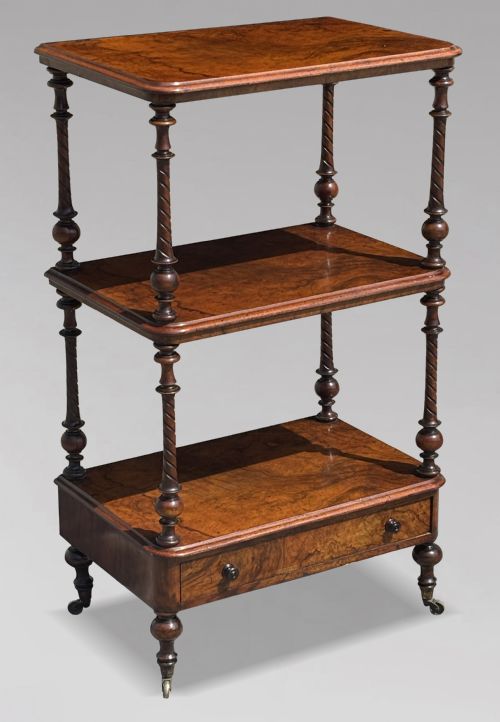
Cabinetmakers constructed these pieces using dense hardwoods such as walnut, burr walnut, mahogany, and rosewood. Sections of burr walnut provide striking natural grain patterns across the shelves and tabletops.
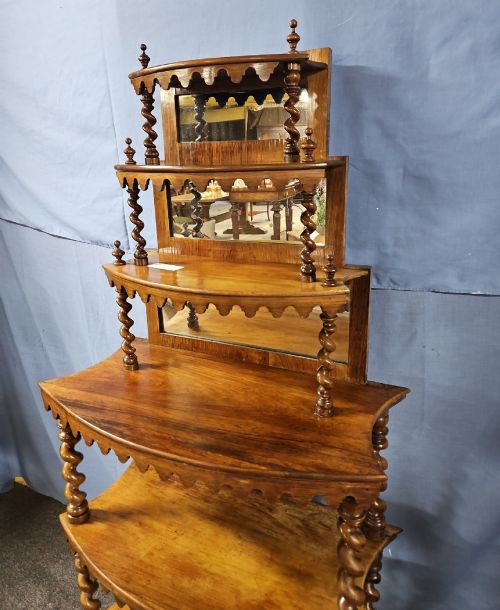
Vertical supports frequently feature hand-turned spiral or hollow barley twist detailing. Additional decorative elements incorporate brass accents, glass panels, mirror backs, and delicate wood inlay.
Tiers connect securely to the upright posts using traditional joinery methods suited to multi-level weight distribution. Certain variations integrate functional lower drawers or compartmentalised sections like canterbury bases.
Some nineteenth-century makers evidently decided standard vertical posts were too dull, carving them into wonderfully dizzying hollow spiral twists.
Distinctions in craftsmanship and materials
The choice of primary timber and veneer heavily influences the distinction between standard and superior examples. Highly figured burr walnut and richly grained rosewood sit at the upper end of the scale.
The crispness and depth of the turned barley twist columns indicate the skill of the original maker. Finer items exhibit precise symmetry and careful finishing across every tier and joint.
The Barley Twist Etagere Stand Glossary
- Etagere
- A piece of furniture consisting of a set of open shelves for displaying small ornaments. The design originated in France during the eighteenth century.
- Whatnot
- A multi-shelved stand used for displaying or storing articles. It became extremely popular throughout the Victorian era in both freestanding and corner configurations.
- Barley twist
- A type of turning shaped like a spiral or helix resembling a rope or barley stalk. It is frequently seen on the upright supports of nineteenth-century furniture.
- Burr walnut
- Timber taken from a tree growth or burl, yielding intricate and swirling grain patterns. Cabinetmakers prized this veneer for high-status table tops and cabinet fronts.
- Canterbury
- A low stand fitted with divisions for sheet music, books, or portfolios, often combined with open shelving. This form appears integrated into certain multi-tier display pieces.
Barley Twist Etagere Stand: Frequently Asked Questions
What is a barley twist etagere stand used for?
These tiered stands provide open vertical space to display ornaments, ceramic collections, and small books. They lift decorative objects off lower surfaces to make better use of room layouts.
Historically, households used them in drawing rooms and parlours to exhibit prized possessions. Today, they serve a similar decorative and functional role in modern interiors.
How do I identify a Victorian whatnot?
Victorian whatnots typically feature three to six graduating tiers supported by turned columns or upright posts. They frequently employ dense timbers like walnut, mahogany, or rosewood.
Many examples incorporate corner designs to fit neatly into domestic architecture. Look for characteristic nineteenth-century joinery and decorative elements such as inlaid wood or barley twist turnings.
Where should I place an etagere stand?
Corner etageres suit neglected angles in living rooms or hallways by utilising dead space for display. Freestanding multi-tier stands work effectively against plain walls where their open shelving remains visible.
Ensure the stand stays clear of direct sunlight to protect sensitive nineteenth-century veneers like rosewood and burr walnut from fading.
Are these stands stable enough for heavy books?
Most tiers are designed for decorative items, ceramics, and lighter volumes rather than heavy reference books. The structural integrity depends on the rigidity of the upright columns and original joinery.
Distributing weight evenly across the lower shelves helps maintain balance. Corner models naturally offer robust support due to their wall-braced geometry.