
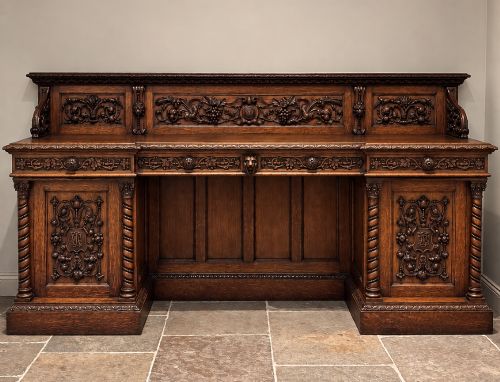
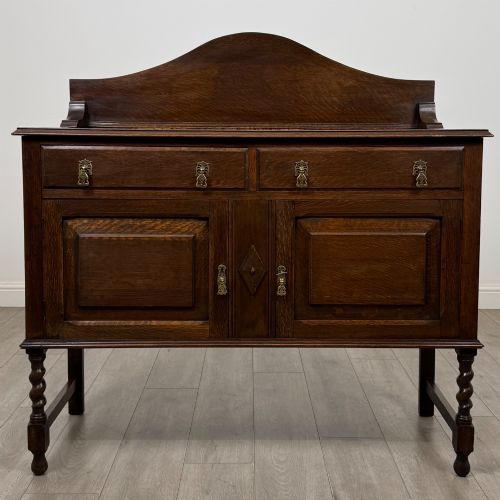
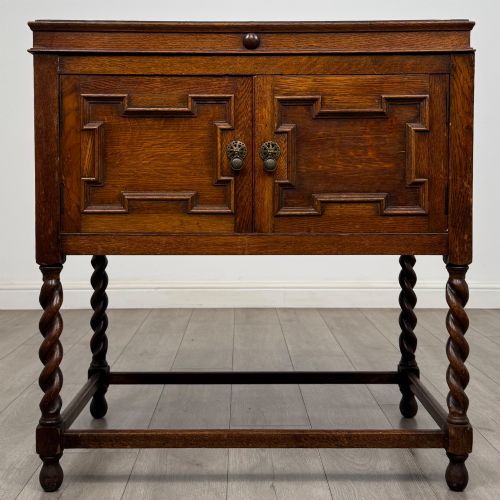
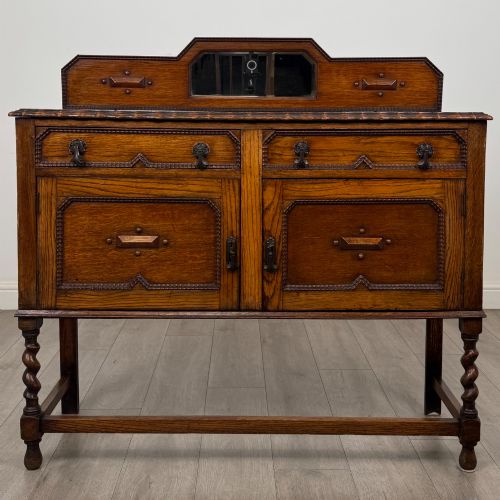



Barley Twist Buffet
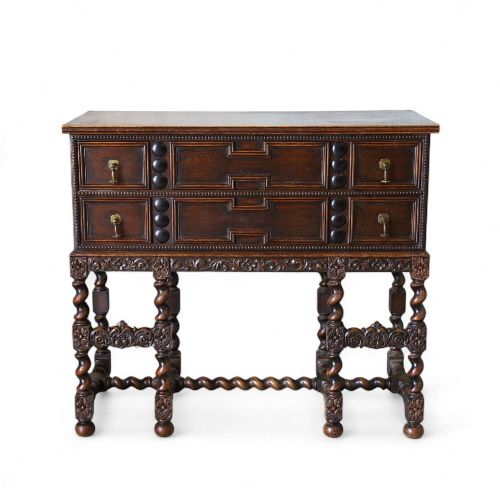
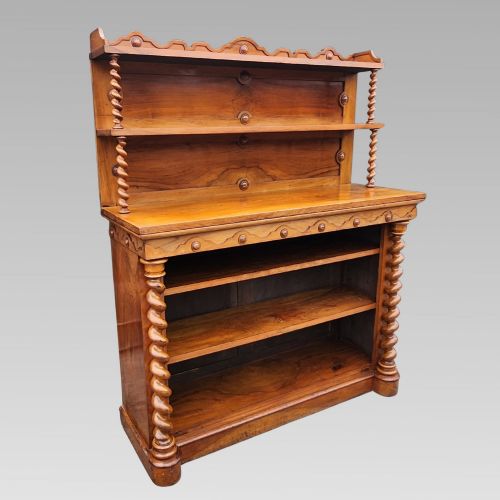
These barley twist buffet examples combine heavy timber construction with signature turned supports, offering practical storage for the dining room.
Barley Twist Buffet
A barley twist buffet serves as a substantial storage and display piece in the dining room or hall, appearing primarily across nineteenth-century and early twentieth-century examples. The selection here spans sideboards, cabinets on stand, and tiered side tables that feature the distinctive spiral turning.
Makers drew on various design revivals, producing pieces in Jacobean, Carolean, and Flemish Renaissance styles alongside simpler Edwardian and Victorian forms. Oak forms the primary structural timber across these items, often paired with carved details like lion masks or Green Man motifs.
Materials and construction
Cabinet makers relied heavily on oak and mahogany to build the carcasses, incorporating brass hardware for handles and hinges where appropriate. Timber selection dictated the depth of the carving, with dense oak taking crisp relief work on doors and backsplashes.
The characteristic spiral columns were produced using specialised lathe turning techniques before being integrated into upright supports, tiers, and mirrorback frames. Joinery methods combined pegged mortise and tenon joints with framed panel construction to support the heavy upper sections.
Several pieces incorporate staring lion masks and leafy Green Man faces to watch over the dining room.
Assessing quality and proportion
Quality rests in the crispness of the hand carving and the balance of the turned barley twist columns against the main body of the buffet. Finer examples display deeply undercut foliage and robust figural work rather than shallow, mechanical stamping.
The choice of timber grain and the integrity of the original construction dictate the standing of a piece. Better specimens maintain straight lines and tightly fitted drawers despite the heavy loads placed upon them.
The Barley Twist Buffet Glossary
- Barley twist
- A spiral turning resembling a traditional loaf of bread or barley sugar, used extensively on furniture legs and columns during the seventeenth and nineteenth centuries.
- Buffet
- A low sideboard or serving table designed for holding food and tableware in a dining room.
- Chiffonier
- A compact sideboard featuring a low cupboard base, occasionally fitted with a small shelf or mirror superstructure.
- Jacobean Revival
- A nineteenth-century design movement that copied or adapted the robust, geometric furniture styles of the early seventeenth century.
- Green Man
- A sculptural architectural motif consisting of a face carved from or surrounded by leaves and vines, frequently seen on nineteenth-century revival furniture.
Barley Twist Buffet: Frequently Asked Questions
What is a barley twist buffet?
A barley twist buffet is a heavy wooden serving piece featuring spiral-turned columns, built primarily during the nineteenth and early twentieth centuries.
These items functioned as dining room storage for dishes and food service, combining practical cupboards with decorative display surfaces.
How do I date an oak sideboard?
Dating relies on examining the construction methods, timber choice, and stylistic revival influences visible in the carving and hardware.
Earlier nineteenth-century examples often display deeper hand-carved relief work and heavier timber framing than later twentieth-century productions.
Where should I place a buffet?
Buffets suit dining rooms and large hallways where their substantial wooden presence and storage capacity can be fully utilised.
Ensure the room has adequate floor space to accommodate the projecting doors and deep shelves without blocking traffic flow.
What is the difference between a sideboard and a buffet?
While both terms describe dining room storage furniture, a buffet traditionally emphasises surface space for food service.
Many pieces listed under these terms share similar proportions, cupboards, and tiered structures.