


Barley Twist Open Bookcase
A barley twist open bookcase brings warmth and turned wooden columns to a room, holding rows of books or displaying treasured objects.
Barley Twist Open Bookcase
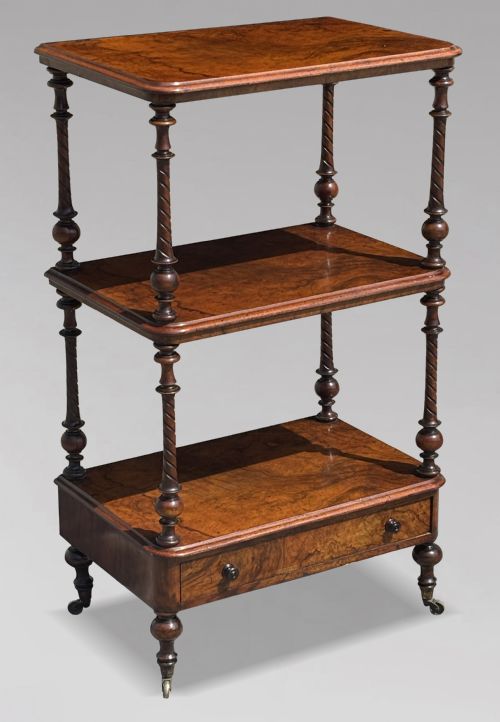
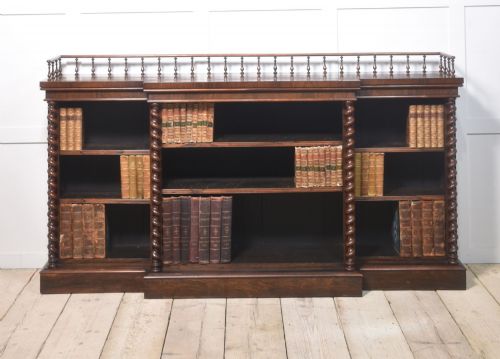
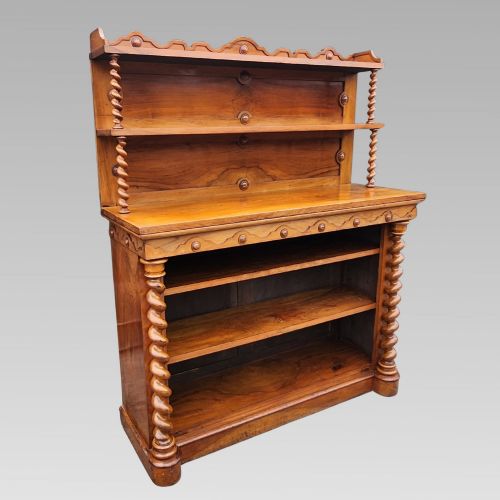
A barley twist open bookcase combines open shelving with the distinctive spiral turning that defines the style, drawing on Victorian and earlier forms. These open pieces range from simple multi-tiered bookcases to elaborate étagères, whatnots, and display stands.
The versions most commonly found here are Victorian pieces featuring stacked open shelves supported by turned columns. Makers often utilised rich timbers such as walnut, rosewood, and mahogany to construct these functional display units.
Beyond straightforward bookcases, the selection encompasses related multi-tiered furniture like whatnot stands and slope-shelf bookcases. Each form provides accessible open storage while displaying the characteristic turned woodwork.
How they were made
Cabinet makers constructed these pieces predominantly from dense hardwoods including rosewood, walnut, mahogany, and oak, often selecting burr walnut veneers for decorative surfaces. These sturdy timbers provided the structural integrity required to support multiple tiers of heavy books and display items.
The defining spiral columns were shaped using lathe turning techniques to create the characteristic twist. Joinery relied on traditional methods, while brass fittings, glass panels, and mirror inserts were occasionally integrated into more elaborate sideboard and display cabinet designs.
Early makers ensured that even the humble bookshelf possessed a twist, turning structural columns into winding wooden sculptures.
What varies in quality
Quality rests primarily in the precision of the timber selection and the crispness of the turned spiral columns. Pieces fashioned from finely figured rosewood or burr walnut demonstrate superior craftsmanship compared to simpler mahogany or oak variants.
The refinement of the joinery and the overall structural proportion distinguish finer examples. Integrated details such as carved friezes, fitted drawers, and multi-tiered stability elevate the execution of the design.
The Barley Twist Open Bookcase Glossary
- Barley twist
- A decorative spiral turning resembling a twisted rope, commonly utilised on the upright columns of Victorian bookcases and whatnots.
- Whatnot
- An open multi-tiered piece of furniture designed for displaying ornaments, books, or small objects, popular throughout the nineteenth century.
- Étagère
- A piece of furniture consisting of a set of open shelves for displaying small articles, closely related to the whatnot.
- Frieze
- A decorative band running horizontally below the upper edge of a bookcase, often plain or carved.
- Regency
- An architectural and furniture style spanning the early nineteenth century, characterised by classical restraint and elegant proportions.
Barley Twist Open Bookcase: Frequently Asked Questions
Where should I place a barley twist open bookcase?
These open pieces suit studies, living rooms, or hallways where books and display items remain easily accessible. Their open shelving allows them to function as room dividers or against plain walls.
Ensure the chosen spot protects rosewood and walnut timbers from direct sunlight and excessive moisture. Pairing the piece with traditional furniture highlights the warmth of the wood and the turned columns.
How do I care for nineteenth-century polished wood?
Dust the shelves regularly with a soft, dry cloth to prevent dirt accumulation in the carved details and spiral turns. Avoid modern chemical sprays that can damage historic French polish.
Apply a traditional beeswax occasionally to nourish the walnut, rosewood, or mahogany surfaces. Maintaining a stable room temperature prevents the timber from warping or splitting over time.
What is the difference between an étagère and a whatnot?
An étagère generally describes an open shelving unit designed specifically for displaying ornaments and decorative objects. A whatnot serves a similar multi-tiered function but often includes small drawers or lower cabinets.
Both forms utilise open construction and frequently feature turned columns or barley twist supports. Their primary purpose remained the display of household items rather than strictly storing large volumes of books.
How do I identify a Victorian piece from earlier styles?
Victorian furniture frequently displays heavier proportions, darker woods like walnut and rosewood, and revival styles such as Jacobean influences. Earlier Regency pieces tend to show cleaner classical lines and lighter mahogany framing.
The presence of spiral barley twist supports became particularly widespread during the Victorian era. Examining the timber grain, construction joints, and backboards helps determine the period of manufacture.