
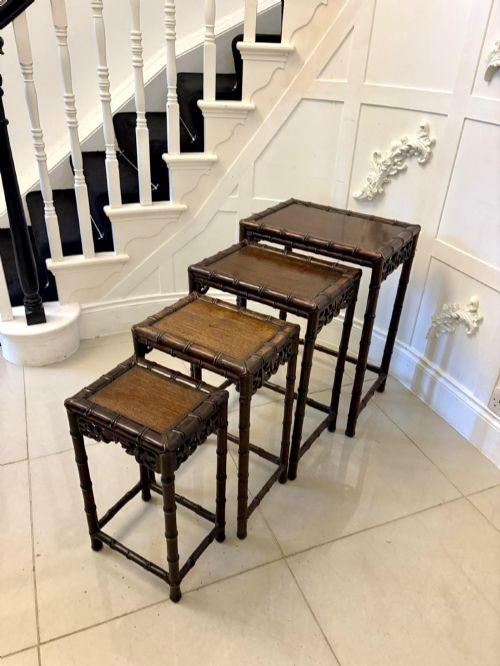
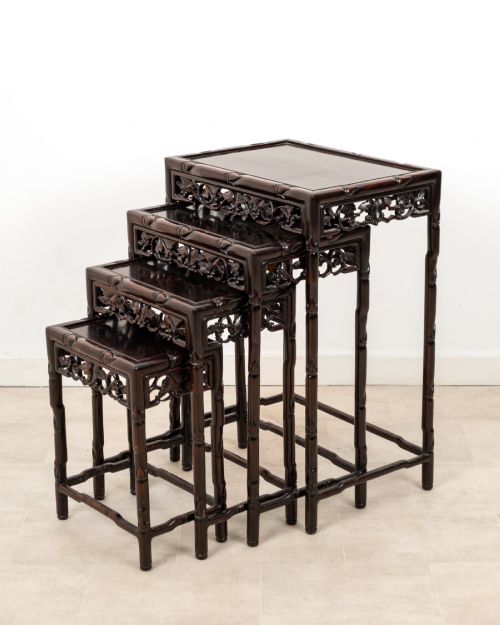
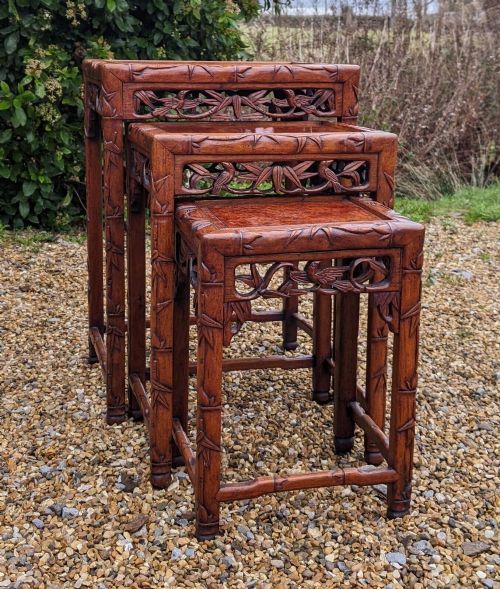
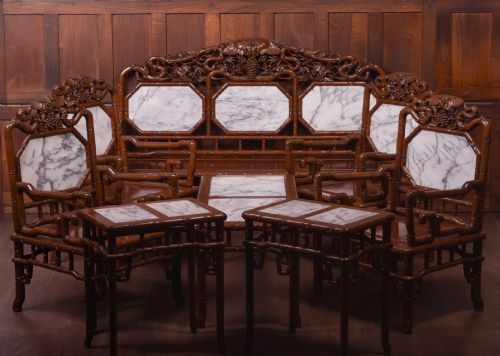


Bamboo Carved Table
When you handle a bamboo carved table, you are looking at nineteenth and early twentieth century export and domestic pieces that bring exceptional timber work into a room.
Bamboo Carved Table
A bamboo carved table encompasses nested sets, coffee tables, occasional pieces, and plant stands produced across the nineteenth and early twentieth centuries. These forms reflect both traditional Chinese workshop methods and nineteenth century Anglo-Japanese tastes.
The pieces you encounter most frequently on this page are nineteenth century Chinese hardwood nests of tables and occasional tables. You also find marble inset stands and folding coffee tables from the Qing dynasty and Edwardian periods.
Originating from export workshops and domestic Chinese scholar studios, these items served practical everyday functions in both Eastern and Western interiors. Their adaptable sizes make them straightforward to place in modern sitting rooms.
Materials and construction
Cabinetmakers utilised dense timbers such as hongmu, huanghuali, rosewood, and general hardwoods to form the rigid frames of each bamboo carved table. These woods provided the structural integrity needed for complex joinery and detailed surface carving.
Craftsmen shaped the solid timber to imitate the natural joints and segments of bamboo canes, pairing these carved elements with inset marble panels where specified by the design. The resulting surfaces rely on the natural grain and colour of the hardwood rather than applied finishes.
Materials represented include hardwood, rosewood, marble, bamboo, hongmu, and huanghuali wood.
Judging quality in the range
The distinction between standard and superior pieces rests on the crispness of the timber carving and the density of the chosen wood. Master workshops achieved deep, lifelike bamboo node detailing that remains sharp across every section of the frame.
Timber selection dictates the overall presence of the piece, with figured huanghuali and heavy hongmu commanding greater visual depth than simpler domestic woods. Construction rigidity without reliance on modern metal fasteners also separates workshop standards.
Liberty of London
The Bamboo Carved Table Glossary
- Hongmu
- A dense, dark traditional Chinese hardwood used extensively for high quality nineteenth century furniture. It takes a fine polish and shows rich red and brown tones.
- Huanghuali
- A prized Chinese scented hardwood prized for its striking grain patterns and warm colour. Pieces in this timber represent the upper tier of export production.
- Anglo-Japanese style
- A nineteenth century aesthetic movement combining British furniture forms with Japanese and Chinese decorative motifs. It appears in occasional tables and decorative stands from the Edwardian era.
- Nest of tables
- A set of graduated tables designed to fit neatly beneath one another when not in use. They became a staple of nineteenth century parlour and drawing room furnishings.
- Qing Dynasty
- The final imperial dynasty of China, spanning from sixteen forty four to nineteen twelve. Many tables on this page date from the later decades of this period.
Bamboo Carved Table: Frequently Asked Questions
How do I style a nest of tables?
Nests of tables provide flexible surface area that you can separate around a room for drinks or lamps when entertaining, then slide back into a single compact stack against a wall.
Their varied heights and modest footprints make them useful beside armchairs or sofas without overcrowding a smaller sitting room.
How can I tell the period of a table?
Dating relies on timber choice, construction joints, and stylistic markers such as nineteenth century Qing dynasty carving conventions or Edwardian Anglo-Japanese details.
Examining the underside and the wear on the wood reveals the age and workshop origin of the piece.
Were these tables made in China?
Many of these pieces originated in Chinese workshops for both domestic use and the nineteenth century export market, while others reflect British interpretation through the Anglo-Japanese style.
Export pieces frequently utilised local hardwoods like hongmu to replicate familiar European forms alongside traditional Asian motifs.