



Ball and Claw Drawers
Ball and claw drawers bring sculptural presence to any room, combining sturdy storage with distinct carved footwork.

Ball and Claw Drawers
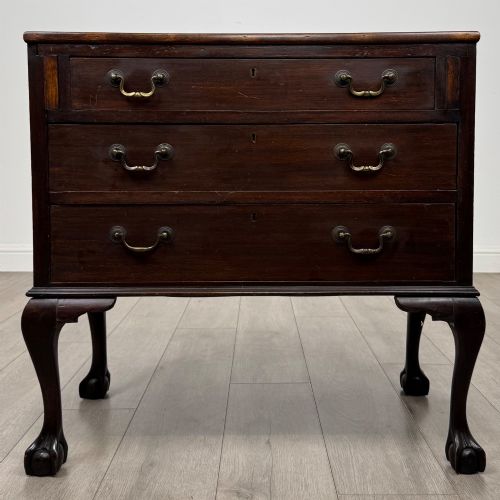
Ball and claw drawers encompass chests of drawers, lowboys, and chests on stand defined by their distinctive carved feet. When searching for ball and claw drawers, buyers encounter pieces ranging from authentic 18th Century examples to later revival interpretations.
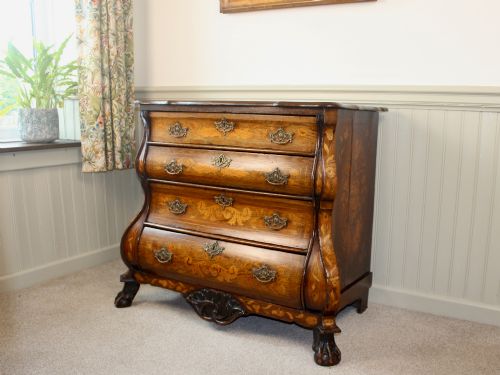
The form spans straightforward mahogany chests to elaborate Dutch marquetry bombe designs and walnut writing desks. Cabinet makers across different eras adopted the motif to anchor substantial pieces of furniture with visual weight.
Origin points vary from English workshops to Dutch, American, and Portuguese makers, showing distinct regional takes on the classic form. Edwardian and 19th Century revivals make up a large share of what appears on the market today.
Materials and construction
Makers relied heavily on dense hardwoods like mahogany, walnut, and oak, often selecting burr walnut or incorporating fruitwood inlay for decorative contrast. Leather surfaces occasionally appear on writing tables and desks within the selection.
Carving the namesake feet required skilled handwork to shape the talon grasping a sphere out of the solid timber of the leg. Marquetry and polished brass hardware added further ornamentation to select drawer fronts and cabinet bodies.
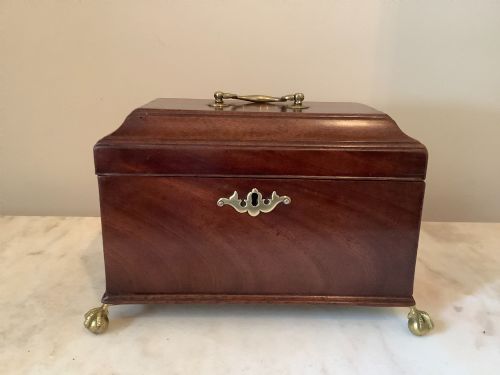
A secret drawer hidden inside a tea caddy demonstrates the clever woodworking tricks beloved by period cabinet makers.
Distinguishing quality
Quality rests in the crispness of the hand-carved footwork and the selection of timber veneers, such as figured walnut or rich mahogany. Superior pieces display thoughtful grain matching across drawer fronts and harmonious proportions throughout the carcass.
Revival pieces sit alongside older items, where the depth of the carving and the integrity of the secondary woods help differentiate the period of manufacture. Original brass fittings and secondary linings signal higher grade production across all eras.
Gillows·Maple and Co·Muirhead Moffat and Co·Morison of Edinburgh
The Ball and Claw Drawers Glossary
- Bombe
- A swelling, convex shape on the front and sides of a chest of drawers. This bulging profile requires advanced woodworking skill to execute properly.
- Lowboy
- A small table with drawers, typically standing on four legs. These pieces often serve as dressing tables or side tables.
- Marquetry
- Decorative veneer work arranged in pictorial patterns using various coloured woods. Craftsmen cut and fit these pieces together before applying them to the carcass.
- Chest on stand
- A cabinet or chest raised upon a separate supporting frame with legs. This form lifts the main storage compartment higher off the floor.
- Chippendale Revival
- A late 19th Century and early 20th Century style copying the 18th Century designs of Thomas Chippendale. These items frequently feature the characteristic ball and claw foot.
Ball and Claw Drawers: Frequently Asked Questions
What periods do these pieces come from?
The selection includes pieces originating from the 18th Century, alongside later 19th Century, Victorian, Edwardian, and 1920s revival examples. Each era brings distinct interpretations of the form and woodwork techniques.
Craftsmen across these periods adapted proportions and timber choices while retaining the signature foot design that defines the category.
How do I identify a revival piece?
Revival items, common from the Edwardian era and the 1920s, often combine older stylistic cues with machine-assisted construction methods. Examining the secondary timbers and joinery helps clarify the true age of the item.
Comparing the sharpness of the carved ball and claw foot against known 18th Century examples also aids in dating the piece accurately.
What timbers were used for these items?
Makers predominantly worked in mahogany and walnut, frequently utilising burr walnut veneers for decorative impact. Oak and fruitwood inlay also appear across various chests and tables.
Brass hardware provides functional contrast on drawer fronts, while leather tops feature on select writing desks.
Where were these items made?
Origin locations span English, Dutch, American, and Portuguese workshops, reflecting widespread adoption of the ball and claw motif. Regional preferences shaped whether a piece took the form of a bombe chest or a straightforward lowboy.
Local timber availability often determined whether walnut, mahogany, or cherrywood formed the primary carcass.