

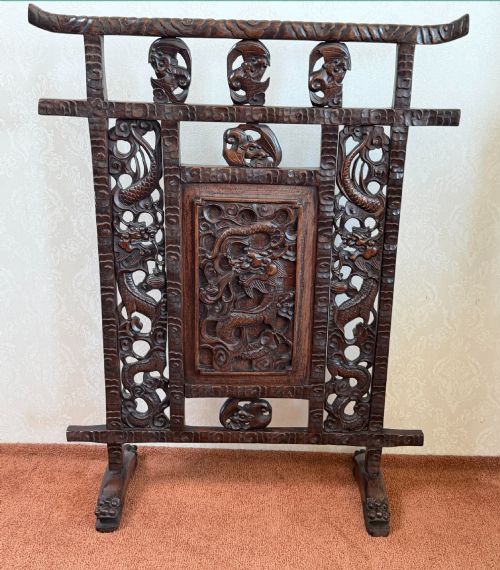

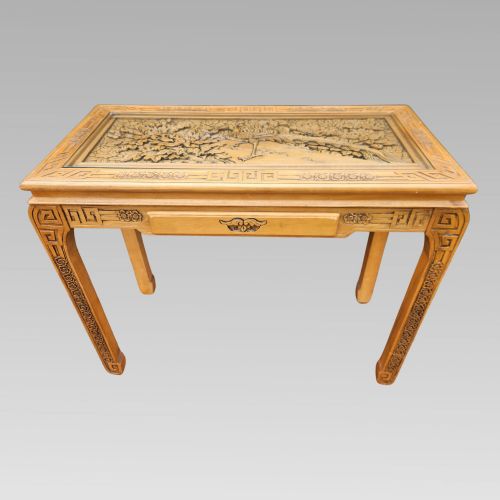


Asian Relief Carved Table
An asian relief carved table brings intricate hand-carved depth and rich timber grain to an interior.
Asian Relief Carved Table
When you search for an asian relief carved table, you are looking at items shaped by regional traditions across the nineteenth and early twentieth centuries. The examples here span styles from Chinese Export and Chinoiserie to Japanese Meiji and Anglo-Indian work, taking forms such as nests of tables, coffee tables, and console tables.
The most common finds on this page are nests of tables and occasional tables carved from hardwoods such as teak and camphorwood. These pieces utilise deep relief carving to depict traditional motifs like dragons and elephants, often finished with detailed surface work.
Dated pieces largely cluster around the nineteenth century, alongside later 1920 and 1930 examples including Art Deco interpretations and mid-century lacquer designs. Such items serve practical functions as side or coffee tables while displaying distinct regional carving techniques.
What varies in quality
Quality rests on the crispness and depth of the carving itself, distinguishing confident hand-tooled execution from softer, more repetitive work. The best pieces show distinct undercut relief where figures and motifs stand free from the background timber.
The choice and preparation of the wood also set examples apart, with well-selected teak or camphorwood displaying stable grain and careful jointing that endures across generations. Hardware integration, such as mother of pearl inlay or bronze elements, further separates standard production from finer craftsmanship.
Asian Relief Carved Table Retail Price Guide 2026
Typical asking prices for asian relief carved table among the pieces listed under this phrase on Sellingantiques today, from the lower quarter to the upper quarter. They describe what is for sale here now, not the wider market.
Elephants and dragons appear across the timber surfaces, keeping watch over your coffee cup.
The Asian Relief Carved Table Glossary
- Relief carving
- A sculptural technique where figures or patterns project from a flat background. This method creates shadow and depth across the top surface of a table.
- Chinoiserie
- European artistic style reflecting Chinese motifs and techniques. It appears on lacquer and carved tables dating to the early twentieth century.
- Nest of tables
- A set of graduated tables designed to stack neatly beneath one another. They offer flexible surface space in living areas.
- Camphorwood
- An aromatic hardwood valued for its resistance to insects and distinctive grain. Makers utilised it for carved chests and occasional furniture.
Asian Relief Carved Table: Frequently Asked Questions
What is an asian relief carved table?
An asian relief carved table is a wooden surface decorated with sculptural, raised designs produced by traditional craftspeople in regions such as China and Japan.
These pieces use dense timbers like teak or camphorwood to showcase motifs including dragons, foliage, and figures, functioning as coffee tables, consoles, or nests.
How do I date an asian relief carved table?
Dating relies on examining the timber, joinery techniques, and stylistic markers tied to specific periods like the nineteenth century or the 1920s.
Earlier examples often display hand-cut joinery and deep, individual chisel work, whereas later twentieth-century pieces may incorporate Art Deco influences or distinct lacquer finishes.
Where should I place a nest of tables?
A nest of tables works well beside a sofa or in a corner where surface space is needed on demand.
Because the smaller tables tuck beneath the main surface, they provide extra utility without crowding a room during everyday use.
What wood was used for these tables?
Makers predominantly utilised durable hardwoods such as teak and camphorwood for their strength and stable working properties.
These timbers allowed artisans to carve deep, intricate relief details that held their shape and resisted splitting over time.