
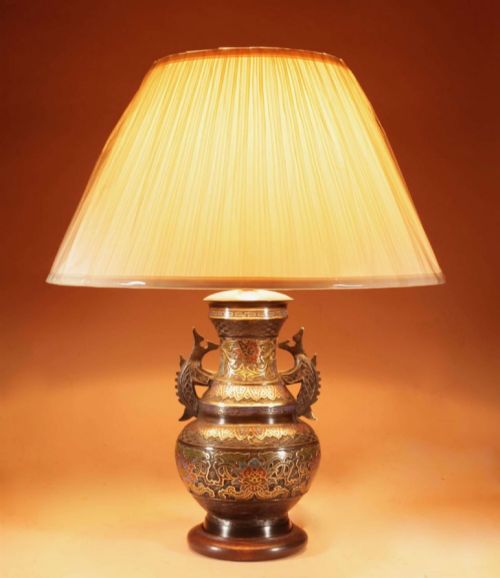


Asian Accent Lighting
Asian accent lighting brings sculptural form and decorative depth to a room through converted vessels, carved wood, and metalwork.
Asian Accent Lighting
Asian accent lighting encompasses decorative table lamps and converted vessels drawn from nineteenth and early twentieth-century traditions.
The selection ranges from Japanese bronze and Satsuma earthenware to Chinese cloisonné vases and carved root wood, often wired later for functional illumination.
Buyers seeking asian accent lighting frequently encounter pairs of lamps alongside individual statement pieces featuring Chinoiserie, Japonisme, and Meiji period aesthetics.
How they were made
Maker techniques rely on traditional metalworking, including champlevé and cloisonné enamel applied to bronze or copper bases.
Earthenware pieces utilise hand-painted Satsuma glazes, while wooden elements employ carved root wood, pickled elm, and standard timber joinery.
Listings feature items spanning the nineteenth century through the 1930s, utilising materials such as bronze, fabric, and elm.
What varies in quality
Quality rests in the precision of the surface decoration, from the delicacy of cloisonné wirework to the hand-painted detail on Satsuma earthenware.
The integrity of the underlying material, whether cast bronze, enamel, or carved root wood, defines the enduring character of each piece.
The Asian Accent Lighting Glossary
- Cloisonné
- Enamelling technique where thin metal wires form raised barriers on a metal body to hold coloured pastes before firing. This method creates distinct cellular patterns across vase and lamp surfaces.
- Satsuma
- Japanese earthenware style characterised by a crackled ivory glaze and elaborate polychrome enamel or gilt decoration. It appears frequently on antique table lamps.
- Champlevé
- Enamelling method where troughs are gouged into a metal base and filled with enamel prior to firing. The technique produces robust coloured designs on bronze surfaces.
- Root wood
- Timber formed from the dense, gnarled root system of a tree, carved into organic furniture and lamp bases. Each piece displays unique natural grain patterns.
Asian Accent Lighting: Frequently Asked Questions
How do I wire an antique lamp?
Wiring is typically handled by a professional electrician who can thread modern cord through the existing central channel without damaging the historical body.
Care is taken to preserve original fittings and materials while meeting current safety standards.
Where should I place these lamps?
These lamps function well on side tables, mantels, or desks where their decorative metalwork or ceramic glaze can be appreciated up close.
They provide warm accent lighting rather than bright task illumination.
How do I clean cloisonne?
Dust the surface gently with a soft, dry cloth to prevent accumulation in the wire recesses.
Avoid liquid cleaners or chemical polishes that can discolour the enamel and metal boundaries.
Are these lamps original or converted?
Many examples are traditional vases or vessels that have been professionally converted into table lamps at a later date.
This adaptation allows antique decorative art to serve a practical function in modern rooms.