



Arts Crafts Desk Clock
An arts crafts desk clock brings honest craftsmanship and tactile materials to a working surface, offering a quiet focal point for a room.
Arts Crafts Desk Clock
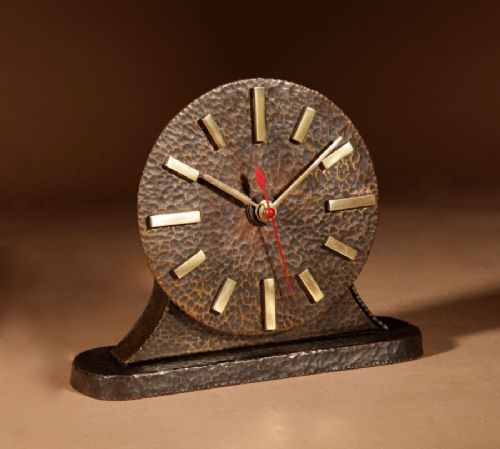
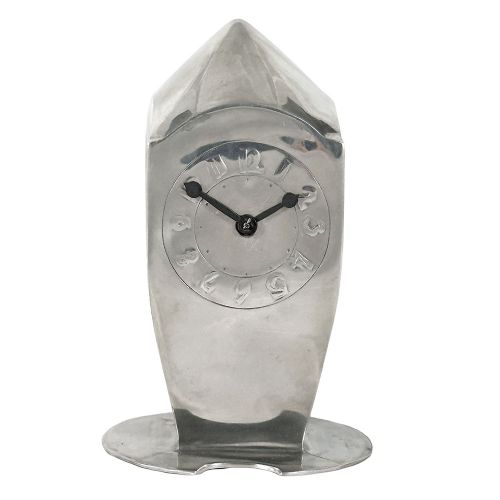
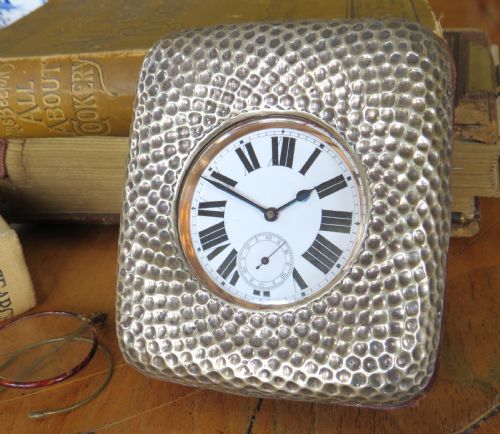
When searching for an arts crafts desk clock, buyers encounter timepieces ranging from compact silver carriage clocks to substantial mantel clocks. The selection spans the Edwardian era through to the early decades of the twentieth century, capturing a period of distinct design shifts.
Most examples found here originate from the early nineteen-hundreds, aligning with the height of the Arts and Crafts movement, alongside later Amsterdam School and Art Nouveau interpretations. These pieces function both as reliable timekeepers and as sculptural objects for desks and mantels.
How they were made
Makers utilised a mix of metals and timber, pairing hammered patinated brass, copper, and Tudric pewter with solid sterling silver and oak. Pewter models often incorporate decorative elements such as enamel and abalone inlay to catch the light.
Construction methods rely heavily on hand-hammering, careful inlay work, and hand-carving. Metal surfaces display visible tool marks and patination, while wooden cases feature deliberate grain patterns and inlaid details.
Arts Crafts Desk Clock Retail Price Guide 2026
Typical asking prices for arts crafts desk clock among the pieces listed under this phrase on Sellingantiques today, from the lower quarter to the upper quarter. They describe what is for sale here now, not the wider market.
Materials across this selection include sterling silver, oak, pewter, brass, copper, enamel, and glass.
What varies in quality
Distinction across the range lies in the integration of materials and the reputation of the designer or workshop. Pieces associated with notable names such as Archibald Knox or Liberty & Co exhibit a higher level of design cohesion.
Execution of decorative details, from the crispness of hand-hammered pewter to the precision of inlaid wood and enamel cabochons, separates standard production from exceptional examples.
Archibald Knox·Liberty and Co·David Veasey
The Arts Crafts Desk Clock Glossary
- Tudric pewter
- A brand name used by Liberty & Co for a range of pewter ware introduced in the early twentieth century. It often contained a higher proportion of silver to give a brighter finish.
- Amsterdam School
- An architectural and design style of the early twentieth century characterised by expressionist forms, rounded brickwork, and elaborate metal detailing.
- Patinated brass
- Brass that has been chemically treated or aged naturally to produce a darkened, stable surface colour with varied tonal depth.
- Carriage clock
- A small, portable spring-driven clock originally designed for travellers, typically featuring a glass case to view the movement.
Arts Crafts Desk Clock: Frequently Asked Questions
How do I wind an antique desk clock?
Most mechanical desk clocks utilise a small key inserted into the dial or backplate to tension the mainspring. Care must be taken not to overwind the movement.
Eighty-day movements require less frequent attention than standard daily or weekly timepieces, but gentle handling remains essential for older mechanisms.
What is Tudric pewter?
Tudric is the trade name for a specific alloy of pewter utilised by Liberty and Co during the Arts and Crafts period. It allowed designers to create sculptural vessels and clocks with complex surface textures.
Pieces made from this material often display maker numbers and distinct hallmarks on the underside or reverse.
How should I clean silver clock cases?
Sterling silver and silver-cased travel clocks benefit from occasional gentle polishing with a soft cloth to maintain their lustre. Abrasive cleaners should be avoided to protect hallmarks and engraved details.
Wooden and pewter components require separate maintenance, keeping them away from direct moisture and harsh chemical solvents.
Are these clocks suitable for daily use?
Many of these timepieces remain fully operational and can keep accurate time when serviced correctly. Mechanical movements from the early twentieth century appreciate regular running and occasional professional oiling.
Placing them on a stable desk or mantel away from direct vibrations ensures the escapement functions without interruption.