
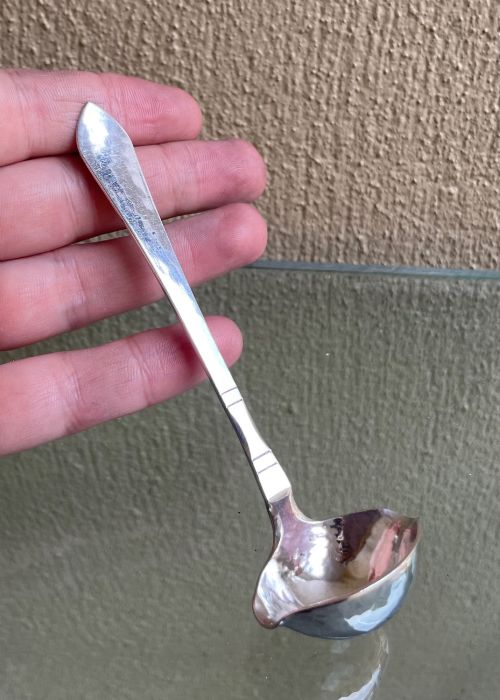
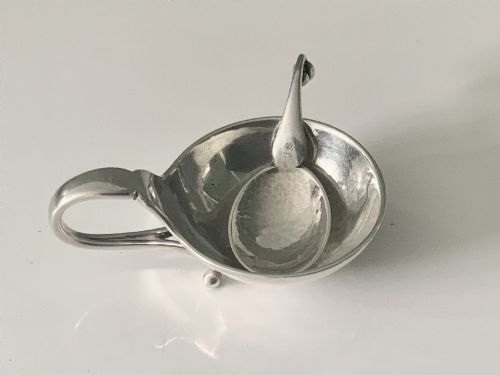


Art Nouveau Silver Spoon
An art nouveau silver spoon brings fluid organic lines and floral motifs directly to the tea table or cabinet.
Art Nouveau Silver Spoon
When searching for an art nouveau silver spoon, collectors encounter diverse forms including teaspoons, caddy spoons, preserve spoons, salt cellars with matching spoons, and larger serving utensils. These pieces originate from periods spanning the late nineteenth century through the early decades of the twentieth century, with items dated around 1900 appearing frequently.
The style manifests through sinuous plant motifs, lily flowers, and leaf bowls characteristic of the movement. British examples join continental European pieces from makers in Germany, Denmark, Norway, and Switzerland, alongside American sterling silver creations.
Materials and construction methods
Silversmiths utilised sterling silver and solid silver varieties, occasionally applying gold-gilt or silver gilt finishes to the bowl interiors. Enamel work frequently adds colour and contrast to handles and stems, particularly in Norwegian and British pieces.
Techniques combine traditional casting and hand-piercing with detailed chasing and embossing to shape naturalistic floral and stem designs. Many sets include custom fitted boxes lined with velvet or leatherette to house the utensils securely.
Art Nouveau Silver Spoon Retail Price Guide 2026
Typical asking prices for art nouveau silver spoon among the pieces listed under this phrase on Sellingantiques today, from the lower quarter to the upper quarter. They describe what is for sale here now, not the wider market.
The documented objects span teaspoons, caddy spoons, ladles, salt cellars, serving spoons, and complete flatware sets.
Distinctions in craftsmanship
The standard of design execution separates standard tableware from masterworks by renowned designers and silversmiths. Crispness in the relief work of delicate stems and floral scrolls indicates superior workshop output.
The presence of pristine enamel panels, well-preserved gilding, and original fitted presentation cases elevates specific pieces. Hallmarks and maker marks also influence collector interest by confirming origin and maker pedigree.
Georg Jensen·Liberty·Oliver Barker·David Andersen·Evald Nielsen·Archibald Knox·John Round·Jezler·Hukin and Heath·Levi and Salaman·Roberts and Belk·Tiffany and Co·Charles Horner·Christian Heise
The Art Nouveau Silver Spoon Glossary
- Sterling silver
- A silver alloy containing 92.5 percent pure silver and 7.5 percent other metals, usually copper, ensuring durability for daily use.
- Caddy spoon
- A short-handled spoon traditionally used for measuring loose tea leaves from a caddy into a teapot.
- Sugar sifter
- A large spoon with a pierced bowl designed for dusting loose sugar over fruit or desserts.
- Silver gilt
- Silver objects that have been coated with a thin layer of gold on the surface, creating a warm two-tone appearance.
- Jugendstilh
- The German term for the Art Nouveau movement, frequently applied to silver and decorative arts originating from Germany and Austria.
Art Nouveau Silver Spoon: Frequently Asked Questions
What is an art nouveau silver spoon used for?
These spoons serve various dining and decorative functions, ranging from stirring tea and coffee to serving sugar, cream, salt, or preserves. Smaller spoons accompany tea sets or Christening gifts, while larger ladles and serving implements handle formal dining tasks.
Many collectors also display cased sets or individual pieces within cabinets to appreciate the intricate floral and botanical motifs unique to the period.
How do I identify art nouveau silver?
Look for characteristic design elements such as whiplash curves, asymmetrical plant forms, and flowing stems that merge into the handle. Maker marks, silver standard hallmarks, and dates stamped on the reverse help confirm the period of manufacture.
Continental pieces often display specific purity numbers like 800 or 84, while British items feature assay office marks and date letters corresponding to the late nineteenth or early twentieth century.
Are these spoons suitable for daily use?
Solid silver and sterling silver spoons are robust enough for gentle everyday dining, provided they are washed by hand promptly after use. Enamelled or gold-gilt pieces require greater care to protect delicate coloured glass layers and surface treatments from abrasive detergents.
Stored safely in fitted velvet or leatherette presentation cases, they remain well-protected between special occasions.
Where were these silver spoons made?
Production centres spanned across Great Britain, the United States, and continental Europe, including workshops in Germany, Denmark, Norway, and Switzerland. British silversmiths in London, Sheffield, and Chester produced notable designs alongside Scandinavian and American firms.
Each region imparted distinct stylistic nuances while embracing the overarching floral aesthetic of the international movement.