





Art Nouveau Brass Lamp
An art nouveau brass lamp brings flowing, organic lines and warm metallic tones into a room, combining practical illumination with distinctive period design.
Art Nouveau Brass Lamp
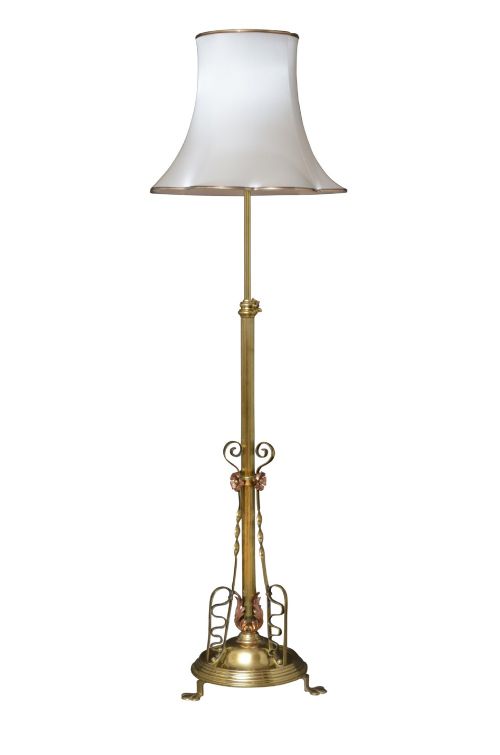
When you search for an art nouveau brass lamp, you encounter items ranging from towering floor standards and adjustable reading lights to compact table lamps and ceiling fixtures. The pieces date predominantly from the late nineteenth and early twentieth centuries, spanning the Victorian, Edwardian, and Secessionist periods.
The selection includes specialised lighting forms such as Pullman carriage lamps, bankers desk lamps, and rise-and-fall ceiling pendants. Continental influences appear frequently alongside English designs, showing diverse regional interpretations of the style in brass, copper, and bronze.
Materials and construction
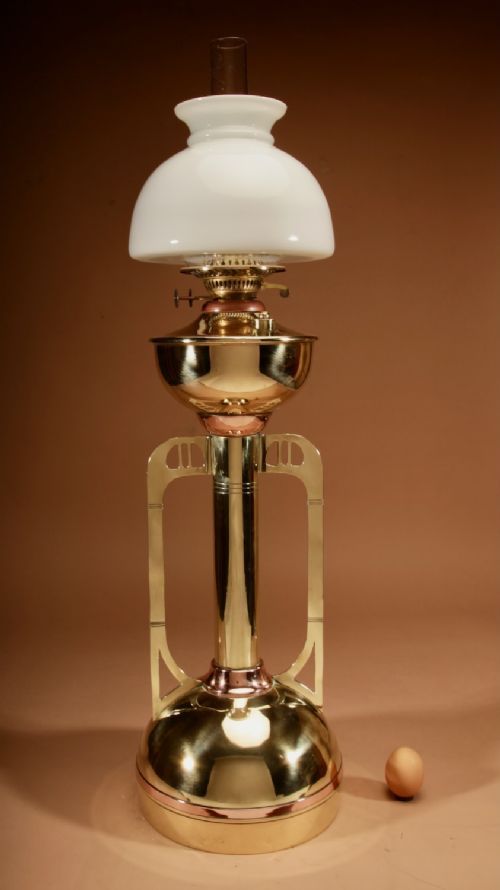
Makers utilised cast and stamped brass as the primary structural foundation, frequently combining it with copper, bronze, or spelter to achieve contrasting metallic tones. Components were often hand-beaten, turned, or joined with visible rivets, particularly in pieces associated with the Arts and Crafts movement.
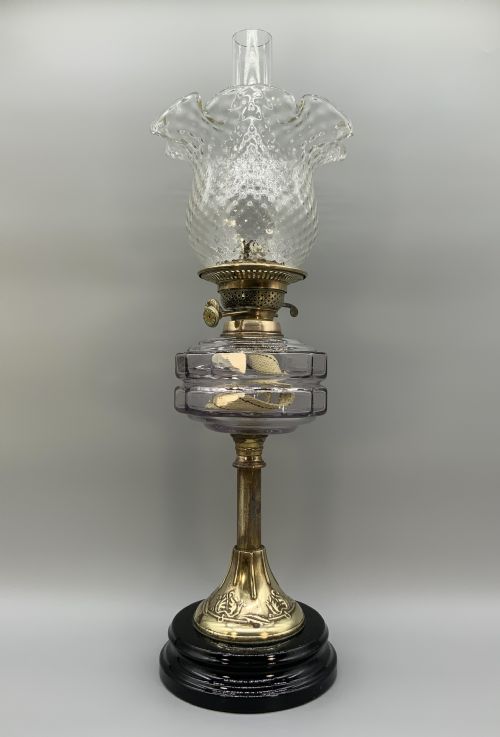
Shades and decorative accents relied heavily on complementary materials, notably hand-blown glass, frosted glass bulbs, ceramic inserts, and crystal. Some designs incorporated delicate fabric shades, glass cabochons, or milk glass to diffuse the light softly.
Art Nouveau Brass Lamp Retail Price Guide 2026
Typical asking prices for art nouveau brass lamp among the pieces listed under this phrase on Sellingantiques today, from the lower quarter to the upper quarter. They describe what is for sale here now, not the wider market.
Listings span the nineteenth and early twentieth centuries, incorporating Victorian, Edwardian, and Secessionist periods alongside Arts and Crafts designs.
Judging quality
The distinction between tiers rests upon the crispness of the casting and the sensitivity of the chased surface detail. Superior examples display deeply articulated floral or foliate motifs without the softening of edges that indicates worn production moulds.
Construction methods also dictate standard, where heavy-gauge metal, stable weighted bases, and robust telescopic or height-adjustable mechanisms separate ambitious workshop pieces from simpler commercial output.
L and F Moreau·Gustave Serrurier Bovy·WAS Benson·Jan Eisenlöffel·Dugué
The Art Nouveau Brass Lamp Glossary
- Secessionist
- A style emerging from Central European art movements that favored geometric abstraction alongside organic curves. It appears on several continental table lamps in the archive.
- Spelter
- An alloy of zinc and lead used as a cost-effective substitute for bronze or brass. It was frequently painted or electroplated to resemble heavier metals.
- Telescopic
- A mechanism allowing standard or floor lamps to adjust in height. This engineering feature is particularly prized on oil and reading lamps.
- Cabochon
- A polished, convex gem or piece of glass without facets. These are occasionally set into metalwork to provide jewel-like colour highlights.
- Rise and fall
- A ceiling light mechanism utilising weights or pulleys to adjust the height of the pendant. It offered adaptable illumination for dining tables and reading areas.
Art Nouveau Brass Lamp: Frequently Asked Questions
How do I rewire an old lamp?
Rewiring typically involves replacing perished internal flex with modern braided cable that meets safety standards. It is advisable to consult a professional electrician to ensure proper earthing, particularly on metal-bodied standard lamps.
Many surviving pieces have already undergone conversion from oil or gas to electricity, or have been tested for electrical safety. Preserving original switches and fittings while updating the internal wiring maintains the integrity of the object.
Were these lamps originally for oil or electricity?
Many examples dating around nineteen hundred were manufactured as paraffin or oil burners before subsequent conversion to electric bulbs. You will often find remnants of burners or reservoirs integrated into the design.
Electric lighting adoption varied by decade, with desk and table lamps evolving alongside domestic electrical grids during the Edwardian era. The presence of weighted bases often relates to the stability required for heavy oil reservoirs.
How do I clean antique brass safely?
Gentle dusting with a soft cloth is usually sufficient to maintain the patinated surface of antique brass. Avoid harsh chemical polishes that strip away the aged tones accumulated over the decades.
If cleaning is necessary, use a mild, non-abrasive soap solution and dry thoroughly. A natural aged patina is generally preferred by collectors over a bright, mirror-like finish.
How do I distinguish art nouveau from arts and crafts?
Art nouveau design is defined by fluid, asymmetrical lines, whiplash curves, and natural forms inspired by plants and insects. It emphasises decorative flow over strict structural honesty.
Arts and crafts pieces tend to emphasise visible construction, hammered metal surfaces, and simpler, sturdier forms. Both movements overlapped chronologically, leading to hybrid styles visible in many period lamps.