

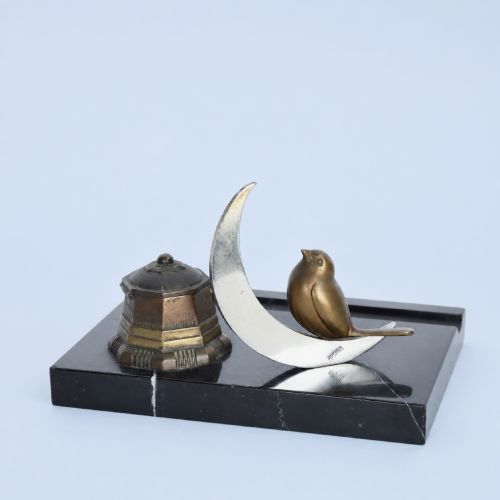


Art Deco Inkwell
An art deco inkwell sits upon the desk as a functional centrepiece of the period, bringing geometric clarity and weight to a writing surface.
Art Deco Inkwell
The pieces on this page span the 1900s through to the 1930s, showing transitions from Edwardian and Art Nouveau aesthetics into pure Art Deco geometric design.
Buyers encounter everything from simple glass reservoirs to elaborate figural desk stands featuring birds, clowns, and crescent moons alongside standard ink pots.
Materials and Construction
The construction relies on the contrast between heavy stone bases, such as marble, alabaster, and green onyx, and fitted metallic elements in sterling silver, bronze, gilt brass, and chrome.
Glass reservoirs utilise heavy cut crystal and moulded shapes, often paired with hinged silver lids, guilloche enamel, or specialised inlays like lapis and butterfly wing.
Foundry cast metals and detailed metalwork create figural elements and desk accessories designed to hold pens, stamps, and calendars alongside the central ink pot.
Art Deco Inkwell Retail Price Guide 2026
Typical asking prices for art deco inkwell among the pieces listed under this phrase on Sellingantiques today, from the lower quarter to the upper quarter. They describe what is for sale here now, not the wider market.
Some desk pieces feature playful figural models of Pierrot clowns and gilded chicks with glass eyes keeping watch over the ink.
Distinctions in Execution
Quality rests in the weight of the materials used, the precision of the stone cutting, and the heft of the sterling silver or cast bronze components.
Superior examples combine multiple luxe elements, such as malachite inlay, hand-turned marble, and crisp hallmarked silver mounts, while simpler versions rely on plain glass and basic metal bases.
Zimmermann·M. Leducq·The Goldsmiths & Silversmiths Company·Henry Matthews·William Hutton & Sons·Deakin and Francis·Cartier·Walker & Hall·John Griffith & Sons·Charles Boyton & Sons·A & J Zimmerman
The Art Deco Inkwell Glossary
- Capstan inkwell
- A desk accessory shaped like a ship's capstan, featuring a wide circular base tapering upwards towards a hinged lid.
- Guilloche enamel
- A decorative technique where precise geometric patterns are engraved beneath a translucent coloured enamel layer.
- Desk tidy
- A combined desktop accessory incorporating compartments for pens, stamps, and small stationery items alongside the ink reservoir.
- Spelter
- A zinc alloy commonly utilised as a less costly alternative to bronze for figural castings during the early twentieth century.
Art Deco Inkwell: Frequently Asked Questions
How do I clean the glass insert?
Remove the glass insert carefully from its silver or stone housing before washing it in warm soapy water. Avoid submerging metal or stone mounts to protect the original adhesives and patination.
Dry the glass completely with a soft cloth before placing it back into the desk stand to prevent moisture trapping against the silver or marble.
Can I still use these for writing?
Most pieces function adequately for modern fountain pens if the glass reservoir and hinged lid remain intact and watertight. Check that the original glass pot is present inside the mount before filling it with ink.
Keep in mind that historical inks can stain old crystal or corrode delicate silver collars if left inside for long periods without cleaning.
How do I date an inkwell?
Sterling silver examples usually feature clear hallmarks that include assay office marks, date letters, and maker's stamps. These punch marks allow precise identification of the year of manufacture.
Pieces made from marble, onyx, or unhallmarked metals rely on stylistic cues, manufacturing techniques, and comparative design traits from the periods represented.
What is a desk stand?
A desk stand is an expanded version of a single inkwell, incorporating built-in channels for pens, small stamp boxes, or matching candleholders onto a unified base. These larger accessories formed the permanent centrepiece of a writing table.
Materials typically match the decorative scheme of the room, using heavy stones like green onyx or marble alongside mounted metals.